
OpenAI builds and deploys advanced AI models like GPT-4o for autonomous agents and workflows.
SignalBrain-OS
0Popularity
About SignalBrain-OS
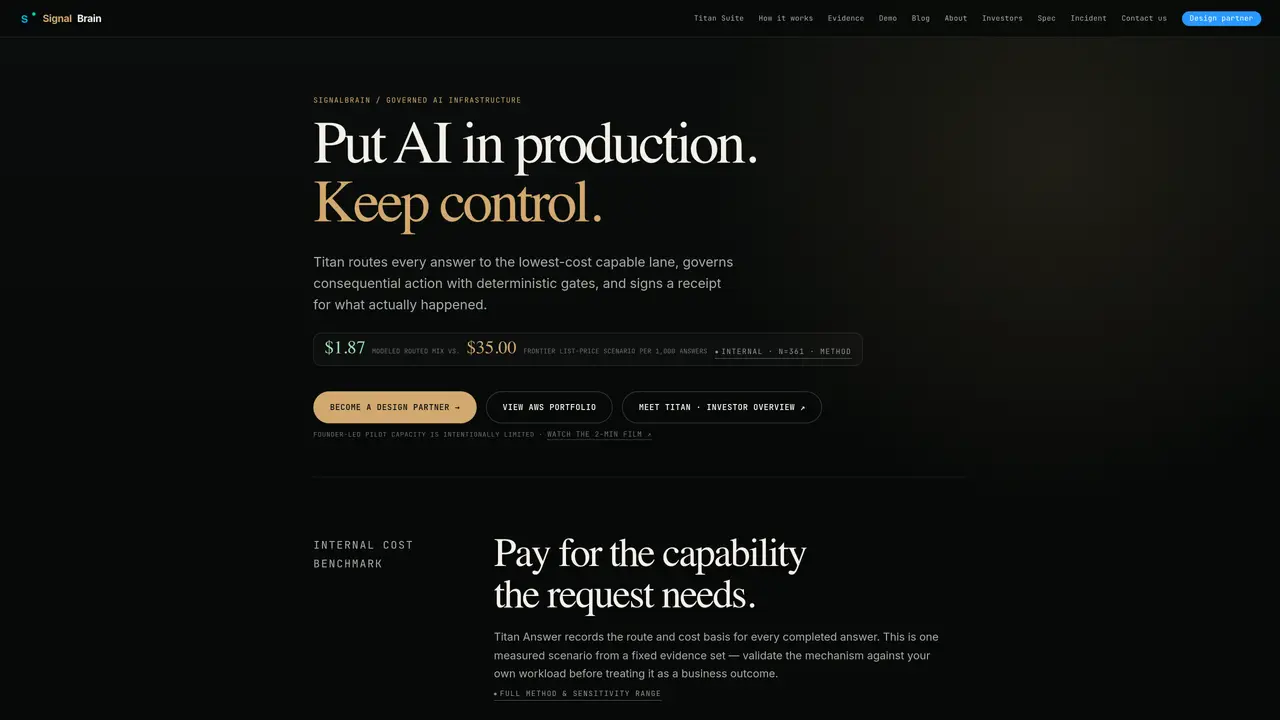
SignalBrain-OS is a governed AI infrastructure platform designed to put AI into production while maintaining control over cost, safety, and performance. The system operates through Titan, a smart router that classifies each request by intent, risk, and capability required, then selects the lowest-cost capable lane—whether deterministic, local-model, or frontier—while enforcing governance through deterministic policy gates. Every action is recorded with a signed receipt detailing the route, latency, model calls, evidence, and cost, ensuring full auditability and replayability. The platform includes four core components: Answer for cost-efficient routing, Guard for deterministic policy enforcement between agent proposals and consequential actions, View for real-time operational observability, and Forge for governed copilot workflows in software delivery. By compiling probabilistic intent into verified, policy-bounded actions, SignalBrain-OS eliminates authority drift, operational blindness, and integration drag while supporting domains such as trading, robotics, defense, healthcare, and infrastructure where low-latency, auditable, and safety-constrained AI orchestration is essential. The system is designed to run locally with minimal cloud dependency, though frontier model overflow remains available under the same governance framework for high-complexity tasks.
Key features
- Deterministic multi-agent AI orchestration
- Local LLM inference and topological signal encoding
- Merkle-anchored tamper-evident audit trail
- Full replayability of execution history
- O(1) constant-time recall on VRAM
- Microsecond-scale decisioning
- Policy-bounded action DSL and syscalls
- Compile-time governance enforcement
- GPU-resident execution
- No cloud dependency
Use cases
- Mission-critical trading systems requiring low-latency and auditable decisions
- Robotics control with safety constraints and deterministic behavior
- Healthcare infrastructure for compliant, replayable AI-driven diagnostics
Pros
- Reduces inference costs by routing requests to the lowest-cost capable model lane while maintaining governance
- Provides deterministic, policy-bounded decisioning with tamper-evident audit trails for every action
- Supports local LLM inference to minimize cloud dependency and latency for routine tasks
- Offers a unified runtime for governance, observability, and software delivery in AI systems
- Enables high-volume AI applications to reserve frontier model spend for only the most critical requests
Cons
- Governance and routing mechanisms may introduce additional complexity in implementation
- Dependence on local model capabilities for routine tasks could limit performance for complex reasoning
- Evidence and benchmarks provided are based on internal or synthetic data, requiring validation for production use
Frequently asked questions about SignalBrain-OS
What does SignalBrain-OS do?
SignalBrain-OS is a governed AI infrastructure platform that routes AI requests to the lowest-cost capable model lane while enforcing deterministic policy gates to authorize or refuse actions. It records every decision with a tamper-evident receipt for auditability and replayability.
Who is SignalBrain-OS designed for?
The platform is designed for organizations requiring low-latency, auditable, and safety-constrained AI orchestration, such as those in trading, robotics, defense, healthcare, and infrastructure. It suits teams prioritizing cost control, governance, and operational visibility in AI deployments.
How does the cost-saving mechanism work?
SignalBrain-OS routes routine reasoning to local open-weight models and reserves frontier model spend for high-complexity tasks, avoiding the need to assign maximum-cost capability to every request. The system records the route and cost basis for each answer, enabling measurable cost savings.
Does SignalBrain-OS require cloud dependency?
The system is designed to run locally with minimal cloud dependency, though it supports frontier model overflow under the same governance framework when higher capability is required. Local inference is prioritized for routine tasks to reduce latency and cost.
What kind of evidence does SignalBrain-OS provide for its claims?
The platform provides measurable claims backed by public evidence or labeled as internal, synthetic, illustrative, or awaiting external validation. Benchmarks and ledgers are documented, but users are encouraged to validate mechanisms against their own workloads.
How can I get started with SignalBrain-OS?
Prospective users can explore the Titan Answer component on AWS Marketplace or contact SignalBrain to become a design partner. The platform offers governed routing, policy enforcement, and operational visibility, with each component deployable independently based on specific needs.