
OpenAI builds and deploys advanced AI models like GPT-4o for autonomous agents and workflows.
Voyager
0Popularity
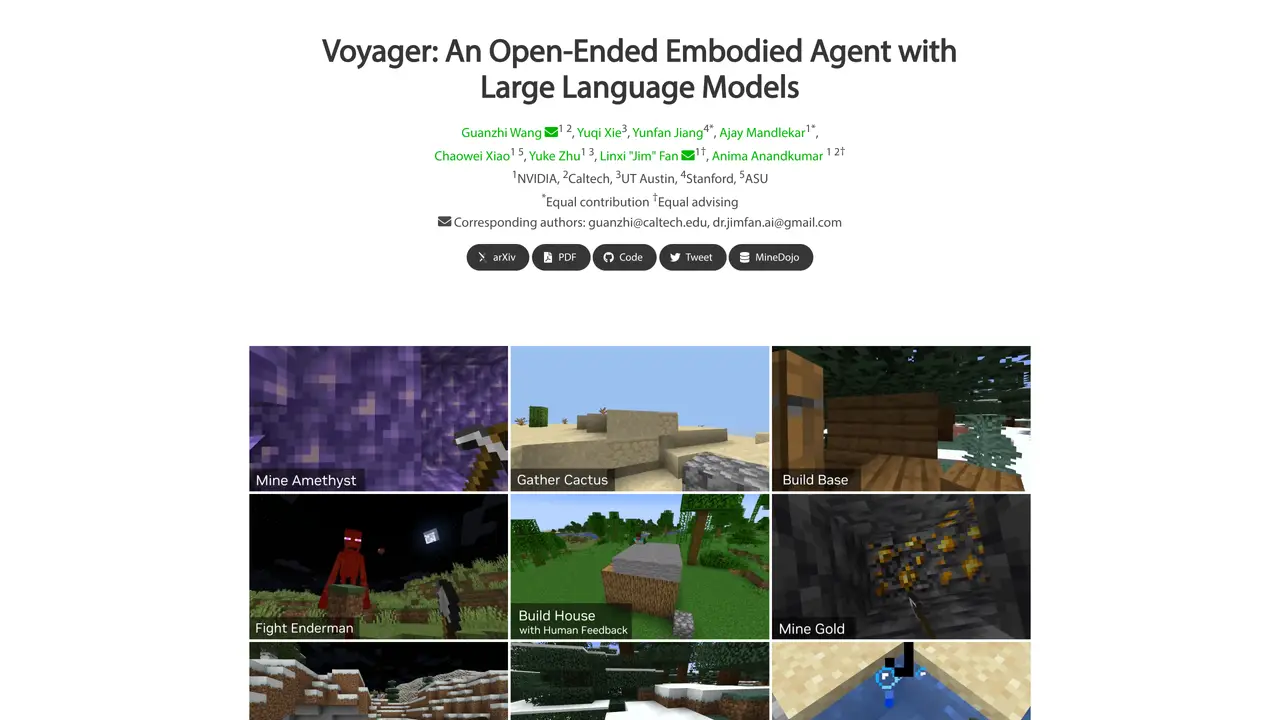
About Voyager
Voyager is the ultimate embodied agent with large language models. It is an open-ended system that enables users to interact with virtual agents in a natural and intuitive way. With Voyager, users can explore and discover new content with the help of a conversational AI. Voyager’s language models are optimized for a wide range of topics, which makes it possible to engage in meaningful conversations with the agent. The system also offers an extensive array of features such as text-to-speech, facial recognition, and emotion detection. Using Voyager, users can access a vast library of educational content, news, and entertainment. Its AI-powered search engine is designed to provide accurate and timely information that is tailored to each user’s interests. Voyager’s natural language processing capabilities make it easy to navigate through all the content, quickly find what the user is looking for, and stay up to date with the latest news.
Key features
- Generate personalized content recommendations based on user interests
- Enable hands-free conversation with virtual agents
- Provide accurate and timely information tailored to each user
- Text-to-speech functionality
- Facial recognition capabilities
- Emotion detection features
Use cases
- Create customized educational content for students
- Develop personalized news feeds for users based on their interests
- Enhance customer service experiences with virtual agents
Pros
- First LLM-powered embodied lifelong learning agent in Minecraft that operates without human intervention
- Automatic curriculum system maximizes exploration and skill acquisition
- Ever-growing skill library stores and retrieves complex, compositional behaviors for reuse
- Iterative prompting mechanism incorporates environment feedback and self-verification for continuous improvement
- Uses code as action space, enabling temporally extended and interpretable behaviors
Cons
- Limited to Minecraft environment, restricting broader applicability
- Relies on blackbox LLM queries (e.g., GPT-4), which may introduce latency or dependency on external services
- Performance heavily dependent on the underlying LLM's capabilities and context window
Frequently asked questions about Voyager
What is Voyager and what does it do?
Voyager is an open-ended embodied agent powered by large language models, designed to explore, learn, and make discoveries in open-ended environments like Minecraft without human intervention.
Who is Voyager designed for?
Voyager is designed for researchers, developers, and AI enthusiasts interested in embodied agents, lifelong learning, and autonomous exploration in virtual environments.
How does Voyager work?
Voyager operates through three key components: an automatic curriculum for exploration, a skill library for storing and retrieving complex behaviors, and an iterative prompting mechanism that generates executable code for embodied control.
What are the key features of Voyager?
Voyager includes lifelong learning capabilities, a growing skill library, self-driven exploration, and the ability to generalize skills across new tasks and environments.
Can Voyager be used in environments other than Minecraft?
Voyager is currently demonstrated in Minecraft, but its architecture is designed to be adaptable to other open-ended virtual or embodied environments.
How can I get started with Voyager?
To get started, visit the official Voyager website for documentation, code access, and setup instructions. The project provides open-source resources for implementation and experimentation.