
Unify customer data, automate workflows, and scale experiences with Einstein AI, Copilot, and Data Cloud in one CRM platform.
110M visits/mo+1.1%#1 Business & Marketing

Simulates autonomous agent-based trade negotiations with controlled failure injection
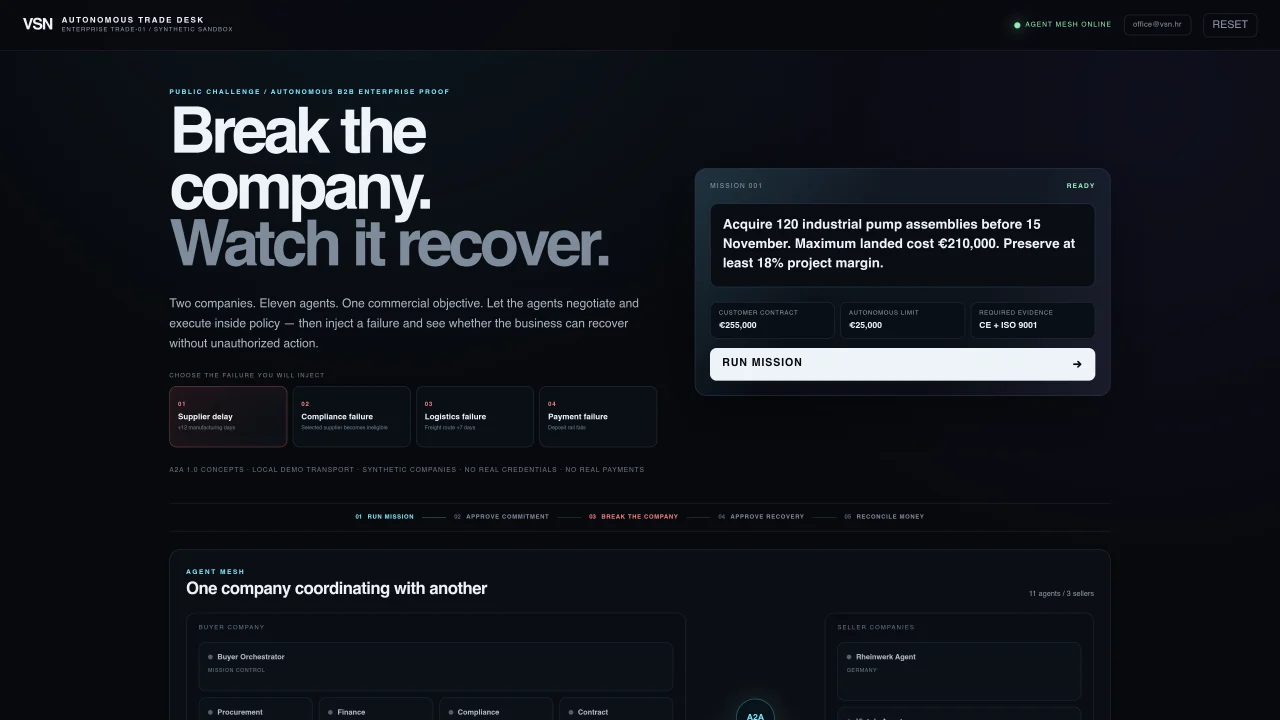
The VSN Autonomous Trade Desk is a synthetic sandbox that models autonomous agent-to-agent commercial interactions between two simulated companies. It uses a network of eleven agents across procurement, finance, compliance, logistics, and revenue control to execute a defined commercial mission. Users can select and inject specific failures such as supplier delays, compliance violations, logistics disruptions, or payment system failures to observe how the agent network adapts and recovers while adhering to policy constraints. The system operates without real suppliers, credentials, or payments, using structured agent-to-agent tasks to simulate end-to-end trade processes. Missions are defined with clear objectives, budgets, margins, and compliance requirements, allowing for controlled testing of recovery mechanisms under stress.
The VSN Autonomous Trade Desk simulates autonomous agent-to-agent commercial interactions between two simulated companies. It models end-to-end trade processes using a network of eleven agents across procurement, finance, compliance, logistics, and revenue control to execute a defined commercial mission.
The tool is designed for organizations seeking to test and validate autonomous trade recovery mechanisms under controlled stress scenarios without real-world risks. It suits teams focused on supply chain resilience, compliance, and financial recovery strategies.
Users can inject specific failures such as supplier delays, compliance violations, logistics disruptions, or payment system failures to observe how the agent network adapts and recovers while adhering to policy constraints. The system operates without real suppliers, credentials, or payments.
Missions are defined with clear objectives, budgets, margins, and compliance requirements. For example, a mission may involve acquiring industrial pump assemblies by a specific date while preserving a set project margin and adhering to required certifications.
No, the system uses synthetic companies and structured agent-to-agent tasks to simulate trade processes without involving real suppliers, credentials, or payments. This ensures a safe environment for testing recovery mechanisms.
To get started, users can select a predefined mission, approve the commitment, inject a failure to test recovery, and then approve the recovery process. The tool provides a step-by-step interface to guide users through the simulation.
We use essential cookies to run Aitoolnavio, and optional cookies to analyze traffic and measure our marketing. You choose what we use — optional cookies stay off unless you turn them on. See our Privacy Policy.
One short email a week: fresh tools worth trying, honest takes and the updates that actually matter. No spam, unsubscribe any time.
Unify customer data, automate workflows, and scale experiences with Einstein AI, Copilot, and Data Cloud in one CRM platform.
Build conversational forms, capture rich responses, and automate follow-ups with AI-powered surveys and workflows.
Transforms thoughts into actions, enhancing productivity and efficiency.
Automate code, research, and documents using agents.
All-in-one team productivity platform combining chat, docs, video meetings, workflows, and AI tools in one place.
Automate workflow, optimize operations, and detect potential issues with this efficient AI-driven solution.
AI-powered IDE for autonomous coding tasks and agentic development workflows
AI Recruitment engine to hire top global talent
Automate tailored conversations, analyze customer behavior, and automate lead gen, customer service, and sales.
AI job search copilot that matches roles to skills, optimizes resumes for ATS, generates cover letters, and autofills applications with real-time insights.
Source, match, and manage talent with predictive analytics for effortless recruiting.
Personal assistant that coordinates tasks across apps and devices via text or call
Matched on what this tool does — grouped by the job you would be replacing.
matches Agent-based trade negotiation simulation · Controlled failure injection (supplier delay, compliance, logistics, payment) · Multi-role agent mesh (procurement, finance, compliance, logistics, revenue control)
Transform logistics with AI-driven call automation and negotiation.
AI workers that take responsibility for defined operational work in logistics
AI-native platform for global product sourcing from design to delivery