
Efficiently create and manage cases, streamline workflows, securely store and share documents, and collaborate with colleagues.
3.8M visits/mo-0.8%#26 Business & Marketing

AI assistant for legal research, litigation, and transactional workflows
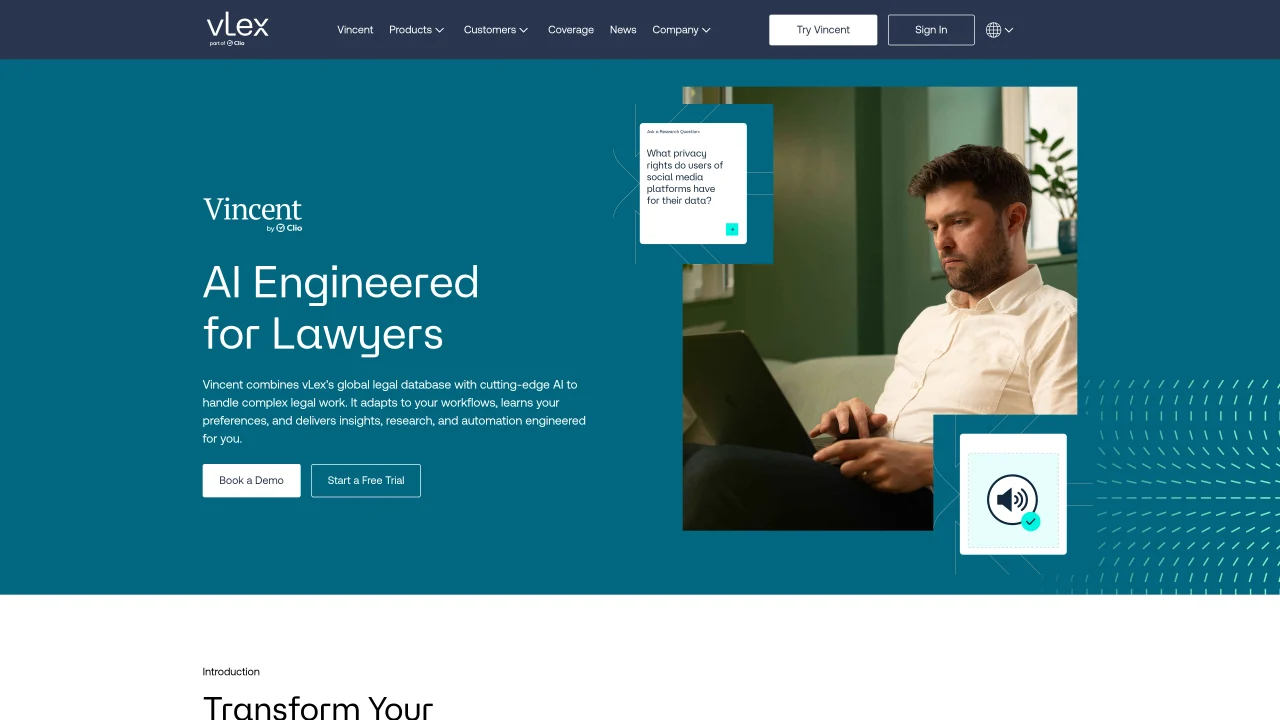
Vincent integrates vLex’s global legal database with AI to assist lawyers in research, litigation, and transactional tasks. It adapts to individual workflows, learns user preferences, and delivers insights, research, and automation tailored to legal practice. The tool is designed for large law firms, in-house legal departments, small practices, and government entities. Vincent offers research workflows that convert natural language questions into comprehensive legal answers with full citations, 50-state surveys, and jurisdiction comparisons. Its litigation tools automate document analysis, including complaint reviews, pleading comparisons, and judicial proceeding transcriptions, to accelerate case strategy. Transactional workflows streamline contract analysis, redlining, and document comparisons to reduce manual effort and improve deal efficiency. Vincent Studio allows teams to embed custom workflows without coding, ensuring consistent adherence to firm-specific processes.
vLex Vincent AI is an AI-powered legal assistant designed to transform legal workflows by integrating vLex’s global legal database with advanced AI. It is engineered for lawyers in large law firms, in-house legal departments, small practices, and government entities.
Vincent AI converts natural language questions into comprehensive legal answers with full citations, performs 50-state surveys, and compares jurisdictions. It searches case law, statutes, and commentary to deliver precise, contextual results with citations and direct links to primary sources.
Yes, Vincent AI automates document analysis for litigation, including reviewing complaints, comparing pleadings, and transcribing judicial proceedings. It identifies weaknesses in opposing arguments, generates action timelines, and provides strategic insights from recorded proceedings.
Transactional workflows in Vincent AI streamline contract analysis, redlining, and document comparisons to reduce manual effort and improve deal efficiency. It helps optimize transaction lawyers' deal flow by automating time-intensive tasks and reducing document turns.
Vincent Studio allows legal teams to embed custom workflows into Vincent AI without coding, ensuring consistent adherence to firm-specific processes. It uses an intuitive no-code interface to design workflows tailored to unique legal practices.
Vincent AI demonstrates superior reliability in randomized controlled trials, outperforming leading LLMs and human research without AI. Independent benchmarking studies also verify that it boosts productivity across legal workflows.
We use essential cookies to run Aitoolnavio, and optional cookies to analyze traffic and measure our marketing. You choose what we use — optional cookies stay off unless you turn them on. See our Privacy Policy.
One short email a week: fresh tools worth trying, honest takes and the updates that actually matter. No spam, unsubscribe any time.
Efficiently create and manage cases, streamline workflows, securely store and share documents, and collaborate with colleagues.
Legal search engine specializing in Indian case law and statutes
Vanta automates compliance certification for SOC 2, HIPAA, ISO 27001, PCI, and GDPR, reducing time from months to weeks.
All-in-one legal case management platform for law firms, combining intake, e-signatures, payments, analytics, and reporting in one secure system.
Create and customize legal documents, consult lawyers, and access legal guides all in one platform.
Legal research platform for case law, statutes and commentary in India
Identify risks quickly, automate risk assessment & monitoring, and customize for tailored risk management.
AI assistant that drafts, reviews, and researches legal documents for lawyers and law firms.
Create custom templates, automate contract workflow, and use analytics to optimize contracts.
Converts scanned documents and images into editable, searchable formats with AI-powered OCR and data extraction.
AI-powered legal practice management platform for law firms to manage matters, billing, documents, and workflows in one secure system.
AI-powered legal research, litigation due diligence and case management platform for India
Matched on what this tool does — grouped by the job you would be replacing.
matches Natural language research queries with contextual answers · 50-state legal surveys and jurisdiction comparisons · Complaint and pleading analysis with strategic insights
AI platform for legal research, drafting, and analysis in law firms
AI legal assistant for lawyers that accelerates legal research, drafting, matter analysis, contract review, and lawyer-verified answers.
AI assistant for legal research, analysis and drafting
Free AI-powered legal research tool for Canadian case law, legislation, and commentary using plain language queries.
matches Contract analysis and redline comparison · Custom workflow creation via no-code Studio
matches Judicial proceeding transcription and analysis
AI-powered legal assistant for drafting, reviewing, and streamlining contract workflow with customizable settings.
AI-driven contract analysis tool with multilingual capabilities and lawyer-trained insights.
AI contract review and risk analysis software for legal teams to extract clauses, assess liability, and track obligations faster.
Automate contract analysis, analyze documents and data, gain insights into legal trends and risks.
Talknotes transforms voice memos into written content with AI-powered magic.
AI-powered legal research assistant for Canadian law with cited answers, meeting analysis, and voice calls