
Discover keywords, analyze competitors' SEO strategies, and make data-driven decisions for website performance.

llms.txt Generator
$19Starting price
0Popularity
About llms.txt Generator
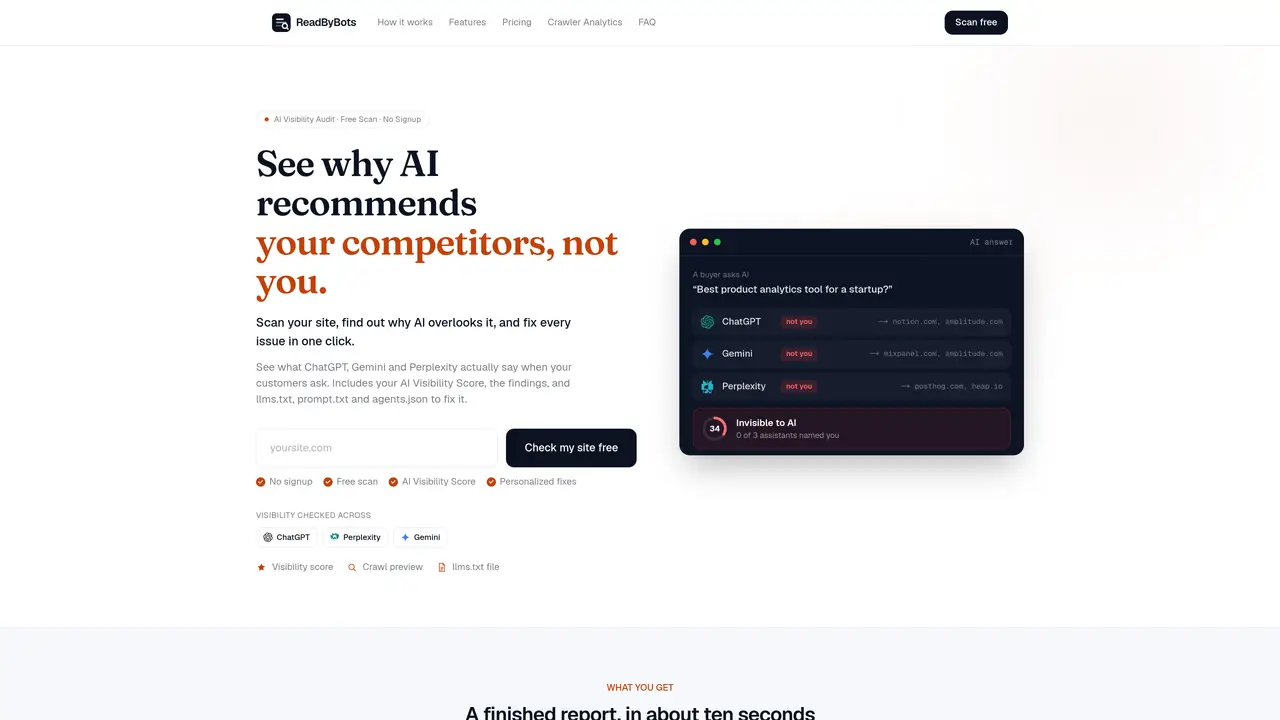
The tool scans a website to measure how visible it is to AI assistants like ChatGPT, Gemini and Perplexity. It evaluates 26 signals including schema markup, headings, FAQ structure and thin content, then generates an AI Visibility Score. The scan removes scripts, navigation and banners to show what an AI model actually reads. Users receive a report with findings, an llms.txt file, prompt.txt and agents.json to address issues. A crawl simulator compares raw HTML with the cleaned text, and one-click fixes can generate missing titles, descriptions or schema. The service also runs live recommendation tests by querying AI assistants with customer questions to see which brands are cited. Crawler Analytics tracks visits from AI bots such as GPTBot and PerplexityBot in real time.
Key features
- AI Visibility Score based on 26 signals
- llms.txt and llms-full.txt file generation
- Live recommendation tests with ChatGPT, Gemini and Perplexity
- Crawl simulator comparing raw HTML to cleaned content
- One-click fixes for titles, descriptions and schema
- Crawler Analytics tracking AI bot visits
- SEO & GEO Playbook with 25+ documents
- Re-testing after fixes to measure improvement
Use cases
- Auditing a company website for AI recommendation visibility
- Generating structured data files to improve AI model responses
- Monitoring which AI bots visit a site and their behavior
Pros
- Measures visibility to multiple AI assistants in a single scan
- Generates llms.txt, prompt.txt and agents.json files for fixes
- Provides a crawl simulator showing what AI models retain
- Includes live recommendation tests with customer questions
- Offers Crawler Analytics to monitor AI bot visits
Cons
- No free tier beyond a single free scan
- One-time pricing only, no subscription option
- Limited to website content analysis for AI visibility
- Requires manual implementation of generated fixes
Frequently asked questions about llms.txt Generator
What is llms.txt?
llms.txt is a plain-text file placed at the root of a website that provides AI assistants with a clean, curated map of its content. It follows the proposal at llmstxt.org and includes structured signals like headings, schema, and key pages to improve AI readability.
Why does my website need an llms.txt file?
Web pages are designed for browsers, often including navigation, scripts, and banners that obscure the actual content. Publishing llms.txt helps AI assistants access the core information more effectively, regardless of whether specific crawlers officially recognize the file.
Do AI companies like ChatGPT or Perplexity actually read llms.txt?
It is unclear whether major AI companies officially read or use llms.txt. Google's Search Advocate has described it as speculative rather than confirmed, and no AI company currently documents it as a citation or ranking signal.
How does the tool measure AI Visibility Score?
The tool evaluates 26 signals that AI crawlers rely on, such as schema markup, headings, FAQ structure, and thin content. It scores these signals out of 100 to provide a comprehensive AI Visibility Score for the website.
What files do I receive after scanning my website?
After scanning, users receive a report with findings, an llms.txt file, prompt.txt, and agents.json to address issues. These files help improve AI readability and provide actionable fixes for missing titles, descriptions, or schema.
Can I test how AI assistants respond to my website's content?
Yes, the tool runs live recommendation tests by querying AI assistants with customer questions to see which brands are cited. This helps identify gaps where competitors are mentioned instead of your website.