An AI chat platform for roleplaying, storytelling, and learning by chatting with millions of user-created AI characters.
151M visits/mo-5.5%#2 Chatbots & Assistants

Implantable brain-computer interface translating neural activity into cursor and keyboard control for assistive communication and research under clinical supervision.
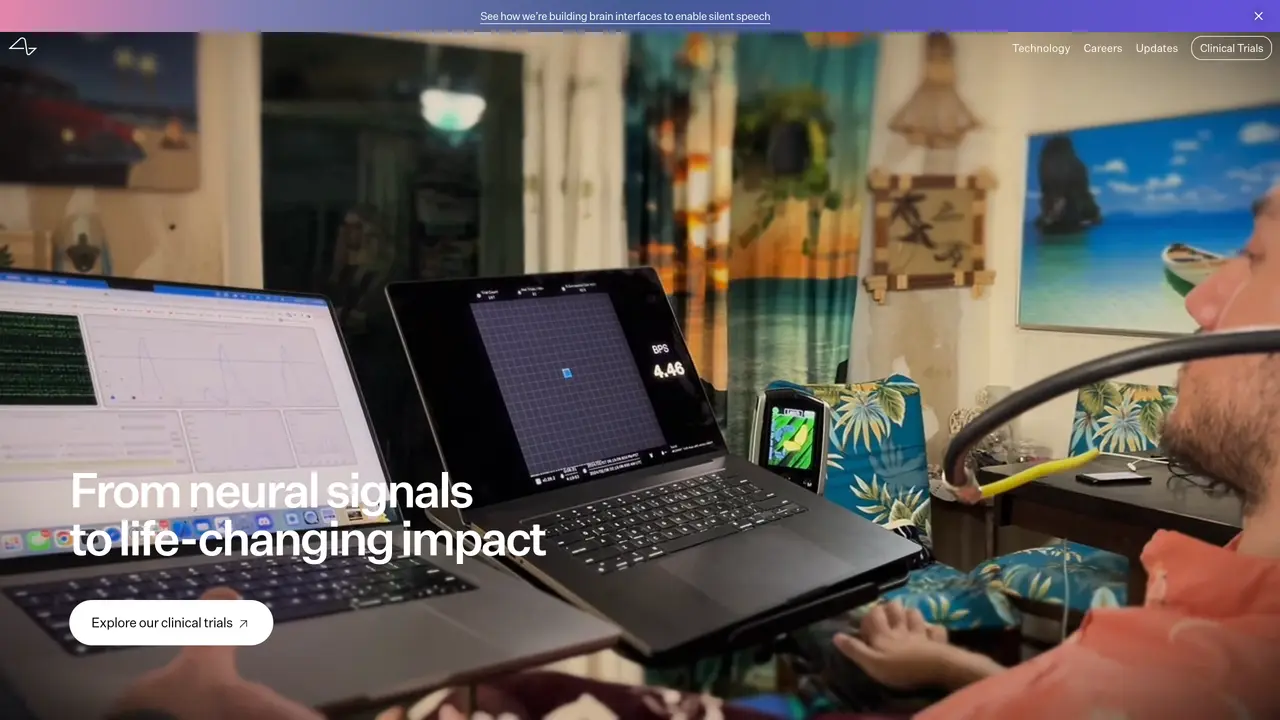
Neuralink is an implantable brain-computer interface designed to capture neural activity and translate it into digital actions such as cursor movement and text entry. It is developed for assistive communication, enabling people with severe motor impairments to regain hands-free digital access through thought-controlled interfaces. The system emphasizes high-fidelity signal capture, low-latency decoding, and real-time performance under strict clinical oversight. After surgical implantation and recovery, participants undergo guided calibration sessions where neural patterns are mapped to specific actions, improving accuracy and stability over time. The interface is optimized for consistency, safety monitoring, and clinician supervision, ensuring reliable operation within approved research and medical protocols. Research teams and engineers use Neuralink to study neural decoding, develop evaluation metrics, and build experimental frameworks for high-stakes brain-computer interface applications. Access is restricted to qualified candidates through formal clinical pathways, with no general public SDK or open API available. All data handling, integrations, and software access occur within ethics-reviewed, regulated environments to prioritize patient safety and compliance with healthcare standards.
Neuralink
Pioneer Building, United States · Founded 2016
Neuralink is a brain-computer interface designed to capture neural activity and translate it into digital actions such as cursor movement and text entry for assistive communication.
Neuralink is developed for people with severe motor impairments who seek hands-free digital access through thought-controlled interfaces, as well as for clinical research teams studying neural decoding.
After surgical implantation, participants undergo calibration sessions where neural patterns are mapped to specific actions, enabling real-time performance and improved accuracy over time.
No, access is restricted to qualified candidates through formal clinical pathways, with no general public SDK or open API available.
The system operates under strict clinical oversight, with data handling, integrations, and software access occurring within ethics-reviewed, regulated environments to prioritize patient safety.
Interested individuals must qualify through formal clinical pathways, as Neuralink is not available for general public use or independent access.
neuralink.com · third-party estimates from Similarweb
Last 4 months · grows by one month every month
Share of visits · estimated visits
Other countries: 25.9%
How people reach this site from other AI tools
476 a month · 0.1% of all visits
Chatbots & Assistants · Sep 2026
Traffic figures are third-party estimates, good for scale and trends; they can differ from a company's own numbers. Updated monthly.
We use essential cookies to run aitoolnavio™, and optional cookies to analyze traffic and measure our marketing. You choose what we use — optional cookies stay off unless you turn them on. See our Privacy Policy.
One short email a week: fresh tools worth trying, honest takes and the updates that actually matter. No spam, unsubscribe any time.
An AI chat platform for roleplaying, storytelling, and learning by chatting with millions of user-created AI characters.
Create and interact with AI companions and virtual characters using GPT-4o on Chub AI's platform.
Create stunning visuals, access image recognition and processing, and express creatively with natural language processing.
Create fully customizable AI companions with persistent memory, selfies, and live voice calls.
Practice conversing with AI, improve pronunciation, and learn a new language in an immersive, safe environment.
Train, customize, optimize, and deploy models easily for powerful AI projects.
AI-powered tarot readings and personalized interpretations for self-reflection and guidance.
Quickly narrow searches by category, control results by country or language, and find relevant, accurate results with ease.
Chat with AI friends, mentors, and characters on the world's largest conversational AI platform for entertainment.
Generate presentations, create interactive slideshows, and customize with themes, fonts, and colors.
Trendspider is a sophisticated all-in-one market research and trading software designed to enhance the trading strategies of investors and traders.
An AI chat platform for immersive, personalized interactions with virtual companions, including image generation.
Matched on what this tool does — grouped by the job you would be replacing.
Paid placement · similar tools from listings that support aitoolnavio™
Instant lead response for home-service pros: your phone rings on every new lead, plus 14 days of follow-up
matches Translates neural activity into on-screen cursor and keyboard control · Enables text entry by thought for assistive communication · Supports hands-free operation of assistive devices via neural intent
Revolutionizing healthcare with safe, efficient AI-driven solutions.
Gain insights, visualize and manipulate brain activity with real-time access to large datasets.
A MacOS app that lets users control their computer with voice commands, dictate text, and automate workflows using GPT-4.