
An AI chat platform for roleplaying, storytelling, and learning by chatting with millions of user-created AI characters.

TAMA
$8/moStarting price
0Popularity
About TAMA
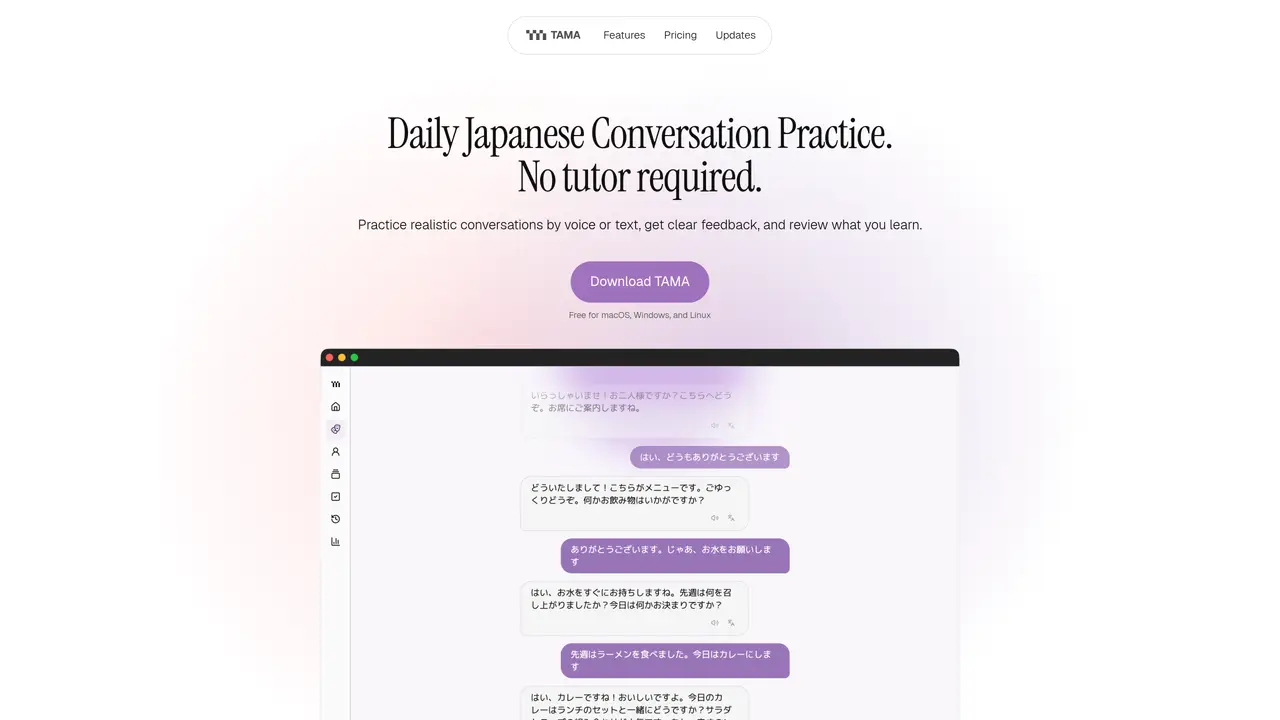
TAMA is a desktop application for practicing Japanese conversation without a tutor. It offers scenario-based practice where users engage in realistic dialogues such as ordering food or checking into a hotel, either by voice or text. After each session, the tool provides clear feedback on areas for improvement and suggests what to practice next. Vocabulary encountered during conversations can be saved directly to flashcards that use spaced repetition to reinforce learning. The app includes a practice dashboard that consolidates daily plans, recent conversations, and due flashcards in one place, allowing users to resume practice without starting from scratch. TAMA supports both local models and user-provided API keys, giving users control over AI providers and associated costs. It is designed primarily for beginner to intermediate learners who already know basic Japanese phrases and wish to improve fluency through practical, everyday scenarios.
Key features
- Scenario-based conversation practice
- Voice and text input options
- Session feedback and improvement suggestions
- Smart flashcards with spaced repetition
- Practice dashboard for consolidated learning
- Local model support
- Custom API key integration
- Persona-based chats
Use cases
- Practicing everyday Japanese conversations
- Building vocabulary through realistic scenarios
- Preparing for travel or social interactions in Japanese
Pros
- Supports both voice and text practice
- Provides feedback and vocabulary suggestions after each session
- Includes spaced repetition flashcards for vocabulary retention
- Available for macOS, Windows, and Linux
- Open-source desktop application under GPL-3.0-only
Cons
- Managed beta requires data disclosure
- No mobile or web version available
- Local model performance depends on user hardware
- API usage costs depend on chosen provider
Frequently asked questions about TAMA
How does TAMA work?
Users select a scenario, practice by voice or text, and receive feedback after each conversation. TAMA identifies useful vocabulary and converts saved words into spaced-repetition flashcards for review.
What level of Japanese is TAMA suitable for?
TAMA works best for learners who already know basic words and phrases, particularly those at beginner to intermediate levels. Users can adjust the difficulty of scenarios as they improve.
Does TAMA work on Windows and Linux?
Yes, TAMA provides public builds for macOS (Apple Silicon), Windows x64, and Linux x64, available for download on the GitHub Releases page.
Is my data stored locally in TAMA?
In the Free app, study history, flashcards, personas, and settings remain on the user's device. Requests are sent only to the chosen AI or speech provider. The managed beta will include separate data disclosure.
What is the difference between the Free and Managed versions of TAMA?
The Free version allows users to employ local models or connect their own API keys, while the planned Managed option at $8/month handles the AI service for users without setup requirements.
How much does API usage cost if I use my own key?
Costs depend on the chosen provider and model, and users pay the provider directly. Alternatively, users can connect a compatible local model to avoid per-request AI charges.