
AI chatbot for conversation, work, research, coding, and content creation.

Dredge Echo Astra
0Popularity
About Dredge Echo Astra
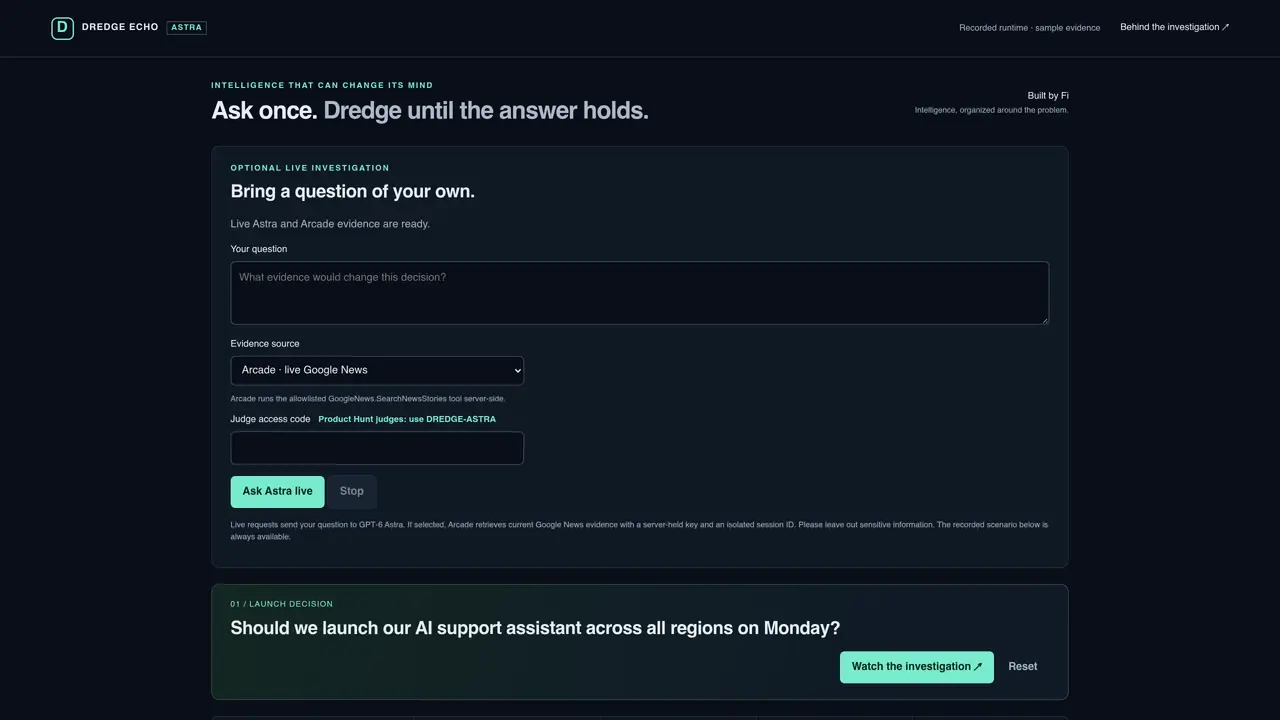
Dredge Echo Astra is an AI investigation system designed to refine answers through iterative evidence gathering. It allows users to pose a question once and then directs the investigation by branching into separate reasoning paths based on emerging evidence. The tool integrates live data sources such as Google News via a server-side tool, feeding evidence into a reasoning plane powered by GPT-6 Astra. Users can explore different investigative directions, with each branch recorded as a separate runtime execution. The system preserves and retires work based on evolving findings, ensuring the final recommendation reflects the most current and relevant evidence. Evidence and execution are tracked separately, connected through a control loop that adapts to new information. The workflow emphasizes transparency, with recorded scenarios and execution graphs available for review.
Key features
- Live evidence integration via Google News
- Separate execution branches for different investigative paths
- Preservation and retirement of work based on findings
- Control loop adapting to new evidence
- Recorded runtime executions for transparency
- Deterministic recorded path for illustrative purposes
- GPT-6 Astra as the reasoning plane
- Evidence-ledger tracking sources and branches
Use cases
- Evaluating business decisions with live market data
- Investigating policy or regulatory impacts across regions
- Exploring multiple scenarios in strategic planning
Pros
- Iterative refinement of answers based on live evidence
- Separate execution branches for different investigative directions
- Integration with live data sources like Google News
- Preservation and retirement of work based on evolving findings
- Transparent tracking of evidence and execution paths
Cons
- Requires live Astra availability for full functionality
- No explicit mention of multi-language support
- Limited to server-side tool integration (Google News only)
Frequently asked questions about Dredge Echo Astra
What is Dredge Echo Astra?
Dredge Echo Astra is an AI investigation system that allows users to pose a single question and iteratively refine the answer by exploring multiple reasoning paths based on emerging evidence. It integrates live data sources, such as Google News, and uses GPT-6 Astra as the reasoning plane to adapt to new information.
Who should use Dredge Echo Astra?
The tool is designed for users who need to conduct thorough, evidence-based investigations, such as researchers, analysts, or decision-makers requiring transparent and adaptable reasoning processes. It is particularly useful for scenarios where answers may evolve with new data.
How does Dredge Echo Astra work?
Users submit a question, and the system initiates an investigation by branching into separate reasoning paths. Evidence is gathered from live sources like Google News, and the reasoning plane evaluates findings to refine the answer. Each branch is recorded as a separate runtime execution, with work preserved or retired based on evolving evidence.
Can Dredge Echo Astra use live data sources?
Yes, the tool can integrate live data sources such as Google News via a server-side tool, which feeds evidence into the reasoning plane. This allows the investigation to adapt to current information, though users are advised to avoid submitting sensitive data.
Is the investigation process transparent?
Yes, the workflow emphasizes transparency by recording scenarios and execution graphs, allowing users to review how the investigation evolved and why the final recommendation changed. Evidence and execution are tracked separately but connected through a control loop.
How do I get started with Dredge Echo Astra?
To start, users submit a question through the interface. The system then initiates the investigation, branching into reasoning paths and gathering evidence. Users can guide the investigation by selecting directions based on the emerging findings, with each choice recorded as a separate runtime execution.