
AI chatbot for conversation, work, research, coding, and content creation.

hum to search
$1.00Starting price
0Popularity
About hum to search
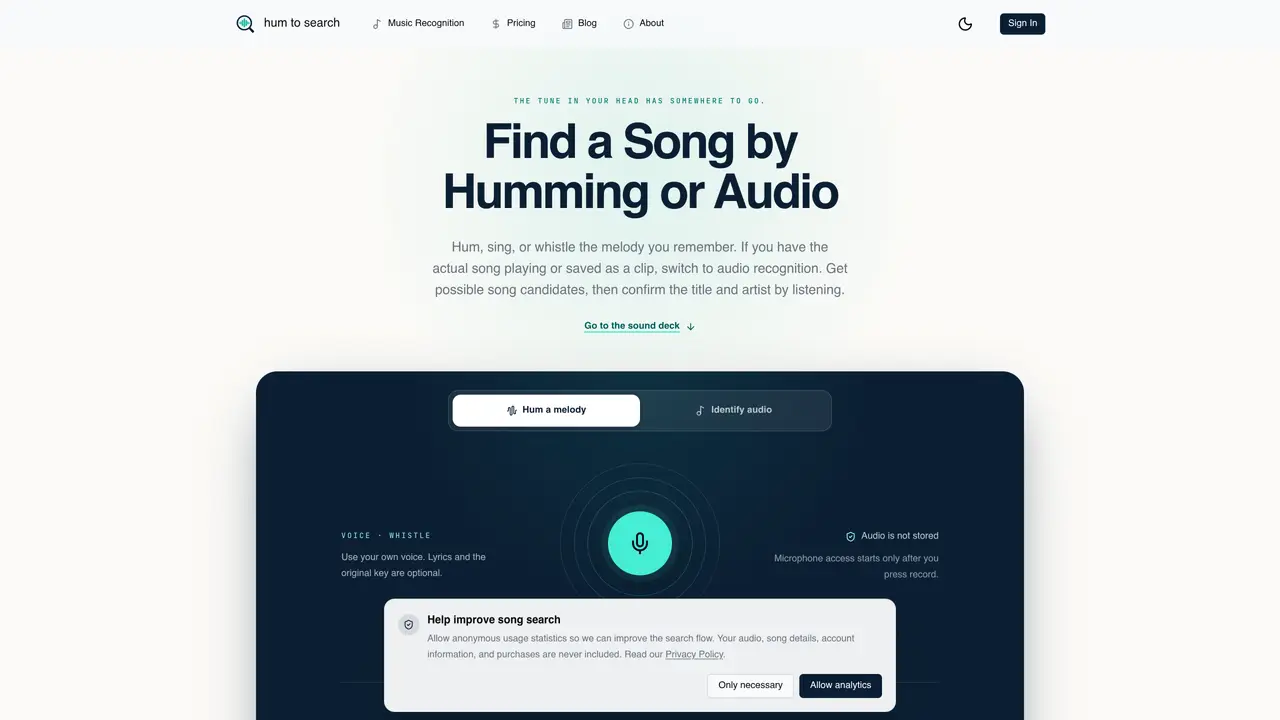
hum to search is a web-based tool that identifies songs from short audio samples. Users can either hum, sing, or whistle a melody they remember or upload an existing audio clip of the song. The service offers two distinct modes: one for self-performed melodies and another for recognizing audio from recordings or files. In the humming mode, the tool focuses on the shape and progression of the melody rather than pitch accuracy or lyrics. For audio recognition, users can record directly through the microphone or upload a file, ensuring the sample contains clear music without excessive background noise. The search process begins with a brief validation of the audio sample, followed by a single search attempt that returns a list of possible song candidates. Users then verify the results by listening to the suggested tracks and comparing them to their memory of the song. The tool emphasizes clarity in input, recommending 8–12 seconds of continuous melody for optimal results. Audio samples are not stored, and microphone access is only activated during active recording.
Key features
- Humming mode for self-performed melodies
- Audio recognition mode for recordings or files
- 8–12 second sample length recommendation
- Temporary microphone access
- Candidate list with song title and artist
- Music platform links for listening
- No storage of audio samples
- One credit per search
Use cases
- Identify a song you remember but cannot name
- Find a track playing in a public space
- Recover a melody from a partial recording
Pros
- Supports both humming and direct audio recognition
- No subscription required; uses one-time credits
- Browser-based with no software installation
- Microphone access is temporary and user-controlled
- Returns multiple candidate matches for verification
Cons
- Requires a one-time credit purchase for each search
- Limited to 8–12 second audio samples
- No mobile app; browser-only functionality
- Audio samples are not stored, limiting retries
Frequently asked questions about hum to search
What is hum to search and how does it work?
hum to search is a web-based tool that identifies songs by analyzing short audio samples. Users can hum, sing, whistle, or upload an audio clip to find matching songs. The service offers two modes: one for self-performed melodies and another for recognizing audio from recordings or files.
Who should use hum to search?
The tool is designed for anyone who remembers a melody but cannot recall the song title or artist. It suits users who want to identify music from humming, singing, whistling, or existing audio clips without needing lyrics or perfect pitch.
How do I get started with hum to search?
Choose between the 'Hum a melody' mode for self-performed tunes or 'Identify audio' for recorded clips. Record or upload a clear 8–12 second sample, then review the candidate matches to confirm the correct song.
Does hum to search store my audio samples?
No, audio samples are not stored. Microphone access is only activated during active recording, and the tool does not retain any uploaded or recorded audio after the search is complete.
What makes a good audio sample for hum to search?
A clear, continuous 8–12 second melody or phrase works best. Avoid background noise, disconnected fragments, or sections with silence. For recorded audio, ensure the music is louder than competing sounds.
Can hum to search recognize songs from lyrics or album covers?
No, the tool only works with pitched melodies or audio recordings. It does not analyze lyrics, spoken descriptions, or visual content like album covers.