
AI chatbot for conversation, work, research, coding, and content creation.

IndexGraph
₹999 /moStarting price
0Popularity
About IndexGraph
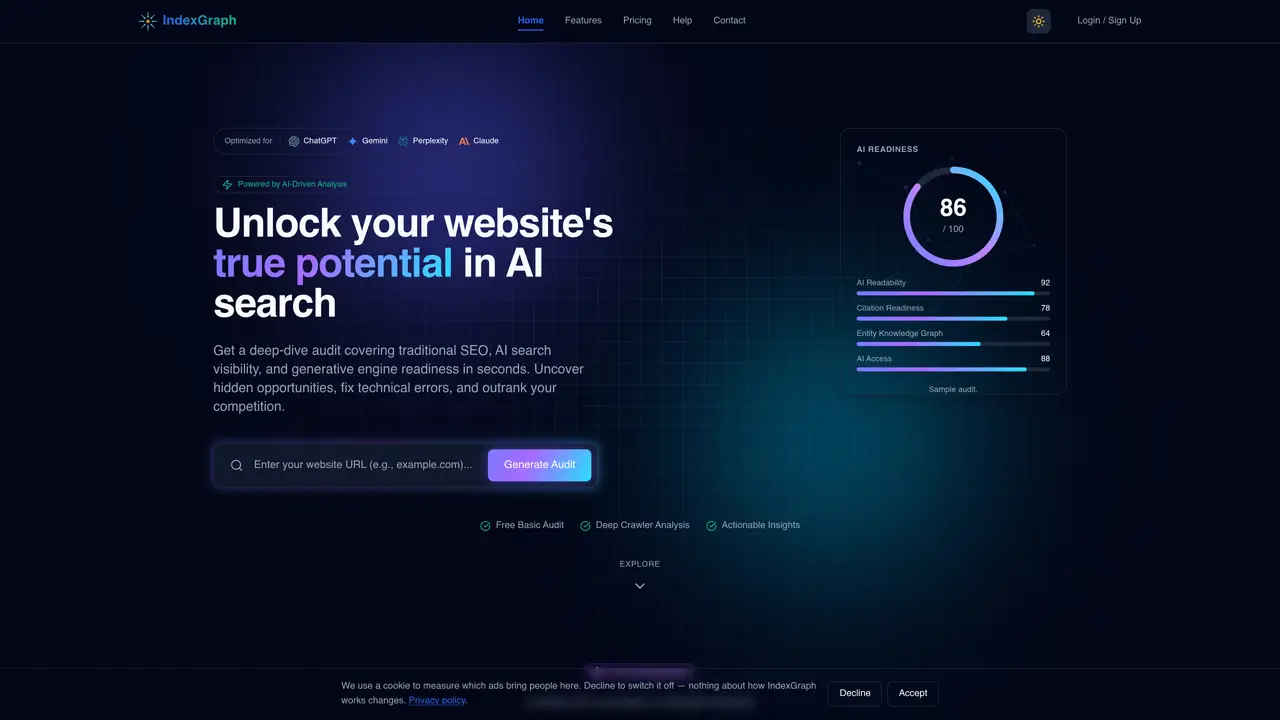
IndexGraph provides AI-powered audits to assess a website’s readiness for AI search engines such as ChatGPT, Google Gemini, Perplexity, and Claude. The tool evaluates seven core dimensions—AI Readability, Content Semantics, Citation Readiness, AI Access, AI Crawlability Intelligence, E-E-A-T Signals, and Entity Knowledge Graph—combining them into a single AI Readiness Score. It performs a deep crawl of the site, including JavaScript rendering and metadata extraction, to simulate how AI models perceive the content. The platform then applies a proprietary Generative Engine Optimization (GEO) scoring algorithm to generate actionable insights and a prioritized playbook for improvement. Technical profiling includes Core Web Vitals, mobile-first accessibility, and secure header checks, while semantic analysis breaks down content into tokens and maps entity relationships. The tool also compares performance against industry benchmarks and allows users to generate competitor reports.
Key features
- AI Readiness Score (0–100 scale)
- Deep crawler with JavaScript rendering
- GEO and AEO audits
- Competitor benchmarking
- Core Web Vitals assessment
- E-E-A-T signal analysis
- Entity Knowledge Graph mapping
- AI-generated action plans
Use cases
- Auditing a website’s readiness for AI search engines
- Comparing SEO/GEO performance against competitors
- Identifying technical errors affecting AI crawler accessibility
Pros
- Evaluates seven dimensions of AI search readiness
- Simulates AI crawler behavior with headless JavaScript rendering
- Generates competitor comparison reports
- Provides actionable, prioritized task lists for optimization
- Supports multiple AI answer engines (ChatGPT, Gemini, Perplexity, Claude)
Cons
- No free tier available
- UPI payments only for launch pricing
- Limited to public URLs (no private site audits)
- Pricing requires subscription for ongoing use
Frequently asked questions about IndexGraph
What is GEO (Generative Engine Optimization)?
GEO is the practice of making a website readable, citable, and trustworthy to AI answer engines like ChatGPT, Gemini, Claude, and Perplexity. Unlike traditional SEO, which optimizes for search engine results pages, GEO focuses on ensuring content is structured for AI models to extract, synthesize, and cite directly.
How is GEO different from traditional SEO?
Traditional SEO prioritizes keyword targeting, backlinks, and ranking on results pages, while GEO emphasizes structured data, factual density, named-entity clarity, server-rendered content, and authoritative citations. A page may rank highly on Google but remain invisible to AI models if it lacks GEO alignment.
Which AI answer engines does IndexGraph optimize for?
IndexGraph optimizes for the major AI answer engines, including ChatGPT (OpenAI), Perplexity, Google Gemini, and Claude (Anthropic). It also audits for Google AI Overviews, which appear in a significant share of Google searches.
What is the AI Readiness Score and how is it calculated?
The AI Readiness Score is a single 0–100 metric summarizing a website’s performance across seven dimensions: AI Readability, Content Semantics, Citation Readiness, AI Access, AI Crawlability Intelligence, E-E-A-T Signals, and Entity Knowledge Graph. These dimensions are evaluated using a proprietary algorithm to generate a comprehensive readiness assessment.
Does IndexGraph perform a deep crawl of the website?
Yes, IndexGraph executes a deep crawl that includes JavaScript rendering and metadata extraction to simulate how AI models perceive the content. This ensures the audit reflects what AI answer engines actually see when accessing the site.
Can IndexGraph compare my site’s performance against competitors?
Yes, IndexGraph includes comparative scoring against industry benchmarks in its audit reports. This allows users to assess their site’s performance relative to competitors and identify areas for improvement.