An AI-driven experience management platform for enterprises to collect multi-channel feedback, analyze structured and unstructured data, and deliver actionable insights.

Lucid Engine
$89Starting price
395Monthly visits
0Popularity
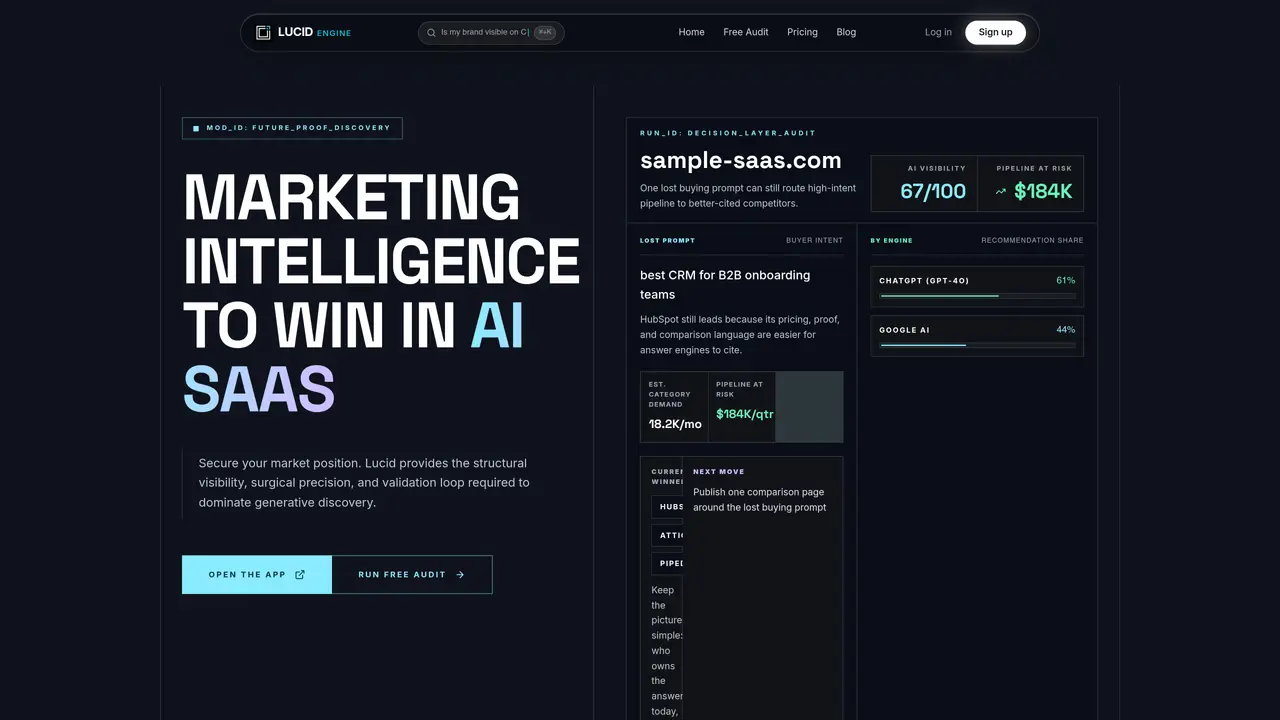
About Lucid Engine
Lucid Engine focuses on AI search visibility for e-commerce brands, showing how often and how prominently a store is cited in answers from ChatGPT, Perplexity, and Google’s AI Overviews. It treats Generative Engine Optimization (GEO) as a measurable channel, combining AI visibility scoring, competitor benchmarking, and a prioritized fix list so teams can win more AI recommendations instead of guessing what models see. Key Features: AI Visibility Audit: Provides a baseline score that blends citations and prominence across ChatGPT, Perplexity, and Google AI, including separate sub-scores for top-position presence and citation quality by URL. Competitor Radar & Share of Voice: Maps which brands AI engines recommend instead, with share-of-voice charts that compare a brand against rivals like Nike, Adidas, or Gymshark across monitored prompts and engines. Action Backlog with P0/P1/P2 Priority: Translates visibility gaps into a clear backlog, flagging critical P0 issues such as missing product information or 404s, along with estimated impact percentages, so teams know what to fix first. Live Tracking & Alerts: Monitors strategic prompts daily and highlights when a brand drops out of the top three or when new competitors appear, with alerting designed for channels like Slack and dashboards showing volatility over recent model updates. Geo & Sentiment Intelligence: Runs identical prompts from different cities, surfaces which sources drive AI answers (Reddit, GQ, Trustpilot, YouTube, and others), and exposes sentiment, recurring adjectives, and topic gaps that shape how engines describe a brand. E-commerce Stack Integrations: Aligns with Shopify, Magento, and WooCommerce, reflecting its focus on catalog-driven brands that need AI to mention products correctly in shopping-type queries.
Key features
- AI Visibility Audit
- Competitor Radar & Share of Voice
- Action Backlog with P0/P1/P2 Priority
- Live Tracking & Alerts
- Geo & Sentiment Intelligence
- E-commerce Stack Integrations
Use cases
- E-commerce Retailers: Tracking how AI assistants recommend their products in shopping-oriented queries and where competitor brands are preferred.
- Direct-to-Consumer Brands: Measuring AI share of voice in lifestyle, fashion, beauty, and home categories, and aligning PR, reviews, and content with what models quote.
- Performance Marketing & SEO Teams: Using GEO insights to complement paid and organic search, feeding the P0/P1/P2 backlog into existing sprint workflows.
Pros
- Measures AI-driven visibility across major generative engines (ChatGPT, Google AI, Perplexity) with real-time tracking and scoring
- Provides competitor benchmarking and share-of-voice analysis to identify displacement risks and opportunities
- Generates prioritized action lists with estimated impact percentages to guide remediation efforts
- Offers geo-specific and sentiment-based insights to refine positioning and messaging for different markets
- Integrates with e-commerce platforms like Shopify, Magento, and WooCommerce for catalog-driven optimization
Cons
- Primarily focused on SaaS and e-commerce brands, limiting applicability for non-product-based businesses
- Requires ongoing monitoring and updates to maintain accuracy as AI models and algorithms evolve
- May involve a learning curve for teams unfamiliar with Generative Engine Optimization (GEO) principles
Frequently asked questions about Lucid Engine
What is Generative Engine Optimization (GEO)?
GEO is the practice of making a brand understandable, defensible, and citable within AI-driven discovery surfaces such as ChatGPT, Google AI, Claude, and Perplexity. It focuses on answer-level visibility, source influence, semantic clarity, and proof quality to ensure AI models recommend the brand in responses.
How does Lucid Engine differ from traditional SEO?
Traditional SEO centers on crawlability, ranking, and click capture, while GEO operates one layer higher by measuring whether AI models can correctly explain a product, trust the right pages, and cite it in comparative queries. Lucid provides visibility into how LLMs frame a brand across engines.
Can Lucid Engine help after the initial diagnosis?
Yes. Lucid supports teams beyond diagnosis by offering truth-layer analysis, evidence gap mapping, page and documentation fixes, structural directives, monitoring, and re-verification to improve AI visibility and recommendation rates.
What does Lucid Engine’s AI Visibility Audit include?
The audit provides a baseline score blending citations and prominence across ChatGPT, Perplexity, and Google AI, including sub-scores for top-position presence and citation quality by URL. It highlights visibility gaps and prioritizes fixes to improve AI recommendations.
How does Lucid Engine track competitor displacement?
Lucid maps which brands AI engines recommend instead, using share-of-voice charts to compare a brand against competitors like Nike, Adidas, or Gymshark across monitored prompts and engines. It identifies prompts where competitors are winning and prioritizes the proof needed to displace them.
What integrations does Lucid Engine support for e-commerce?
Lucid Engine aligns with e-commerce platforms such as Shopify, Magento, and WooCommerce, ensuring AI models correctly mention products in shopping-type queries by reflecting catalog-driven brand needs.
Lucid Engine Website Engagement
Last Update: 9 days ago
Total Monthly Visits
0
Bounce Rate
—
Visit Duration (avg)
—
Pages Per Visit
—
Country Rank
—
Unknown
Global Rank
—