
AI chatbot for conversation, work, research, coding, and content creation.

LinkDigest
$9Starting price
0Popularity
About LinkDigest
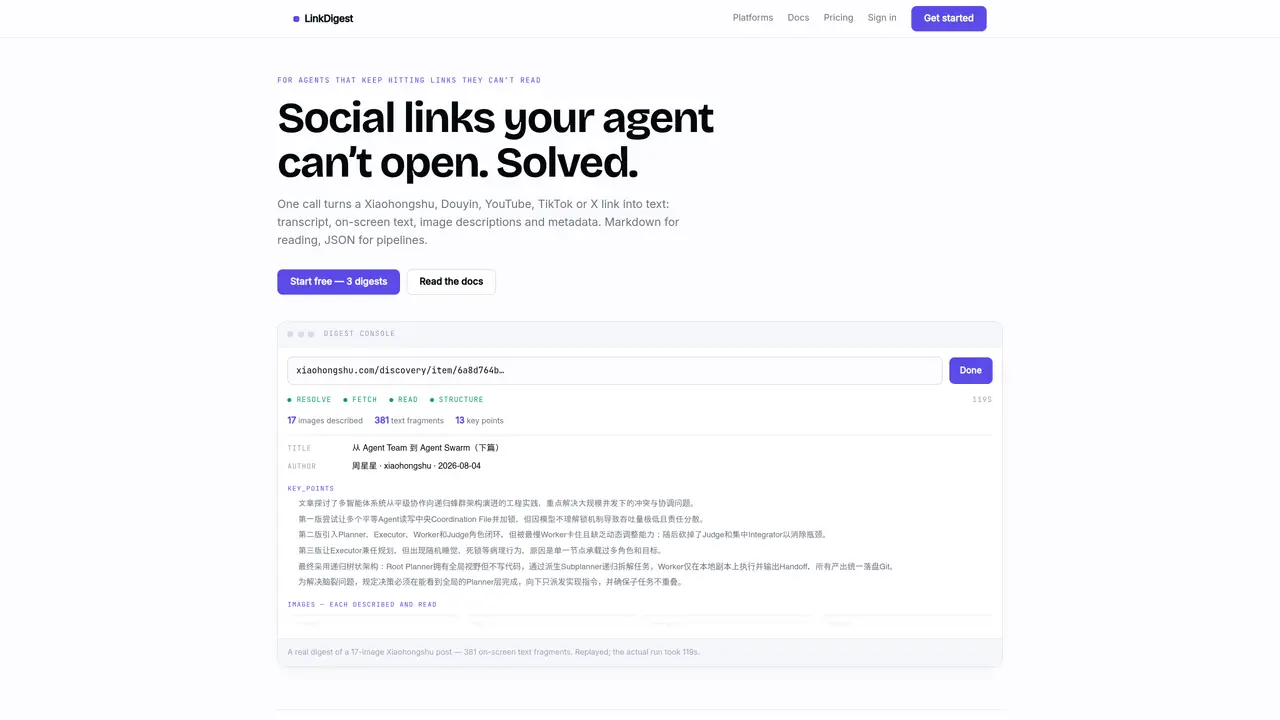
LinkDigest processes social media links into structured text digests containing transcripts, on-screen text, image descriptions, metadata, and key points. It supports platforms such as Xiaohongshu, Douyin, YouTube, TikTok, X, and generic web pages. The tool resolves short links, strips tracking parameters, and caches results to avoid redundant processing. For platforms without captions, it transcribes audio and extracts burned-in text from sampled frames. Output is provided in both Markdown for readability and JSON for integration into automated pipelines. The service operates via an API or MCP server, allowing agents to automatically digest links without manual intervention. Typical use cases include enabling AI agents to read social media content, extracting structured data for analysis, and preserving context from multimedia posts.
Key features
- Resolves short links and strips tracking parameters
- Transcribes audio and extracts burned-in text from frames
- Generates structured digests with transcripts, OCR text, and metadata
- Provides output in Markdown and JSON formats
- Supports API and MCP server integration
- Caches results to avoid redundant processing
- Monitors platform changes and fails loudly when blocked
- Processes media in temporary directories without storage
Use cases
- Enabling AI agents to read and process social media content
- Extracting structured data from multimedia posts for analysis
- Preserving context from social media links in automated pipelines
Pros
- Supports multiple social platforms including Xiaohongshu, Douyin, YouTube, TikTok, and X
- Provides structured outputs in both Markdown and JSON formats
- Caches digests to avoid redundant processing and reduce costs
- Transcribes audio and extracts on-screen text for platforms without captions
- Offers both API and MCP server integration for automated workflows
Cons
- Limited to supported platforms; some like Bilibili are blocked
- Requires periodic session refresh for Douyin
- No free tier beyond initial three digests
- Video processing consumes credits based on duration
Frequently asked questions about LinkDigest
What is LinkDigest and what does it do?
LinkDigest converts social media links into structured text digests containing transcripts, on-screen text, image descriptions, metadata, and key points. It supports platforms like Xiaohongshu, Douyin, YouTube, TikTok, X, and generic web pages.
Who is LinkDigest designed for?
The tool is designed for AI agents or users who need to automatically read and extract structured data from social media posts that are otherwise inaccessible or unreadable by standard link-fetching methods.
How does LinkDigest handle platforms that block automated access?
When a platform blocks automated access, LinkDigest explicitly indicates this failure rather than returning an incorrect or partial result. For example, Bilibili is currently blocked due to server address restrictions.
Can LinkDigest transcribe non-English content, such as Chinese speech?
Yes, LinkDigest uses SenseVoice for transcription, which is optimized for Mandarin and provides higher accuracy than Whisper-class models. Captions published by platforms are used when available.
Does LinkDigest store videos or images from the processed links?
No, media is processed in a temporary directory and deleted immediately after extraction. Only the resulting text digest is stored, and cached results are reused to avoid redundant processing.
How do I integrate LinkDigest into my workflow or AI agent?
LinkDigest can be integrated via its REST API or MCP server. For example, you can add the MCP server to Claude Code and call the digest_url function automatically when encountering a social link.