
AI chatbot for conversation, work, research, coding, and content creation.
5.9B visits/mo+5%#1 Chatbots & Assistants

Browser extension and web app that analyzes news articles for bias, funding, purpose and factual accuracy
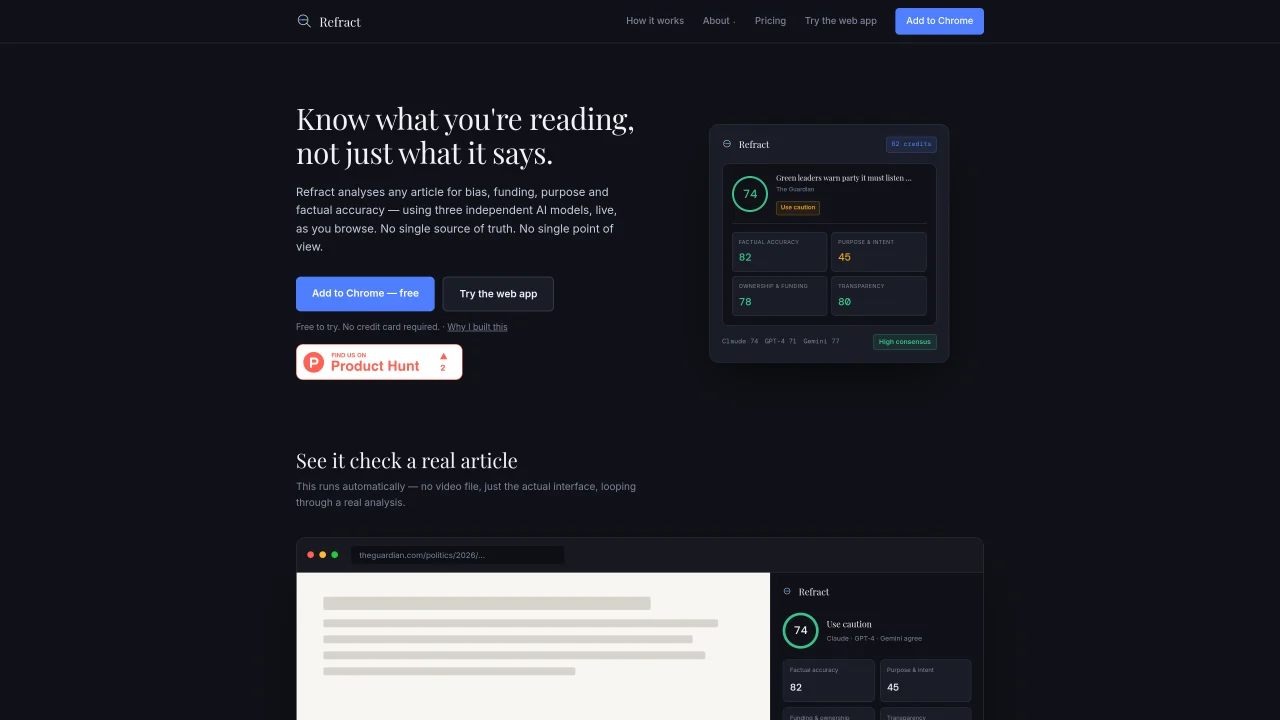
Refract evaluates news articles using three independent AI models—Claude, GPT-4, and Gemini—to assess bias, funding transparency, purpose and intent, and factual accuracy. The tool offers two analysis modes: Quick Scan, which provides a trust score in about fifteen seconds, and Deep Verify, which checks every factual claim against primary sources such as government datasets or official reports. Results are presented with scores and links to sources, highlighting where models agree or disagree. The service operates in real time as users browse, with no single point of view or source of truth prioritized. It is available as a Chrome extension and a web app accessible on any device. Refract is designed for readers who want to critically assess the reliability of news content before sharing or acting on it.
Refract analyzes news articles for bias, funding transparency, purpose and intent, and factual accuracy using three independent AI models—Claude, GPT-4, and Gemini. It provides trust scores and source links to help users critically assess the reliability of content before sharing or acting on it.
Refract is designed for readers who want to critically evaluate the reliability of news content. It suits individuals, newsrooms, classrooms, and teams looking to verify information with deeper analysis.
Refract operates on a credit-based system where Quick Scans cost fewer credits and Deep Verify checks cost more. Users receive a monthly allocation of credits, with options to upgrade for higher usage tiers.
Refract is available as a Chrome extension and a web app accessible on any device. It integrates directly into browsing workflows without requiring additional software or complex setups.
Refract relies on AI models, which may have blind spots or assumptions. While it checks claims against primary sources, some claims may lack verifiable sources, and results depend on the availability of official datasets or reports.
Users can start for free by signing up to receive an initial set of credits. Refract can be added as a Chrome extension or accessed directly through the web app on any device without requiring a credit card.
We use essential cookies to run aitoolnavio™, and optional cookies to analyze traffic and measure our marketing. You choose what we use — optional cookies stay off unless you turn them on. See our Privacy Policy.
One short email a week: fresh tools worth trying, honest takes and the updates that actually matter. No spam, unsubscribe any time.
AI chatbot for conversation, work, research, coding, and content creation.
Efficiently answer research queries, translate natural language to SQL, and utilize OpenAI WebGPT and larger language models.
Search privately, customize interface, track search history, and stay in control of online activities.
Transforms queries into real-time, customized pages with expert insights.
Search scientific papers, discover relevant publications, and enhance understanding of academic literature.
Access research, sort data, and get insights with predictive analytics.
Access hundreds of millions of answers powered by AI technology.
Create research report with references
Search a large knowledge base for verified articles, facts, opinions, and multimedia to answer questions across any topic.
Chat with many top models for everyday tasks.
Centralized AI industry news aggregator with curated daily selections, model rankings, and trending topics.
A free AI platform that answers questions, searches across languages, and generates slides, mind maps, docs, images, and webpages.
Matched on what this tool does — grouped by the job you would be replacing.
matches Quick Scan trust scoring · Deep Verify claim-by-claim fact-checking · Bias and political lean assessment
AI fact-checking platform that extracts and verifies claims from text, video, and audio against trusted sources for journalists, analysts, and risk teams.
Browser extension that fact-checks YouTube videos in real time with sources
AI-powered fact-checking tool that verifies online and social media claims
AI-powered platform for verifying news, links, social posts and multimedia content