
AI chatbot for conversation, work, research, coding, and content creation.

TasteGPT
FreeStarting price
0Popularity
About TasteGPT
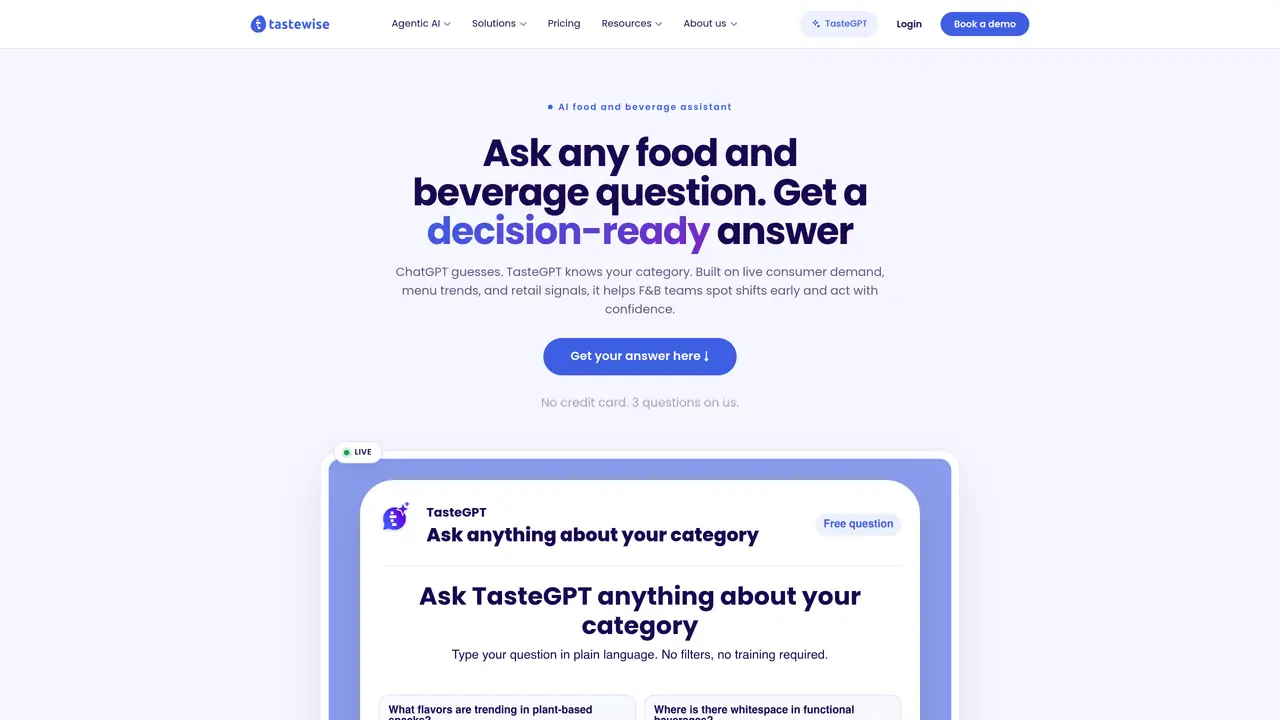
TasteGPT is Tastewise’s conversational food and beverage intelligence assistant. It lets teams ask natural language questions about categories, consumers, menus, and retail performance, then responds with statistically grounded answers built on consumer panels, menu trackers, and real purchase signals. Instead of static dashboards, it focuses on decision-ready insight that explains which trends matter, for which audiences, in which channels, and how to act on them across innovation, marketing, and sales. Key Features: Food-specific conversational engine: Natural language Q&A tuned exclusively for food and beverage questions, from flavor trends to whitespace and claims. Live, multi-source data backbone: Draws from consumer panels, social food conversations, home cooking behavior, menus, retail and eRetail signals in dozens of markets. Statistical confidence and audience cuts: Surfaces growth rates, penetration, and social share with filters by demographic, channel, region, and occasion. Decision-ready narratives: Packages findings into clear takeaways, including why a trend is moving, who drives it, and suggested next steps. Evidence transparency: Each answer links back to underlying datasets and metrics so users can defend choices in retailer or internal meetings. TasteGPT stands out by being built only on food and beverage intelligence rather than a generic internet corpus. Its combination of live consumer panels, menu and retail trackers, and a food-trained generative layer means it answers “What should we launch next?” with specific products, audiences, and claims, not vague trend labels. The emphasis on statistical validation and transparent evidence makes it unusually suitable for high-stakes decisions like retailer pitches and global innovation bets.
Key features
- Food-specific conversational engine
- Live, multi-source data backbone
- Statistical confidence and audience cuts
- Decision-ready narratives
- Evidence transparency
- Natural language Q&A
- Consumer panels and menu trackers
- Retail and eRetail signals
Use cases
- Global CPG and beverage brands use TasteGPT to spot emerging flavors, test concepts, and build retailer sell-in stories.
- Ingredient and flavor houses quantify demand for ingredients, occasions, and benefit territories to guide customers' pipelines.
- Retailers and shopper teams shape category roles, shelf strategy, and promotion themes with demand evidence.
Pros
- Food-native AI trained exclusively on food and beverage data across 39 markets
- Provides decision-ready insights with transparent evidence and statistical validation
- Combines live consumer panels, menu trackers, retail signals, and social food conversations
- Offers enterprise-grade traceability with citable sources and audit trails
- Designed for high-stakes decisions like retailer pitches and global innovation bets
Cons
- Limited to food and beverage industry applications
- Requires reliance on proprietary data sources for accuracy
- May not capture emerging trends outside tracked markets or categories
Frequently asked questions about TasteGPT
What is TasteGPT?
TasteGPT is an AI-powered food and beverage assistant designed to answer natural language questions about trends, audiences, claims, channels, and whitespace using live consumer demand, menu trends, and retail signals.
Who should use TasteGPT?
It is tailored for food and beverage teams, including product innovators, marketers, sales teams, and strategists in CPG, foodservice, and retail sectors.
How does TasteGPT generate answers?
It combines a food-native AI model trained on live market behavior with multi-source data, including consumer panels, social listening, menu trackers, and retail signals across 39 markets.
Does TasteGPT provide evidence for its answers?
Yes, every answer includes citations to underlying datasets and metrics, ensuring transparency and defensibility for high-stakes decisions.
Can TasteGPT integrate with other tools?
TasteGPT can connect to AI assistants like Claude and Gemini via MCP, and it supports integrations with existing data and workflow tools.
How do I get started with TasteGPT?
Users can start by asking up to three free questions on the platform without requiring a credit card, or request a demo for further exploration.