
Create and interact with AI companions and virtual characters using GPT-4o on Chub AI's platform.

Adaptive
$1Starting price
10KMonthly visits
17Popularity
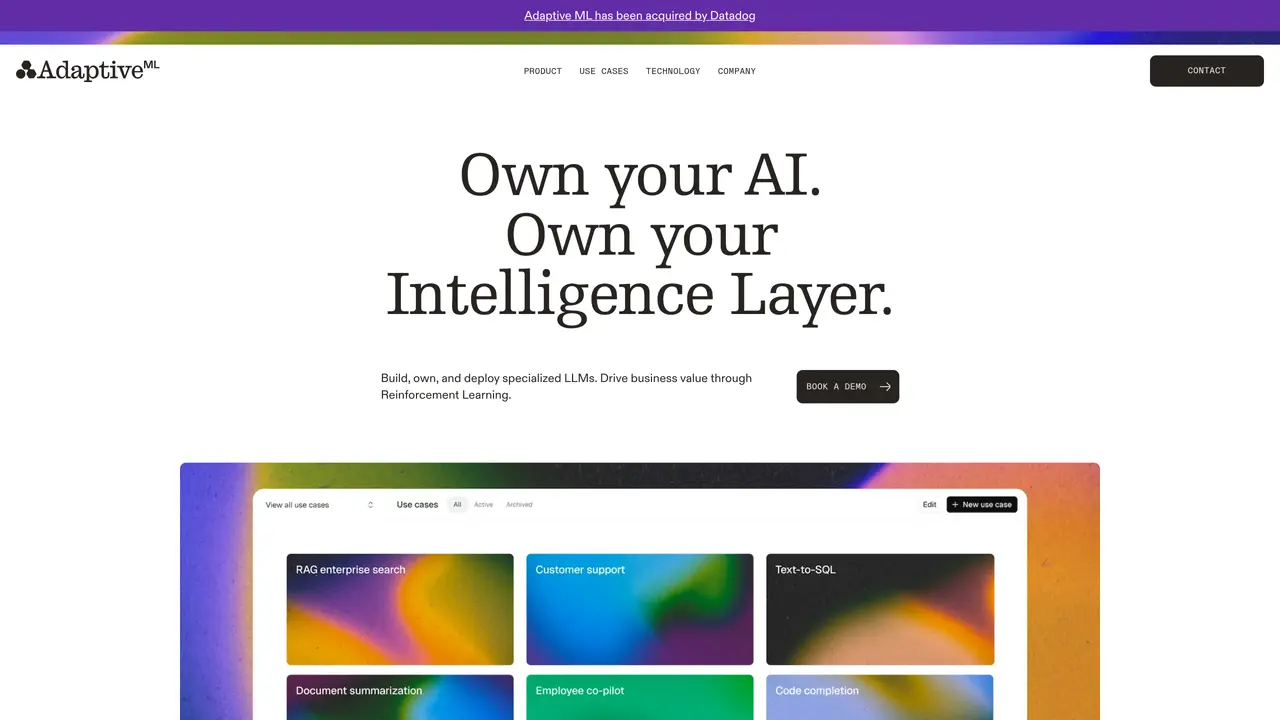
About Adaptive
Adaptive provides businesses with a platform to fine-tune and deploy open large language models using reinforcement learning techniques such as RLHF (Reinforcement Learning from Human Feedback) and RLAI (Reinforcement Learning from AI Feedback). The platform enhances model performance to align with specific business requirements while ensuring strict data privacy by operating entirely within a company’s private cloud infrastructure. It supports fast inference capabilities to deliver low-latency responses, automated A/B testing to identify and deploy optimal model versions, and continuous monitoring of key performance indicators for ongoing refinement and improvement. Designed for organizations aiming to enhance their generative AI capabilities, Adaptive integrates real-time user feedback directly into the learning loop, enabling iterative and adaptive model training. The platform scales seamlessly from small-scale experiments to large enterprise deployments, accommodating diverse operational needs. Its Rust and Python codebase allows for custom development and seamless API integration with existing systems, making it particularly suitable for industries such as technology, finance, healthcare, and retail where secure, high-performance AI solutions are critical. By combining advanced reinforcement learning with robust privacy controls, Adaptive enables businesses to deploy AI models that are both performant and compliant with internal data governance policies.
Key features
- Model adaptation using reinforcement learning (RLHF & RLAI)
- Fast inference with low-latency responses
- Automated A/B testing for model optimization
- Privacy-centric operation within private cloud environments
- Continuous monitoring of KPIs and user metrics
- Real-time user feedback integration for model improvement
- Scalable deployment for small to large business needs
- Seamless API integration with existing LLM systems
- Rust+Python codebase for custom development
- Support for continuous model refinement
Use cases
- Enhancing customer service bots for tech companies
- Implementing real-time fraud detection in financial institutions
- Personalizing patient interactions in healthcare settings
Pros
- Enables fine-tuning of open large language models using reinforcement learning techniques like RLHF and RLAI
- Operates within a company’s private cloud to maintain strict data privacy and security
- Supports fast inference for low-latency responses and automated A/B testing for model optimization
- Integrates real-time user feedback into the learning loop for continuous model refinement
- Scales from small experiments to large enterprise deployments with custom development via Rust+Python codebase
Cons
- Requires technical expertise to implement and manage reinforcement learning workflows
- May involve significant upfront effort to set up and integrate with existing systems
- Dependent on the quality and relevance of synthetic data used for fine-tuning
- Limited to organizations with the infrastructure to support private cloud deployment
Frequently asked questions about Adaptive
What does Adaptive ML do?
Adaptive ML provides a platform to build, own, and deploy specialized large language models using reinforcement learning techniques such as RLHF and RLAI. It enables organizations to fine-tune open models to meet specific business requirements while maintaining data privacy within private cloud environments.
Who is Adaptive ML suitable for?
The platform is designed for enterprises across industries like technology, finance, healthcare, and retail that require secure, high-performance AI solutions. It supports use cases such as enterprise search, customer support, business intelligence, and content moderation.
How does Adaptive ML improve model performance?
Adaptive ML uses reinforcement learning to fine-tune models, reducing hallucinations and improving factuality. It supports synthetic data generation, automated A/B testing, and continuous monitoring of performance metrics to ensure optimal model versions.
Can Adaptive ML integrate with existing systems?
Yes, Adaptive ML offers a Rust+Python codebase that enables custom development and seamless API integration with existing systems. This allows organizations to incorporate specialized models into their workflows without disrupting current operations.
What are the key features of Adaptive ML's platform?
The platform includes reinforcement learning-based fine-tuning, synthetic data generation, bespoke AI judges for evaluation, A/B testing for performance validation, and real-time production feedback integration. It also supports low-latency inference and continuous monitoring of key performance indicators.
How do I get started with Adaptive ML?
Prospective users can book a demo through the Adaptive ML website to explore use cases, evaluate the platform, and discuss deployment options tailored to their specific needs.
Adaptive Website Engagement
Last Update: 9 days ago
Total Monthly Visits
0
Bounce Rate
0%
Visit Duration (avg)
0.00s
Pages Per Visit
0
Country Rank
0
United States
Global Rank
0
Category Rank
#0
Jobs & Employment
Monthly Traffic
Traffic Sources
Traffic Share By Country
- United States61.4%
- France16%
- India9.1%
- United Kingdom8.5%
- Japan2%