
Create and interact with AI companions and virtual characters using GPT-4o on Chub AI's platform.

Webapi.ai 2.0
$2.99Starting price
0Popularity
About Webapi.ai 2.0
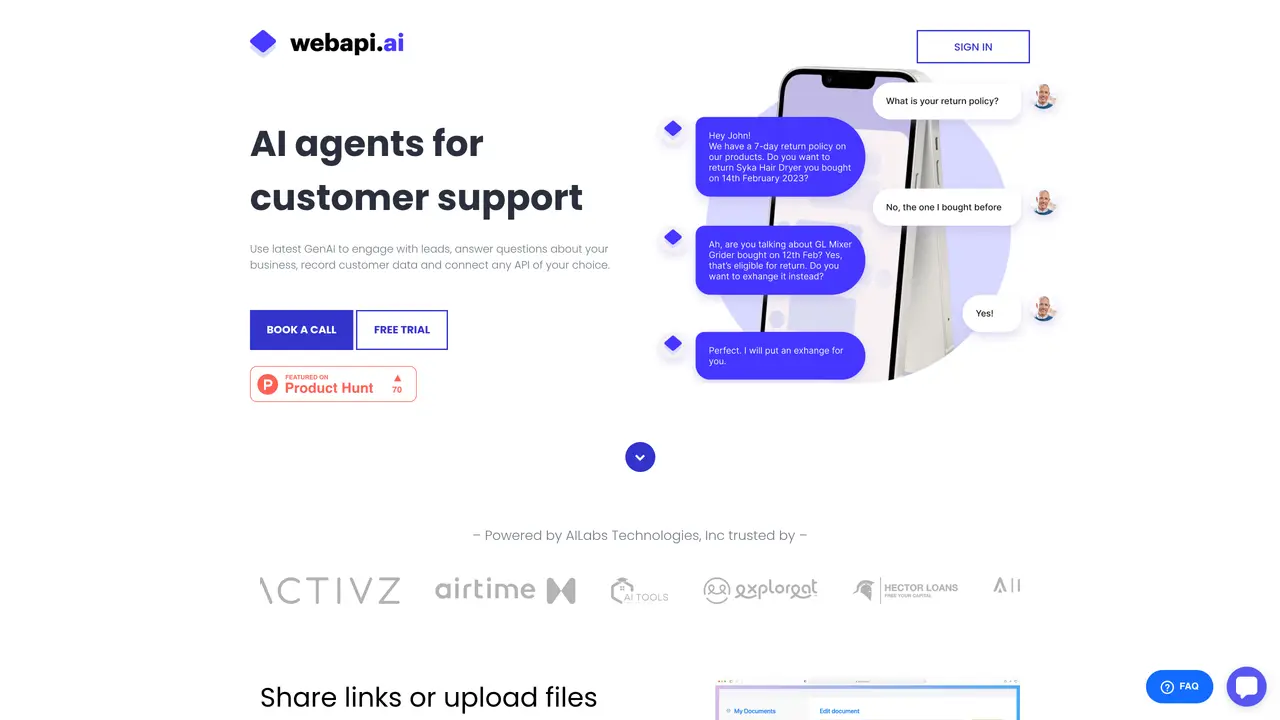
WebApiai 2.0 is the next-generation chatbot builder that makes it easier than ever to create intelligent, conversational AI-powered bots. Powered by GPT-3 based conversational AI technology, it requires only a few user-chatbot dialogue samples to start functioning. With WebApiai 2.0 you can easily create bots that understand natural language and respond to user queries in real-time. The AI-enabled technology helps users to create complex conversations with their customers, giving them the ability to quickly provide answers to frequently asked questions, while also providing more personalized customer service experience. Additionally, the platform provides advanced analytics that allow users to track user engagement and better understand customer needs. With WebApiai 2.0, businesses can quickly and easily build their own chatbots that can help them to engage with their customers better, allowing them to provide a more personalized and efficient customer service experience.
Key features
- Create chatbots that understand natural language
- Build advanced conversation flows
- Track user engagement
- Analyze customer needs
- Use GPT-3 based AI technology
- Quickly build intelligent, conversational AI-powered bots
Use cases
- Create chatbots for customer service and support
- Build conversational interfaces for websites and mobile apps
- Automate tasks and workflows with chatbot automation
Pros
- Enables deployment of AI agents for customer support using generative AI
- Supports integration with multiple channels including website, WhatsApp, Telegram, and Facebook Messenger
- Allows users to upload documents, FAQs, and business information for AI-powered responses
- Provides tools to create multi-step dialogue scenarios and API integrations for workflow automation
- Offers analytics and reporting features to track user engagement and chatbot performance
Cons
- Pricing structure is usage-based, which may lead to unpredictable costs for high-volume usage
- Requires initial setup of dialogue scenarios and domain knowledge for optimal performance
- Enterprise plan pricing is not transparent and may be prohibitive for smaller businesses
Frequently asked questions about Webapi.ai 2.0
What is Webapi.ai 2.0?
Webapi.ai 2.0 is an AI-powered platform for building conversational agents designed to engage with leads, answer customer questions, record data, and integrate with business APIs. It leverages generative AI to handle customer support, lead qualification, and workflow automation across multiple channels.
Who should use Webapi.ai 2.0?
The platform suits businesses seeking to automate customer interactions, such as support teams, sales departments, and operations managers. It is particularly useful for organizations needing multi-channel chatbots with API integrations for bookings, account management, or ticket handling.
How does Webapi.ai 2.0 work?
Users upload documents or write instructions to train the AI, then create dialogue scenarios to teach the bot multi-step conversations. The system can connect to APIs for actions like booking systems or notifications, and deploy chatbots across channels like websites, WhatsApp, or Telegram.
What integrations does Webapi.ai 2.0 support?
The platform offers built-in integrations with services like Zapier, Zendesk, Calendly, and Pabbly. It also allows users to connect their own APIs for custom workflows such as order management, ticket cancellation, or account updates.
Does Webapi.ai 2.0 require AI model training?
No, the platform does not require traditional AI model training. Users can start by providing dialogue samples or uploading documents, and the system learns from these inputs to generate responses and perform actions.
How can I get started with Webapi.ai 2.0?
Users can sign up for a free trial or a free plan to explore the platform. The process involves setting up domain knowledge, creating dialogue scenarios, and configuring API integrations or channels like websites or messaging apps.