
OpenAI builds and deploys advanced AI models like GPT-4o for autonomous agents and workflows.

AI OAuth SDK
0Popularity
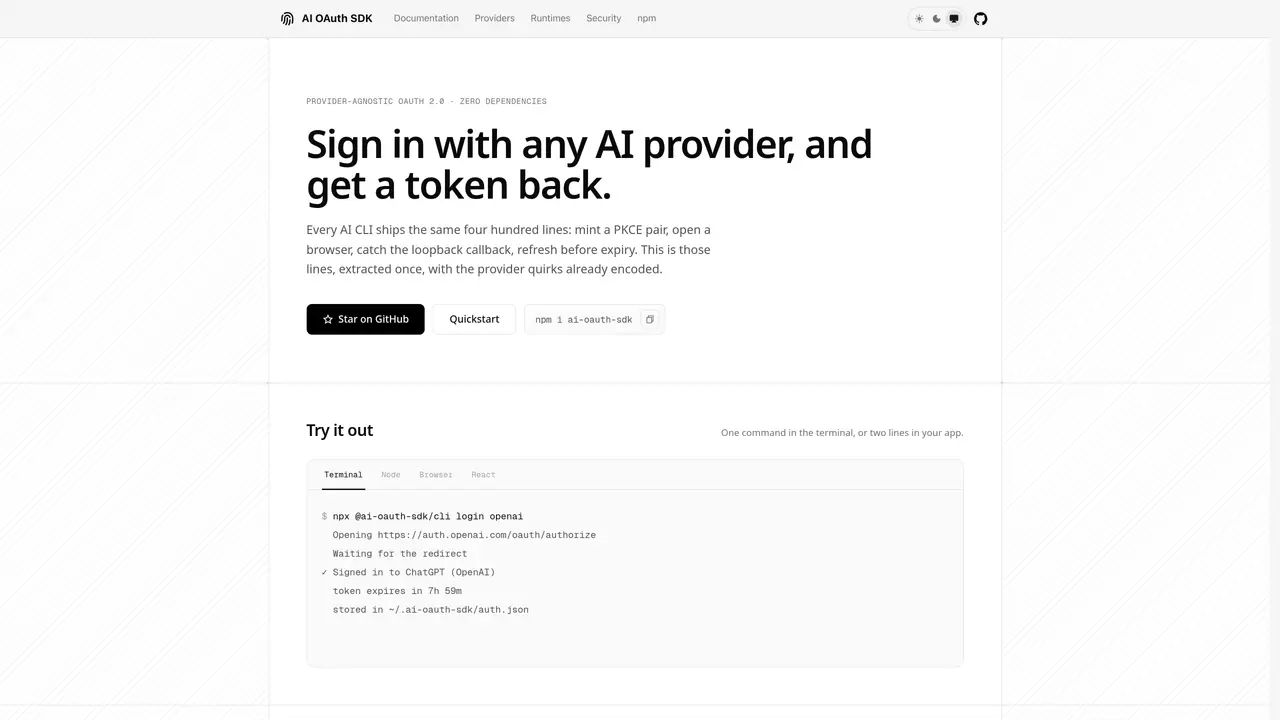
About AI OAuth SDK
AI OAuth SDK provides a unified OAuth 2.0 implementation for AI providers, abstracting the repetitive authentication flows required by different services. It handles PKCE, state management, loopback callbacks, and token refresh across providers without additional dependencies. The library supports terminal-based CLIs, Node.js, browser environments, React, React Native, and script tags, storing tokens locally with appropriate permissions. It includes built-in support for eight AI providers and allows adding custom providers through a defined interface. The core package runs on any JavaScript runtime with fetch support, while adapters provide runtime-specific functionality. The project is MIT licensed and maintained independently.
Key features
- PKCE and state management with S256 and constant-time comparison
- Loopback callback server on 127.0.0.1
- Popup and redirect browser receivers
- Device code flow for headless environments
- File-backed token storage with restricted permissions
- React bindings with observable store
- React Native support with SecureStore
- Self-contained script tag bundle
Use cases
- Authenticating AI CLI tools with multiple providers
- Adding OAuth to AI applications in browser or Node.js
- Building React or React Native apps that require AI provider authentication
Pros
- Provider-agnostic OAuth 2.0 implementation
- Zero runtime dependencies
- Built-in support for eight AI providers
- Multiple runtime targets (Node, browser, React, React Native)
- PKCE and state management enforced with security best practices
Cons
- Limited to JavaScript/TypeScript environments
- No official support for mobile platforms beyond React Native
- Requires manual handling of provider-specific terms of service
Frequently asked questions about AI OAuth SDK
What is AI OAuth SDK?
AI OAuth SDK is a provider-agnostic OAuth 2.0 library designed to simplify authentication for AI providers. It abstracts repetitive authentication flows such as PKCE, state management, loopback callbacks, and token refresh across different services.
Who should use AI OAuth SDK?
The tool is suitable for developers building AI applications or CLIs that require OAuth 2.0 authentication with multiple AI providers. It supports terminal-based CLIs, Node.js, browser environments, React, React Native, and script tags.
How does AI OAuth SDK handle token storage?
Tokens are stored locally with appropriate permissions, using file-backed storage in terminal and Node.js environments, session or local storage in browser environments, and SecureStore in React Native.
Does AI OAuth SDK support custom AI providers?
Yes, the SDK allows adding custom providers through a defined interface, while also including built-in support for eight AI providers such as OpenAI, Copilot, and Qwen.
What are the runtime requirements for AI OAuth SDK?
The core package runs on any JavaScript runtime with fetch support and has zero dependencies. Adapters provide runtime-specific functionality for terminal, Node.js, browser, React, React Native, and script tags.
Is AI OAuth SDK free to use?
Yes, the project is MIT licensed and maintained independently, making it free and open-source for use in both personal and commercial projects.