AI assistant for safe, reliable productivity with code, collaboration, and integrations.
140M visits/mo+24.5%#3 Chatbots & Assistants

AI coding agent for C and C++ that compiles, runs and verifies its own work
Be the first member to say you use it
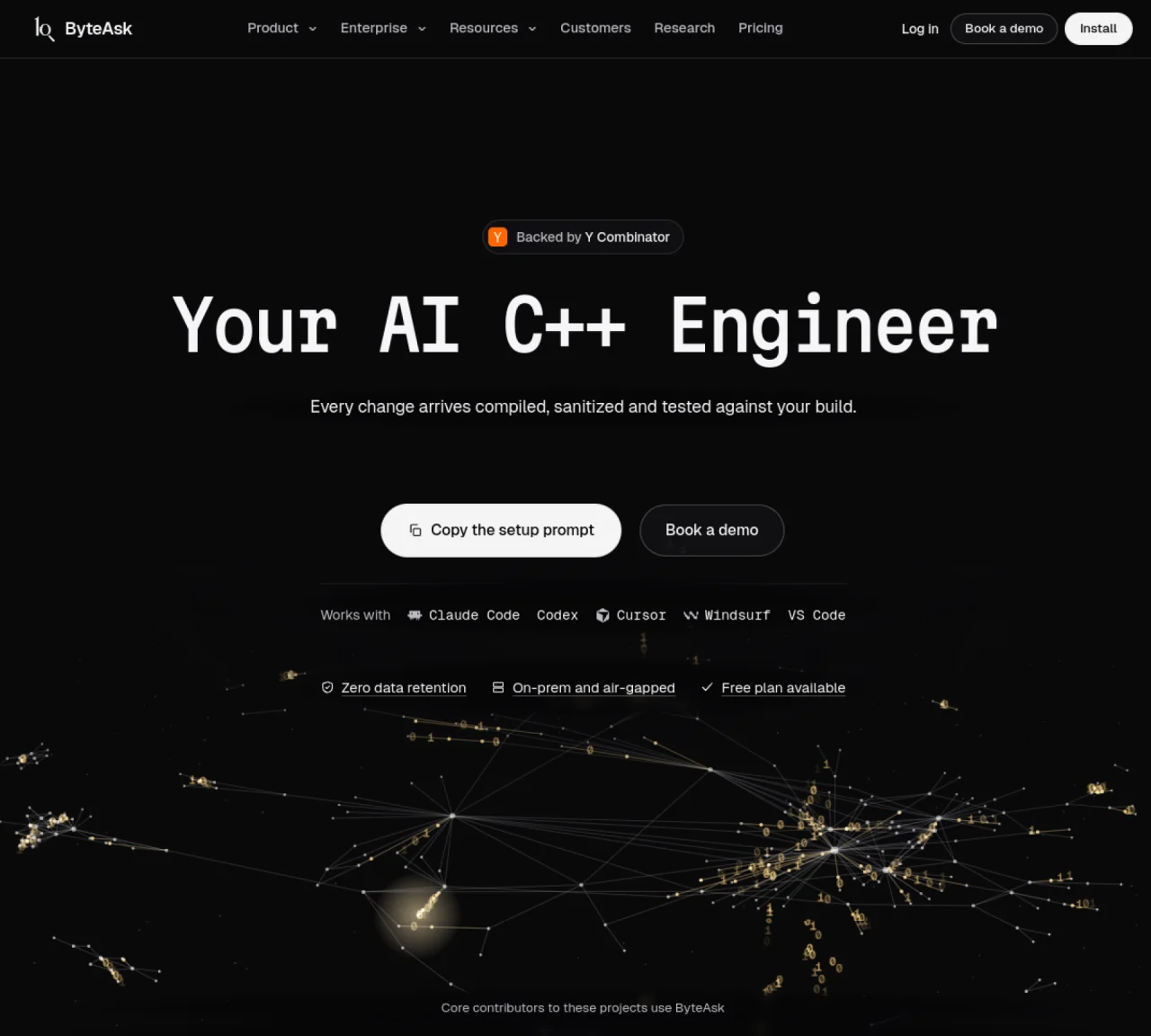
ByteAsk is an AI coding agent designed specifically for C and C++ development. It plans fixes and drives terminal editors and CI tools to implement changes, then compiles, runs, and tests the results against the user’s build system. The agent operates within the user’s environment, using their toolchain, compiler, and tests to validate each change before presenting a pull request. It focuses on the relevant functions, callers, and tests rather than the entire codebase, aiming to reduce the risk of incorrect or untrusted AI-generated output. ByteAsk supports integration with existing development workflows and tools such as VS Code, Git, GitHub, Jira, and Jenkins. It offers both cloud-based and on-premises deployment options, including air-gapped environments, and allows users to bring their own model keys. The tool emphasizes zero data retention and does not use user repositories to train models.
ByteAsk is an AI coding agent designed specifically for C and C++ development. It plans fixes, drives terminal editors and CI tools, compiles, runs, and tests changes against the user’s build system, and presents a pull request only after validation.
ByteAsk is suited for C and C++ developers, teams, and organizations that need reliable AI-assisted coding with zero tolerance for incorrect output. It is particularly useful for those working in domains like trading systems, embedded firmware, or high-performance computing.
Yes, ByteAsk supports integration with popular development tools such as VS Code, Git, GitHub, GitLab, Jira, Linear, Slack, Jenkins, and CI/CD pipelines. It works with compilers like GCC, Clang, and LLVM, as well as sanitizers and static analysis tools.
Yes, ByteAsk offers both cloud-based and on-premises deployment options, including air-gapped environments. Users can also bring their own model keys and maintain full control over their data and toolchain.
ByteAsk verifies each change by compiling, running, and testing it against the user’s build system before presenting a pull request. It focuses on relevant functions, callers, and tests, and runs sanitizers and static analysis on the affected code.
No, ByteAsk has zero data retention and does not use user repositories to train models. Prompts and code are processed to answer the request and then dropped, ensuring user privacy and security.
We use essential cookies to run aitoolnavio™, and optional cookies to analyze traffic and measure our marketing. You choose what we use — optional cookies stay off unless you turn them on. See our Privacy Policy.
One short email a week: fresh tools worth trying, honest takes and the updates that actually matter. No spam, unsubscribe any time.
AI assistant for safe, reliable productivity with code, collaboration, and integrations.
AI-powered website builder that generates a professional site in under a minute and includes tools for content, SEO, and analytics.
A free web-based AI chatbot and agent for writing, coding, research, and content creation with multilingual support.
Privacy-focused AI chatbot that generates uncensored text, code, images, and translations without storing conversations or requiring an account.
AI-powered IDE for autonomous coding tasks and agentic development workflows
Agentic development platform for building software with AI agents, offering CLI, IDE, and SDK interfaces for structured, auditable workflows.
Automate code, research, and documents using agents.
Open-source AI coding agent that runs locally to generate, debug, and refactor code across desktop, terminal, mobile, and IDEs.
Write & run code in 50+ languages, auto-complete with AI, and code faster with an intuitive interface.
An IDE that automates legacy-to-modern code migration using autonomous coding agents.
Enhance coding efficiency with AI-driven insights.
Practice coding challenges, improve technical skills, get detailed explanations, compare performance with peers.
Matched on what this tool does — grouped by the job you would be replacing.
matches Plans and implements code fixes automatically · Compiles and runs changes against production build · Runs sanitizers and static analysis on touched code
AI software engineer for automated coding solutions
An AI-driven full-stack development platform that writes, reviews, tests, and deploys code with built-in analytics and integrations.
matches Generates pull requests with verified changes · Integrates with VS Code, Git, GitHub, Jira, and other tools
matches Compiles and runs changes against production build · Runs sanitizers and static analysis on touched code
matches Plans and implements code fixes automatically · Generates pull requests with verified changes · Integrates with VS Code, Git, GitHub, Jira, and other tools
AI-powered code review and security scanning platform that automates pull request feedback and IDE reviews with one-click fixes.
AI-powered GitHub integration that automates code reviews, generates PR descriptions, and provides contextualized feedback for development teams.
AI-powered code review tool that fixes issues and validates against CI pipelines
AI-powered code reviewer that enforces team-specific standards in pull requests
Web-based regression guard that reviews every code change against the full codebase and connected systems for engineering teams.
Verifies agent-written code matches intended specifications before release
Verifies AI-written code changes against tests, policies and rules before deployment
An AI coding agent for VS Code that generates production-ready code, runs tests, debugs issues, and deploys apps from prompts.
GitHub Marketplace coding agent that turns GitHub issues into code changes and unit-tested pull requests for engineering teams.
Converts plain-language tickets into production-ready code, refactors, and pull requests while learning team coding patterns.