
OpenAI builds and deploys advanced AI models like GPT-4o for autonomous agents and workflows.

Claude Science
$17/mStarting price
0Popularity
About Claude Science
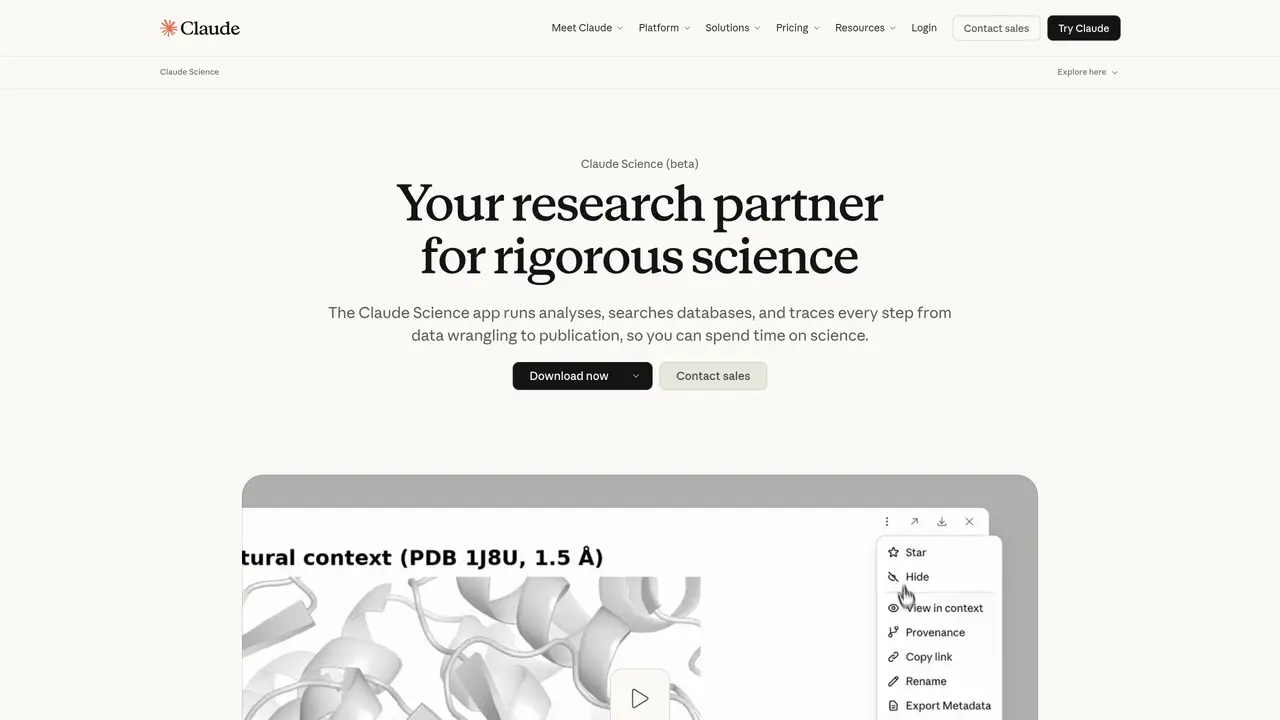
Claude Science is an agentic research environment designed for life sciences that orchestrates compute, queries scientific databases, and renders domain artifacts natively. It runs analyses end-to-end while maintaining full provenance, ensuring every output—figures, tables, or reports—is traceable to exact code, inputs, environment, and conversational context. The tool supports persistent Python and R kernels across sessions, enabling fast, reproducible iteration without restarting environments. Users can submit and manage jobs via SSH on local machines or Slurm clusters, with support for distributed GPU compute through Modal. It flags citation inconsistencies, untraceable numbers, and mismatched figures through automated background review, enhancing reliability for publication-ready outputs. Built-in connectors integrate with over 60 scientific databases and domain tools, while native viewers display structures, alignments, genomic tracks, chemical structures, and PDFs directly in the workspace. The environment manager packages dependencies per analysis, reducing maintenance burdens for long-running or parallel workflows. Team and Enterprise deployments offer centralized administration, SSO/SCIM integration, and usage controls for scalable adoption across organizations.
Key features
- Persistent Python and R kernels for reproducible iteration
- Full provenance tracking from raw data to publication artifacts
- HPC orchestration via SSH, Slurm, and Modal for distributed compute
- Native renderers for proteins, alignments, genomic tracks, and chemical structures
- Automated citation validation and provenance checks
- 60+ scientific database and tool integrations with reusable skills
- Environment packaging with exact dependencies per analysis
- Team and Enterprise deployments with SSO/SCIM and usage controls
- MacOS and Linux desktop app with domain-specific templates
- Background review for questionable citations and untraceable outputs
Use cases
- Single-cell RNA-seq analysis with traceable pipelines and publication-ready figures
- Protein modeling workflows integrating structural databases and alignment tools
- Cheminformatics projects combining chemical structure rendering with computational analysis
Pros
- Maintains full provenance for all outputs, ensuring traceability from data wrangling to publication
- Supports persistent Python and R kernels across sessions for reproducible iteration
- Includes built-in scientific renderers for proteins, structures, alignments, genomic tracks, and chemical structures
- Automatically flags citation inconsistencies, untraceable numbers, and mismatched figures
- Integrates with over 60 scientific databases and domain tools
Cons
- Currently in beta, which may include unresolved features or limitations
- Requires setup for compute management on local machines or clusters
Claude Science videos
Frequently asked questions about Claude Science
What is Claude Science?
Claude Science is an agentic research environment designed for life sciences that orchestrates compute, queries scientific databases, and renders domain artifacts natively while maintaining full provenance.
Who is Claude Science for?
It is built for scientists at academic and nonprofit research institutions, as well as teams in life sciences requiring rigorous, reproducible research workflows.
How does Claude Science handle compute and scalability?
The tool manages compute on laptops, clusters, or GPUs, including distributed GPU compute through Modal, and builds environments per analysis to reduce maintenance burdens.
Does Claude Science support team collaboration?
Yes, Team and Enterprise deployments offer centralized administration, SSO/SCIM integration, and usage controls for scalable adoption across organizations.
What types of scientific artifacts can Claude Science render?
It natively renders proteins, structures, molecules, alignments, genomic tracks, chemical structures, and PDFs directly in the workspace.
How does Claude Science ensure the reliability of outputs?
A background reviewer flags incorrect citations, untraceable numbers, and figures that don’t match their underlying code to enhance reliability for publication-ready outputs.