
OpenAI builds and deploys advanced AI models like GPT-4o for autonomous agents and workflows.

evo
$19Starting price
44Monthly visits
0Popularity
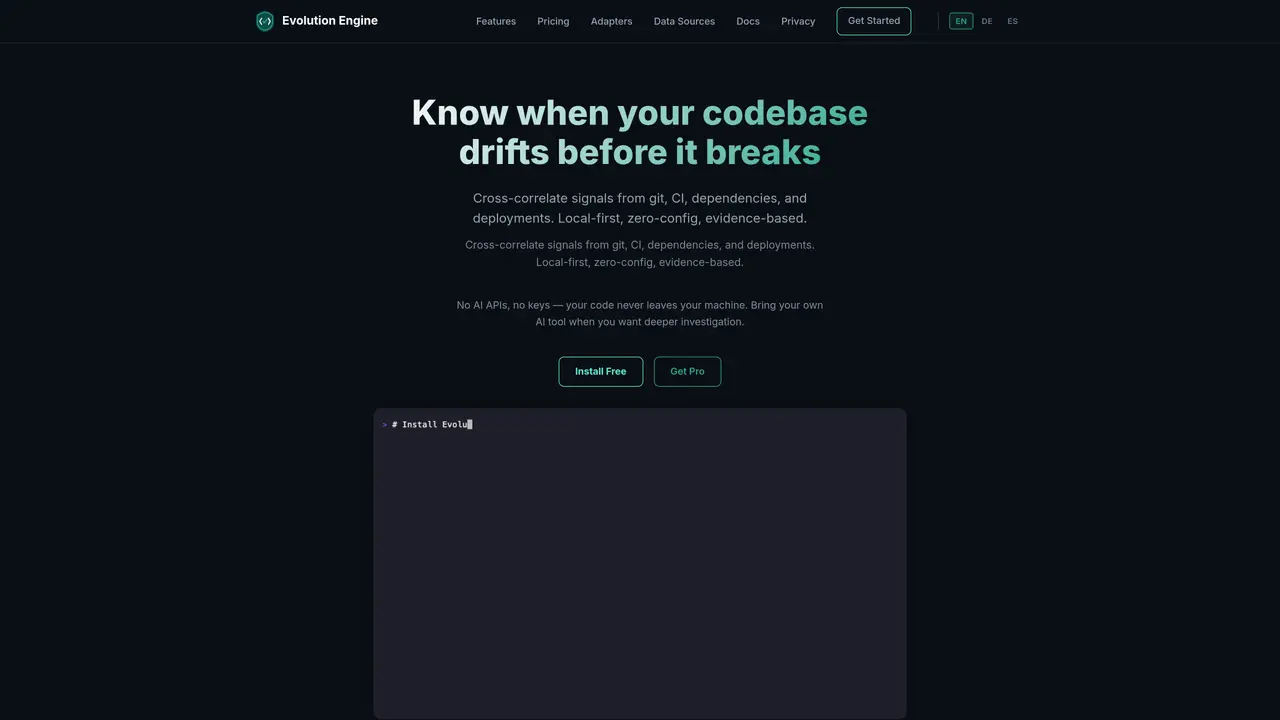
About evo
evo by CodeQual is a local-first tool designed to detect and analyze structural drift in codebases. It correlates signals from git, CI pipelines, dependencies, and deployments to identify statistically significant deviations. The tool produces evidence-based investigation prompts that can be pasted into an AI assistant for triage, suggesting fixes and verifying resolutions. evo runs zero-configuration on your machine, requiring no AI keys or external APIs, and generates interactive HTML reports. It supports an AI investigation and fix loop, making it particularly useful for teams leveraging AI coding tools. By providing early, explainable detection of codebase drift, evo offers a safe way to use AI for analysis and remediation, helping teams maintain codebase integrity and reduce technical debt.
Key features
- Local-first operation with no AI keys or external APIs required
- Correlates signals from git, CI, dependencies, and deployments
- Surfaces statistically significant deviations in codebase structure
- Generates evidence-based investigation prompts for AI assistants
- Produces interactive HTML reports for visual analysis
- Supports AI-driven triage, fix suggestions, and resolution verification
- Zero-configuration setup for immediate use
- Facilitates an AI investigation and fix loop for continuous monitoring
Use cases
- Early detection of structural drift in large codebases to prevent technical debt
- Integration with CI/CD pipelines to monitor codebase health over time
- Assisting AI coding teams in identifying and resolving deviations efficiently
Pros
- Local-first analysis ensures code and data never leave the user's machine
- Zero-configuration setup with automatic tool detection from existing configs and lockfiles
- Cross-correlates multiple data sources (git, CI, dependencies, deployments) for comprehensive drift detection
- Generates evidence-based investigation prompts for AI-assisted triage and remediation
- Extensible adapter ecosystem allows integration with a wide range of tools and data sources
Cons
- Advanced features like CI, deployment, and security signal analysis require a paid subscription
- Limited to supported adapters, which may not cover all niche or proprietary tools
Frequently asked questions about evo
What is evo and what does it do?
evo is a local-first CLI tool designed to detect and analyze structural drift in codebases by correlating signals from git, CI pipelines, dependencies, and deployments. It identifies statistically significant deviations and generates evidence-based investigation prompts for AI-assisted triage.
Who is evo suitable for?
evo is particularly useful for development teams leveraging AI coding tools who need to maintain codebase integrity and reduce technical debt. It suits teams looking for early, explainable detection of codebase drift without relying on external APIs.
Does evo require any setup or configuration?
No, evo runs zero-configuration and auto-detects tools from existing configs, lockfiles, and imports. Users only need to install the tool and run a single command to start analysis.
What data sources does evo support?
evo supports git history, dependency lockfiles (pip, npm, go, cargo, bundler), CI pipelines (GitHub Actions, GitLab CI, CircleCI), deployments (GitHub Releases, GitLab Releases), testing (JUnit XML), coverage (Cobertura XML), error tracking (Sentry), and security (Dependabot).
How does evo handle privacy and data security?
All analysis runs locally, and no code or file paths leave the user's machine. Only opt-in anonymous telemetry (command name, duration) and a hashed email for license checks are sent outbound, with no sensitive data included.
Can I extend evo to support additional tools not listed?
Yes, evo offers an open adapter ecosystem where users can create custom adapters using a scaffold tool and ship them as pip packages. The community can also request adapters based on demand.
evo Website Engagement
Last Update: 9 days ago
Total Monthly Visits
0
Bounce Rate
0%
Visit Duration (avg)
—
Pages Per Visit
0
Country Rank
—
Unknown
Global Rank
—