
OpenAI builds and deploys advanced AI models like GPT-4o for autonomous agents and workflows.

IO Inventory
0Popularity
About IO Inventory
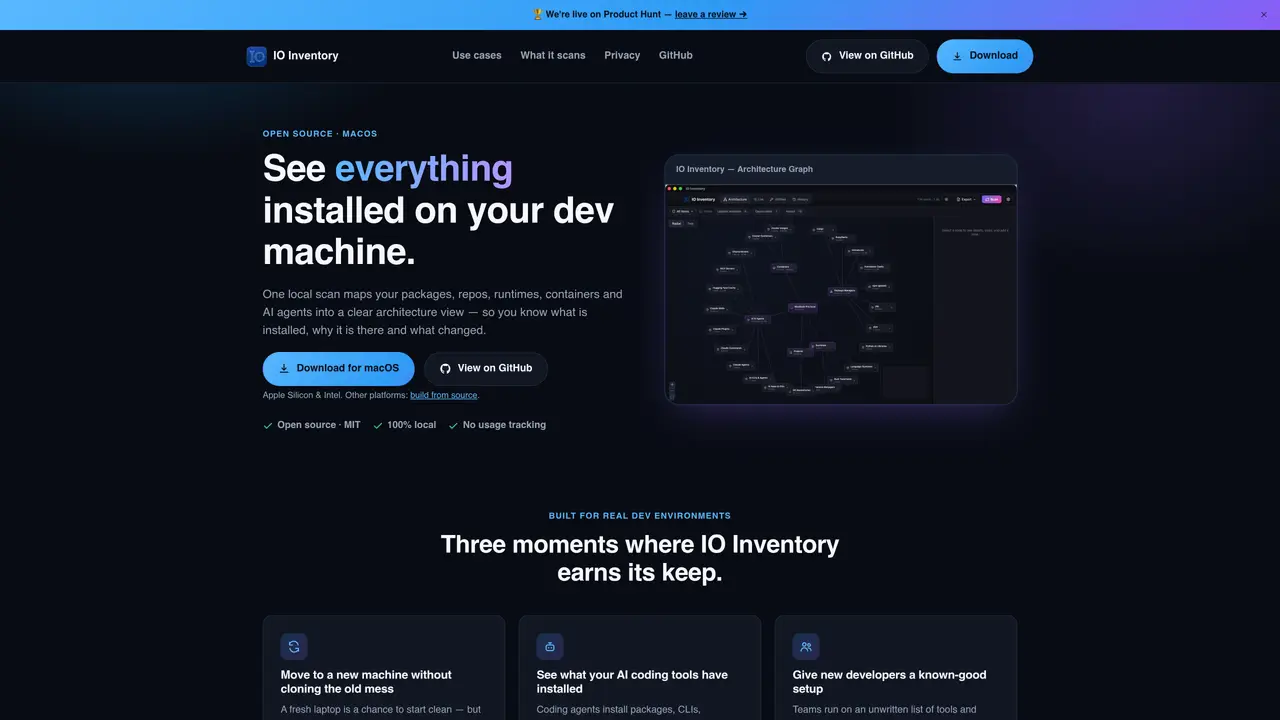
IO Inventory performs a local scan of a developer machine to map installed packages, repositories, runtimes, containers and AI agents into a clear architecture view. It shows what is installed, why it is present and what has changed between scans. The tool provides both a graph and list view to inspect and manage the environment, including support for searching, tagging, updating and uninstalling items with confirmation. Snapshots can be taken to capture the state of a machine or project, then compared to identify additions, removals or updates. IO Inventory is designed to help developers move to new machines without carrying unnecessary dependencies, onboard new team members with a known-good setup, and track changes introduced by AI coding tools. It includes a bundled MCP server to expose inventory data to compatible AI clients. The application runs entirely locally with no usage tracking or data collection.
Key features
- Local architecture graph visualization
- Snapshot creation and comparison
- Package manager and runtime detection
- AI agent and MCP server tracking
- List view with search and tagging
- Bulk install missing dependencies
- MCP server for AI client integration
- GitHub update checking
Use cases
- Moving to a new machine while preserving essential dependencies
- Onboarding new developers with a known-good environment snapshot
- Tracking changes introduced by AI coding tools
Pros
- Local execution with no data collection or tracking
- Supports multiple package managers, runtimes and AI tools
- Provides snapshot comparison to track changes over time
- Open source under MIT license
- Includes MCP server for AI client integration
Cons
- Currently available only for macOS
- Other platforms require building from source
- No built-in cloud synchronization or sharing
Frequently asked questions about IO Inventory
What does IO Inventory scan on my machine?
IO Inventory scans installed packages, repositories, runtimes, containers, AI agents, dependency manifests, and running containers. It covers package managers like Homebrew, npm, pip, and cargo, as well as tools such as Node.js, Python, Rust, Go, Docker, and AI coding agents like Claude Code, Cursor, and Ollama.
Who is IO Inventory designed for?
IO Inventory is built for developers who need visibility into their local development environment, especially those working with AI coding tools. It helps onboard new team members, migrate to new machines, and track changes introduced by AI agents.
How does IO Inventory handle data privacy?
All scans, storage, and the user interface run locally on the user's machine. No data is uploaded or tracked, and IO Inventory does not collect analytics or usage information. It only checks GitHub's public release API for updates without sending personal data.
Can IO Inventory integrate with AI coding tools?
Yes, IO Inventory includes a bundled MCP server that exposes inventory data to compatible AI clients. This allows AI tools to query the local environment, search for items, and access snapshot context, though it is read-only by default unless configured otherwise.
How do I get started with IO Inventory?
Download IO Inventory for macOS or build it from source for other platforms. Run a local scan to map your environment, then use the graph or list view to inspect, search, tag, update, or uninstall items. Snapshots can be taken and compared to track changes over time.
Does IO Inventory support bulk actions like installing missing dependencies?
Yes, IO Inventory allows users to compare snapshots and bulk-install missing dependencies. It also supports searching, tagging, updating, and uninstalling items with explicit confirmation, providing a clear overview of the local development setup.