OpenAI builds and deploys advanced AI models like GPT-4o for autonomous agents and workflows.

IT Abyss
$9/moStarting price
0Popularity
About IT Abyss
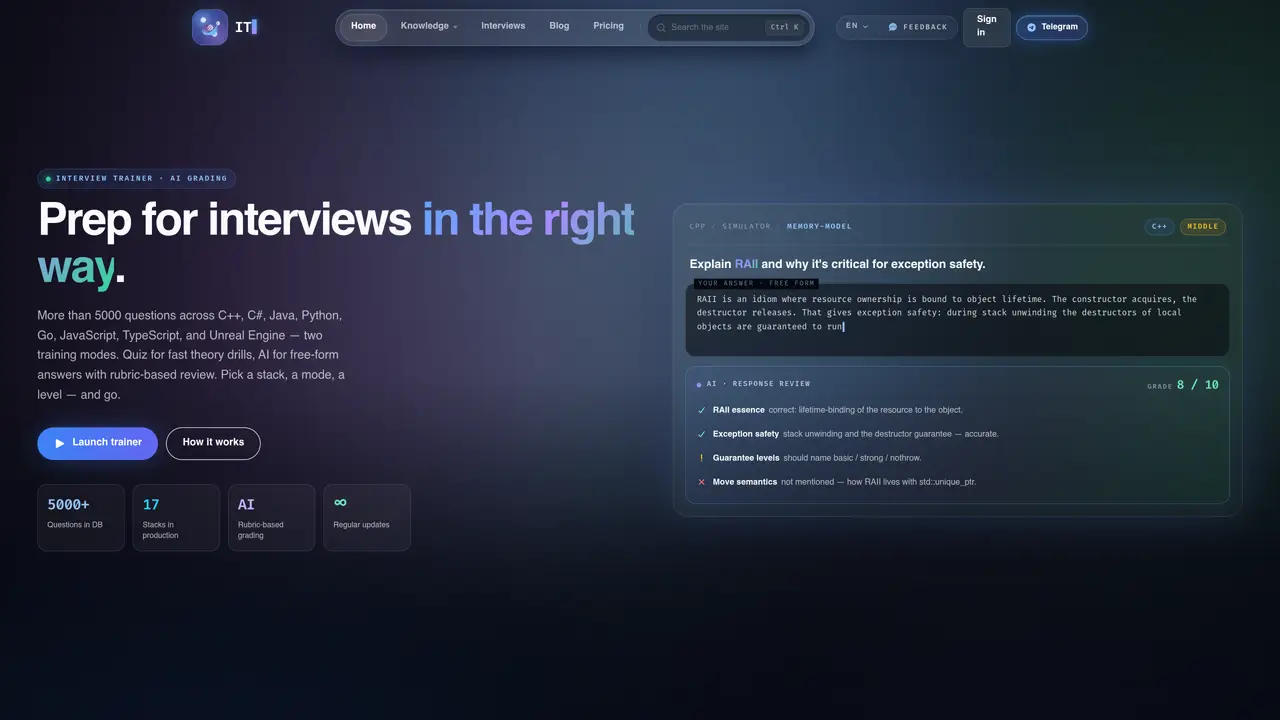
IT Abyss provides a structured learning environment for software developers preparing for technical interviews. The platform combines a question bank of over 5,000 interview questions across multiple programming languages and frameworks with two training modes: a fast quiz mode for theory drills and an AI-powered long-form mode that simulates real interview scenarios. Each answer is evaluated against a rubric aligned with junior, middle, or senior levels, offering targeted feedback rather than simple right/wrong responses. The platform includes visual progress tracking through a dependency graph that maps topics from basic concepts to advanced topics like memory models and template metaprogramming. Additional resources include roadmaps that outline learning paths, documentation on best practices and idioms, and a community section for discussions. The system supports languages such as C++, Go, Python, Java, JavaScript, TypeScript, and Unreal Engine, with regular updates to content.
Key features
- 5000+ interview questions across 17 stacks
- AI grading with level-aware rubrics
- Fast quiz mode for quick theory drills
- Long-form AI interview simulation
- Visual dependency graph for progress tracking
- Roadmap and best practices documentation
- Community access via Telegram and Discord
- Regular content updates
Use cases
- Preparing for technical interviews in software engineering
- Practicing coding questions across multiple programming languages
- Learning structured roadmaps for career development
Pros
- AI-powered grading with rubric-based feedback for free-form answers
- Visual progress tracking via dependency graph showing knowledge gaps
- Two training modes: fast quiz for theory and AI interview simulation
- Structured roadmaps and documentation for guided learning paths
- Supports multiple programming languages and frameworks
Cons
- Subscription-based model with token system for access
- Limited free tier with restricted features
- No explicit mobile application support mentioned
Frequently asked questions about IT Abyss
What programming languages and frameworks does IT Abyss support?
IT Abyss supports a wide range of programming languages and frameworks, including C++, Go, Python, C#, Java, JavaScript, TypeScript, PHP, Kotlin, Swift, Unreal Engine, and more. The platform regularly updates its content to include additional stacks.
How does the AI-powered interview trainer work?
The AI-powered interview trainer simulates real interview scenarios by presenting long-form questions where users write detailed answers. The AI evaluates responses against a rubric aligned with junior, middle, or senior levels, providing targeted feedback rather than simple right/wrong responses.
What are the two training modes available on IT Abyss?
IT Abyss offers two training modes: a fast quiz mode for theory drills and an AI-powered long-form mode that simulates real interview scenarios. The quiz mode uses multiple-choice questions to quickly test knowledge, while the AI mode focuses on free-form answers and detailed feedback.
How does IT Abyss track user progress?
IT Abyss tracks progress through a visual dependency graph that maps topics from basic concepts to advanced topics. Each question is represented as a node, with colors indicating the user's last score and sizes reflecting difficulty. Progress is automatically saved and displayed in a dashboard.
Does IT Abyss provide resources beyond interview questions?
Yes, IT Abyss includes roadmaps that outline learning paths, documentation on best practices and idioms, and a community section for discussions. These resources complement the question bank and help users build a deeper understanding of their chosen stack.
How can I get started with IT Abyss?
To get started, users can select a programming stack, choose a training mode (quiz or AI), and begin answering questions. The platform guides users through the process, offering immediate feedback and progress tracking to help identify areas for improvement.