AI-powered website builder that generates a professional site in under a minute and includes tools for content, SEO, and analytics.
52M visits/mo+0.7%#4 Coding & Development

AI platform that converts plain-language prompts into production-ready full-stack applications
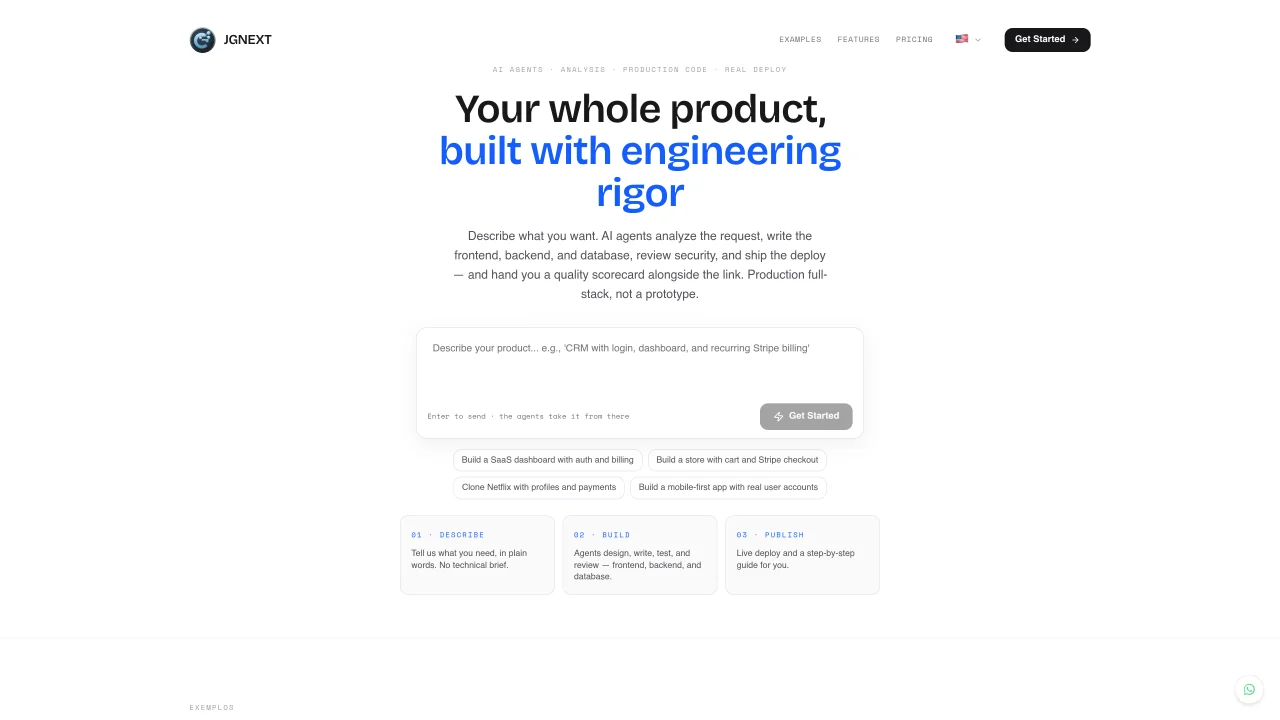
JGNEXT uses a team of specialized AI agents to transform a written description into a deployable full-stack application. The process begins with a plain-language prompt describing the desired product. AI agents then design, write, test, and review the frontend, backend, database, and deployment pipeline in a single run. The output includes a production-ready application with authentication, payment integration, and a quality scorecard. A step-by-step guide accompanies the delivered codebase, enabling users to publish and maintain the project independently. The platform supports SaaS dashboards, online stores, mobile-first apps, and landing pages, with real databases, REST APIs, and integrations like Stripe and n8n. Deployments are handled via Vercel or Fly.io with SSL, and custom domains can be configured through DNS verification.
JGNEXT is an AI-powered platform that transforms plain-language descriptions into production-ready full-stack applications. It uses specialized AI agents to design, write, test, and deploy frontend, backend, database, and deployment pipeline components in a single workflow.
The tool is designed for entrepreneurs, startups, and developers who need to quickly build and deploy functional applications without writing extensive code. It suits those who want to validate ideas, launch SaaS products, or create mobile-first apps efficiently.
JGNEXT deploys applications via Vercel or Fly.io with SSL certificates included. Users can configure custom domains through DNS verification, and the platform provides a step-by-step guide for publishing and maintaining the project independently.
Yes, JGNEXT includes built-in integrations for Stripe for payments and n8n for automations with over 400 third-party tools. These integrations are pre-configured and tested as part of the generated application.
Users can build SaaS dashboards, online stores, mobile-first apps, and landing pages. Each project includes authentication, real databases (PostgreSQL, MongoDB, or Redis), and a quality scorecard for evaluation.
JGNEXT uses an evaluator agent to grade the application across dimensions like security, database design, and integrations. The platform also provides a quality scorecard that estimates the market value of the delivered project.
We use essential cookies to run aitoolnavio™, and optional cookies to analyze traffic and measure our marketing. You choose what we use — optional cookies stay off unless you turn them on. See our Privacy Policy.
One short email a week: fresh tools worth trying, honest takes and the updates that actually matter. No spam, unsubscribe any time.
AI-powered website builder that generates a professional site in under a minute and includes tools for content, SEO, and analytics.
AI-powered coding platform that uses agents to plan, write, and test software with real-time feedback and verifiable artifacts.
Automate code, research, and documents using agents.
AI-powered code assistant that generates, reviews, optimizes, and debugs code with natural language prompts and editor integrations.
AI assistant for safe, reliable productivity with code, collaboration, and integrations.
AI-powered IDE for autonomous coding tasks and agentic development workflows
Privacy-focused AI chatbot that generates uncensored text, code, images, and translations without storing conversations or requiring an account.
A free web-based AI chatbot and agent for writing, coding, research, and content creation with multilingual support.
Write & run code in 50+ languages, auto-complete with AI, and code faster with an intuitive interface.
An IDE that automates legacy-to-modern code migration using autonomous coding agents.
AI models that return typed decisions with calibrated confidence for software automation
Practice coding challenges, improve technical skills, get detailed explanations, compare performance with peers.
Matched on what this tool does — grouped by the job you would be replacing.
matches Production-ready full-stack apps with React, Next.js, Node, Python, and REST APIs · Converts plain-language prompts into production-ready full-stack applications
AI-native builder that turns prompts into full-stack web apps, syncs to GitHub, and deploys to Vercel in seconds with visual editing.
Turn natural language into full-stack apps, SaaS products, and websites without coding using an AI-powered no-code builder.
Turn plain-English prompts into production-ready full-stack React/Next.js apps with one-click deployment.
Builds software and AI apps from plain English instructions without coding
matches Real databases (PostgreSQL, MongoDB, Redis) with Prisma and migrations · Auto-generates production-ready Postgres databases · Creates typed CRUD APIs (REST/GraphQL)
matches AI agents for strategy, code, marketing, sales, operations, and support · Customer support agent for WhatsApp, Telegram, Instagram, Facebook, and email · Automations via n8n with 400+ integrations (email, CRM, spreadsheets)
Open-source backend platform providing Postgres, authentication, APIs, and real-time features to build scalable apps quickly.
AI-native no-code database platform that turns plain-English prompts into spreadsheets, apps, and automations on PostgreSQL.
Turns frontend code into a production-ready backend with Postgres, APIs, auth, and edge functions automatically.
Unified AI agents for customer conversations and CRM updates across messengers
AI-powered business automation and custom digital solutions
Custom AI agents, n8n workflows and chatbots for business process automation