OpenAI builds and deploys advanced AI models like GPT-4o for autonomous agents and workflows.

Opik
$19/moStarting price
0Popularity
About Opik
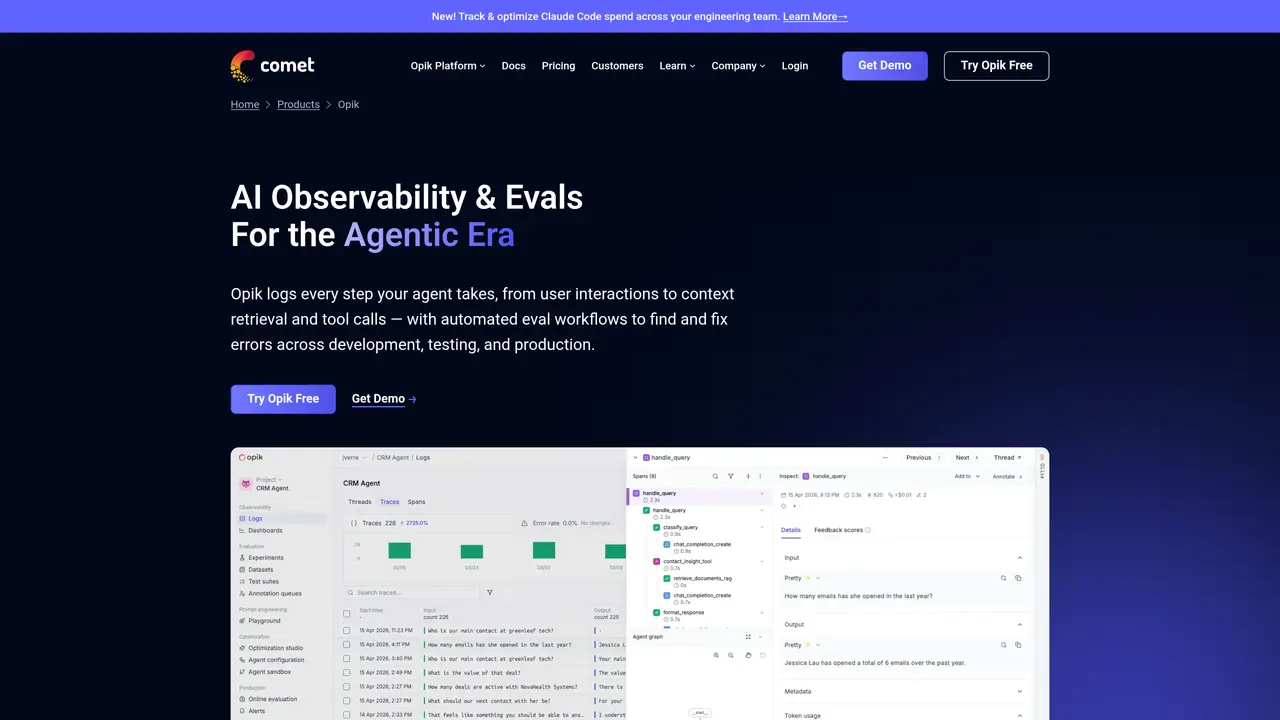
Opik provides end-to-end observability for AI agents by logging every step from user interactions to tool calls and model responses. It supports automated evaluation workflows to identify and resolve errors across development, testing, and production environments. The platform includes features for tracing, debugging, prompt management, and production monitoring, enabling teams to scale agents from prototype to production with confidence. Opik offers LLM-as-a-judge evaluation metrics, real-time production monitoring, and cost intelligence tools to track token usage and model spending. It also provides an AI debugging assistant called Ollie for automated fixes and a prompt optimizer with six algorithms for performance tuning. The tool is designed for both individual developers and large organizations, with open-source, cloud, and enterprise deployment options.
Key features
- Agent tracing and execution graph visualization
- Automated evaluation with LLM-as-a-judge metrics
- Test Suites and assertions for unit testing
- Agent Playground for end-to-end testing
- Ollie AI debugging assistant for automated fixes
- Prompt optimizer with six algorithms
- Token and cost tracking for model usage
- Multi-media logging (images, videos, audio)
Use cases
- Debugging and optimizing AI agent performance in production
- Tracking and reducing coding agent costs across engineering teams
- Evaluating and improving LLM responses with automated metrics
Pros
- Open-source core feature set available for local deployment
- Supports agent tracing, debugging, and automated evaluation
- Includes LLM-as-a-judge metrics and prompt optimization
- Provides cost intelligence for tracking coding agent spend
- Offers free tier with no credit card required
Cons
- Enterprise features require contact for custom pricing
- Pro plan has usage limits (100k spans per month)
- No explicit mention of mobile or offline support
Frequently asked questions about Opik
What is Opik and what does it do?
Opik is an open-source AI observability platform designed for the agentic era. It logs every step of an AI agent's workflow, from user interactions to tool calls and model responses, while providing automated evaluation workflows to identify and resolve errors across development, testing, and production environments.
Who should use Opik?
Opik is suitable for both individual developers and large organizations. It is particularly useful for teams building and scaling AI agents, as well as engineering teams managing coding agents like Claude Code or Codex.
Does Opik offer a free tier?
Yes, Opik provides a generous free tier that does not require a credit card to sign up. The platform also offers open-source, cloud, and enterprise deployment options.
What features does Opik include for debugging and optimization?
Opik includes features such as end-to-end tracing, debugging with an AI assistant called Ollie, prompt management, LLM-as-a-judge evaluation metrics, and a prompt optimizer with six algorithms for performance tuning.
How does Opik help with production monitoring?
Opik enables real-time monitoring of AI agents in production, allowing teams to evaluate traces, receive alerts for failures, apply guardrails to block content and policy violations, and track token usage and model costs for optimization.
Can Opik integrate with other tools or platforms?
Opik is designed to work with a variety of AI agent workflows and can be deployed in different environments, including open-source, cloud, and enterprise setups. It also supports collaboration features for teams to annotate and fix traces.