OpenAI builds and deploys advanced AI models like GPT-4o for autonomous agents and workflows.

Splyntra
FreeStarting price
0Popularity
About Splyntra
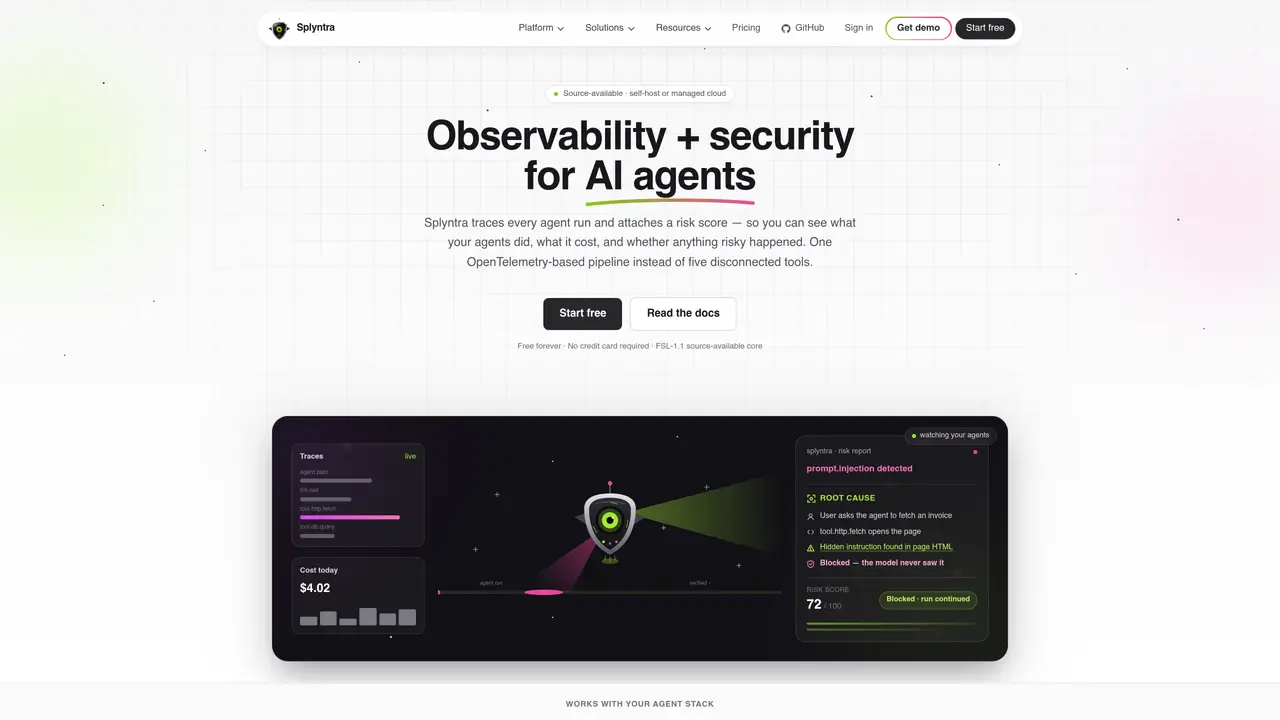
Splyntra provides observability, monitoring and security for AI agents by tracing every agent run and attaching a risk score. It consolidates execution, cost, quality and risk into a single OpenTelemetry-based pipeline instead of using multiple disconnected tools. The platform records every reasoning step, model completion, tool invocation and state transition on a continuous timeline, enabling users to see what agents did, how long it took, what it cost and whether anything risky occurred. Splyntra supports integration with common AI agent frameworks such as LangGraph, CrewAI, OpenAI Agents SDK, LlamaIndex, AutoGen and Dify, as well as any custom agent pipeline exporting OTLP traces. It includes features for secret and PII detection with automatic redaction, prompt-injection detection, cost analytics, datasets for evaluation, regression and CI gates, and governance controls like spend limits, approvals and a policy engine. The platform is available as a source-available core for self-hosting or as a managed cloud service, with enterprise features including compliance reports, SSO/SAML/SCIM and multi-tenant support.
Key features
- End-to-end tracing of agent runs
- Cost analytics per run, model and project
- Secret and PII detection with automatic redaction
- Prompt-injection detection in inputs and tool calls
- Datasets, scorers and CI regression gates
- Spend controls, approvals and policy engine
- Immutable audit ledger and compliance reports
- Agent identity and SSO/SAML/SCIM support
Use cases
- Monitoring production AI agents for debugging and performance analysis
- Detecting and preventing prompt injection and data leakage in agent workflows
- Enforcing governance policies, spend limits and approval workflows for agent deployments
Pros
- OpenTelemetry-native tracing for agents, LLM calls, tool calls and retrieval
- Unified pipeline combining execution, cost, quality and risk metrics
- Secret and PII detection with automatic redaction
- Prompt-injection detection integrated into the pipeline
- Source-available core with self-hosting option
Cons
- Beta status for prompt-injection detection
- Limited event retention in lower tiers (7 to 90 days)
- No free tier beyond the basic free plan
- Enterprise features require custom pricing
Frequently asked questions about Splyntra
What is AI agent observability and how is it different from LLM monitoring?
AI agent observability monitors non-deterministic, multi-step, tool-calling agents across graph state transitions, external API parameters, and sub-agent delegations. Unlike single-turn LLM chatbots, autonomous agents require distributed OpenTelemetry tracing, FinOps loop circuit breakers, and real-time security risk scoring on every span.
How does Splyntra trace and monitor AI agents in production?
Splyntra uses standard OpenTelemetry GenAI semantic conventions to record every reasoning step, model completion, and tool invocation on one continuous timeline. Users can auto-instrument frameworks using the Splyntra SDK or point any standard OpenTelemetry exporter directly to Splyntra.
Which AI agent frameworks does Splyntra support?
Splyntra natively integrates with LangGraph, CrewAI, OpenAI Agents SDK, LlamaIndex, AutoGen, Dify, and any custom agent pipeline exporting OTLP traces.
How does Splyntra detect prompt injection in autonomous agents?
Splyntra inspects data flows at multiple points to identify hidden instructions or malicious inputs, flagging prompt-injection attempts in both inputs and tool calls.
Can Splyntra be self-hosted or is it only available as a cloud service?
Splyntra is available as a source-available core for self-hosting or as a managed cloud service, allowing users to choose based on their infrastructure and compliance needs.
Does Splyntra provide compliance reports for audits?
Yes, Splyntra generates auditor-ready evidence reports mapped to frameworks such as SOC 2, EU AI Act, and NIST AI RMF, derived directly from the activity ledger and policy data.