GitHub hosts HunyuanVideo, Tencent's open-source framework for large-scale video generation models, enabling AI-driven video creation.

Langfuse
$4Starting price
829KMonthly visits
49Popularity
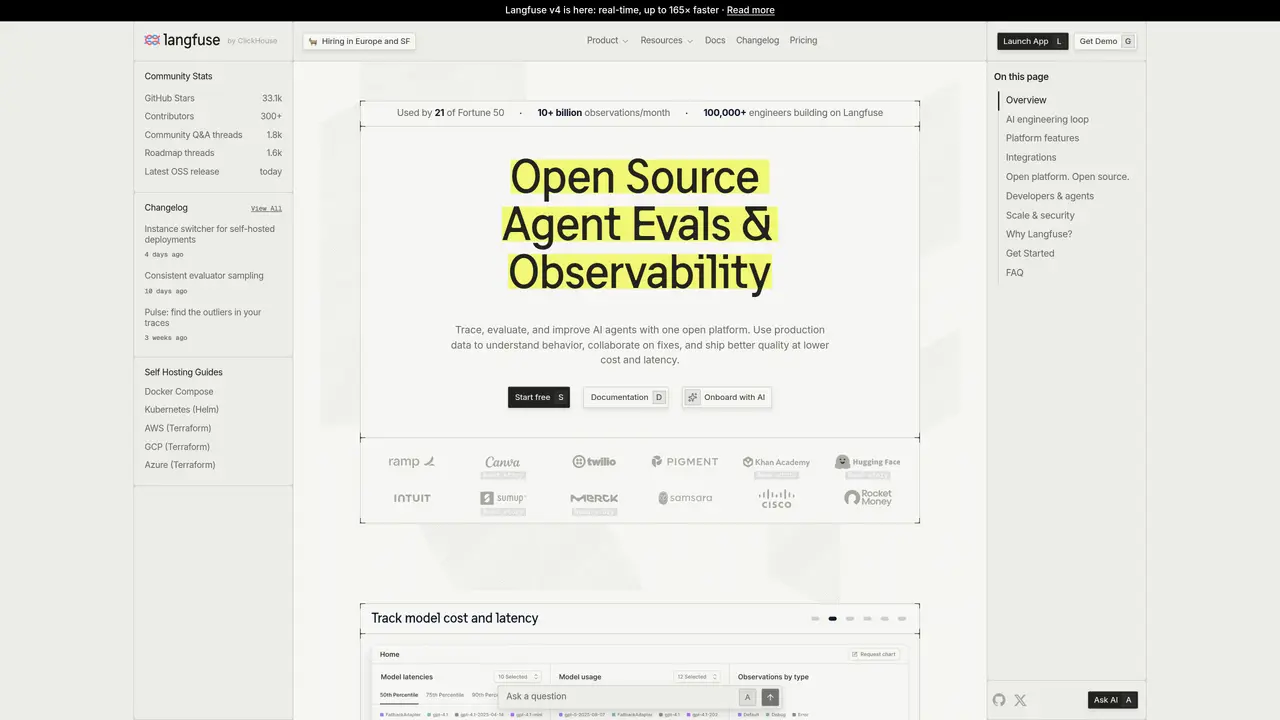
About Langfuse
Langfuse is a platform designed for developers and engineers working with large language model (LLM) applications. It provides tools for tracing, evaluation, prompt management, and metrics to help users debug, analyze, and improve their applications effectively. The platform supports developers in identifying issues, tracking performance, and refining prompts to enhance model outputs. It is particularly useful for teams building and maintaining LLM-based solutions, offering insights into application behavior and data. Langfuse also caters to data scientists and enterprises seeking secure and compliant solutions for managing language models. Its features are tailored to streamline the development lifecycle of AI-driven applications, from debugging to optimization.
Key features
- LLM application tracing
- Prompt management and optimization
- Performance metrics and analytics
- Debugging tools for LLM outputs
- Evaluation and testing capabilities
- Secure and compliant infrastructure
- Open-source option available
- Comprehensive data analysis tools
Use cases
- Debugging LLM applications
- Analyzing LLM data and performance
- Optimizing application prompts
Pros
- Provides end-to-end AI engineering observability with tracing, evaluation, prompt management, and metrics in one platform
- Supports hierarchical traces capturing every LLM call, tool invocation, and retrieval step with filtering by user, session, cost, latency, or custom metadata
- Offers open-source core with MIT licensing and self-hosting options via Docker, Kubernetes, AWS, GCP, and Azure
- Integrates with over 100 frameworks, model providers, and tools including LangChain, OpenAI, Anthropic, and Vercel AI SDK
- Includes collaborative features like human annotation, experiments, and a built-in AI assistant for automated debugging and optimization
Cons
- May require technical expertise to fully leverage advanced features like custom evaluators or self-hosting configurations
- Self-hosted deployments demand infrastructure management and maintenance responsibilities
- Real-time performance improvements depend on underlying infrastructure and data volume
Frequently asked questions about Langfuse
What is Langfuse and what does it do?
Langfuse is an open-source platform for LLM observability, prompt management, evaluation, and experimentation. It helps teams trace, debug, and improve AI applications by capturing hierarchical traces, managing prompts, running evaluations, and monitoring cost and latency.
Who should use Langfuse?
Langfuse is designed for developers, data scientists, and enterprises building and maintaining LLM-based applications. It supports teams working with any language, framework, or model provider through integrations and OTel instrumentation.
How does Langfuse handle data and integrations?
Langfuse supports over 100 integrations with frameworks like LangChain, Vercel AI SDK, and model providers such as OpenAI and Anthropic. It also offers self-hosting options and open APIs for data portability, ensuring no vendor lock-in.
Can Langfuse be used for agent workflows?
Yes, Langfuse provides tools for tracing, evaluating, and improving AI agents, including collaborative human-in-the-loop workflows and automated investigation via the Langfuse Assistant. It also supports coding agents through SKILL.md, CLI, and MCP integrations.
Is Langfuse free to use?
Langfuse offers an open-source version with core features available under the MIT license. It also provides a hosted platform with additional capabilities, and users can self-host the software for full control over their data.
How do I get started with Langfuse?
Users can start by ingesting traces using OpenAI, LangChain, or the native SDKs, following the step-by-step guide provided in the documentation. The platform also offers in-app tutorials, workshops, and community resources for onboarding.
Langfuse Website Engagement
Last Update: 9 days ago
Total Monthly Visits
0
Bounce Rate
0%
Visit Duration (avg)
0.00s
Pages Per Visit
0
Country Rank
0
United States
Global Rank
0
Category Rank
#0
Computers Electronics & Technology
Monthly Traffic
Traffic Sources
Traffic Share By Country
- United States15.6%
- China12.2%
- India9.7%
- Vietnam9.4%
- Germany8%