
OpenAI builds and deploys advanced AI models like GPT-4o for autonomous agents and workflows.

Project CodeNet by IBM
0Popularity
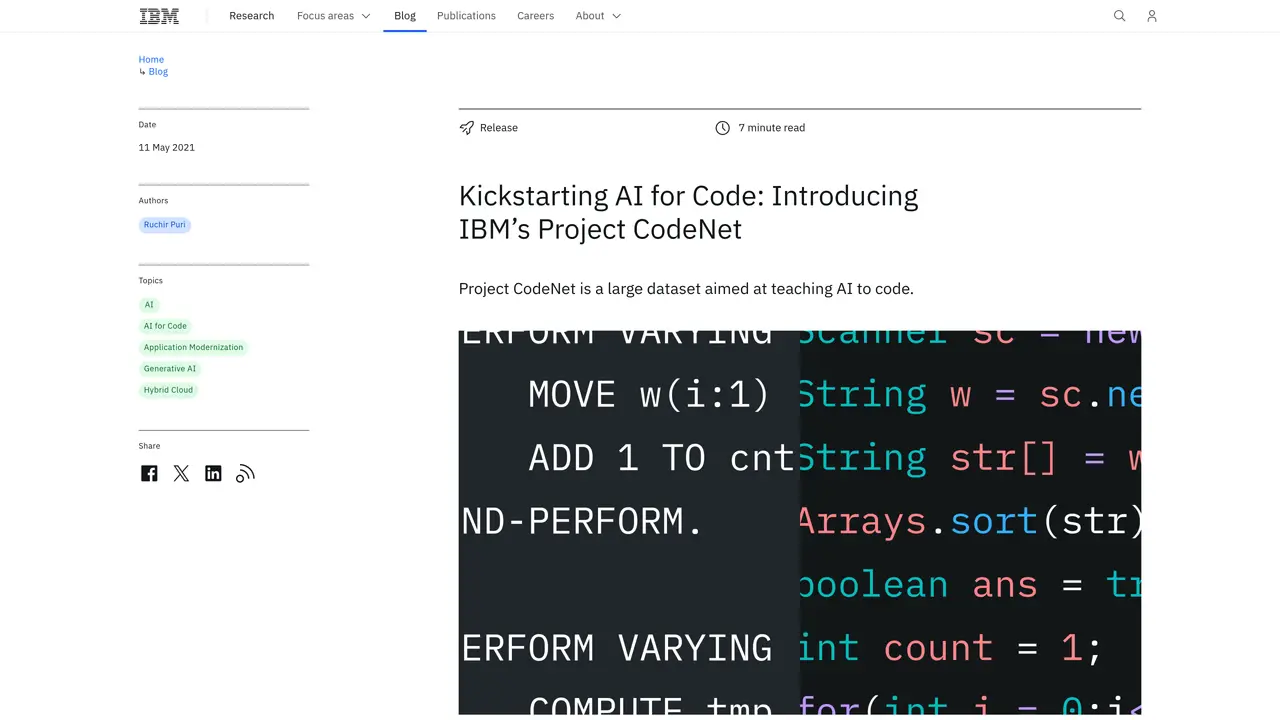
About Project CodeNet by IBM
Project CodeNet by IBM is a revolutionary AI-powered code search engine designed to help developers and researchers quickly find the information they need. It uses a powerful deep learning model to understand code and natural language, allowing users to search for code snippets, algorithms, and datasets. The results are presented in a graphical user interface that provides easy access to relevant information.With Project CodeNet, users can quickly find answers to their coding questions and gain insight into new technologies and techniques. It enables developers to explore different coding approaches and apply the best techniques in their own projects. And researchers can quickly locate datasets and algorithms to use in their research.Project CodeNet is an invaluable resource for developers, researchers, and students. With its AI-powered search engine, users can quickly locate code snippets, algorithms, and datasets, allowing them to stay up to date with the latest technologies and techniques.
IBM
Armonk, United States · Founded 1911
- Founders
- Charles Ranlett Flint, Thomas John Watson, Sr.
- Founded
- 1911
- Headquarters
- Armonk, United States
- Legal status
- Public company
Key features
- AI-powered search engine
- Code snippet searching
- Algorithm searching
- Dataset searching
- Coding approach exploration
- Resource location for research
Use cases
- Developers can quickly find answers to their coding questions and gain insight into new technologies and techniques.
- Researchers can quickly locate datasets and algorithms to use in their research.
- Students can stay up to date with the latest technologies and techniques using Project CodeNet's AI-powered search engine.
Pros
- Large-scale dataset with 14 million code samples across 55+ programming languages
- Rich metadata including problem descriptions, input/output samples, CPU run time, and memory footprint
- Supports code search, clone detection, and automatic code correction through labeled acceptance status
- Enables AI-driven code translation and intent equivalence verification
- Acts as a benchmark dataset for source-to-source translation, similar to ImageNet for computer vision
Cons
- Primarily a dataset rather than a ready-to-use tool, requiring technical expertise to implement
- Limited real-time functionality as it is not a live search engine but a curated dataset
- High computational requirements for processing and analyzing the dataset
- Focuses on competitive programming code, which may not fully represent real-world software development scenarios
Frequently asked questions about Project CodeNet by IBM
What is Project CodeNet by IBM?
Project CodeNet is a large-scale dataset designed to advance AI for code understanding and generation, consisting of 14 million code samples and 500 million lines of code across over 55 programming languages.
Who should use Project CodeNet?
It is intended for researchers, developers, and organizations focused on AI-driven code analysis, translation, modernization, and automation in software development and IT infrastructure.
How can Project CodeNet be used in practice?
The dataset supports applications like code search, clone detection, automatic code correction, source-to-source translation, and benchmarking AI models for code-related tasks.
What makes Project CodeNet unique compared to other code datasets?
It includes high-quality metadata such as problem descriptions, input/output samples, acceptance status, CPU run time, and memory footprint, enabling richer AI training and evaluation.
Does Project CodeNet support multiple programming languages?
Yes, it covers a wide range of languages, including modern ones like Python, Java, and Go, as well as legacy languages such as COBOL, Pascal, and FORTRAN.
Can Project CodeNet help with legacy code modernization?
Yes, its diverse code samples and metadata can assist in refactoring, translating, and modernizing legacy software systems for cloud-native environments.