
OpenAI builds and deploys advanced AI models like GPT-4o for autonomous agents and workflows.

Pruve
$99Starting price
0Popularity
About Pruve
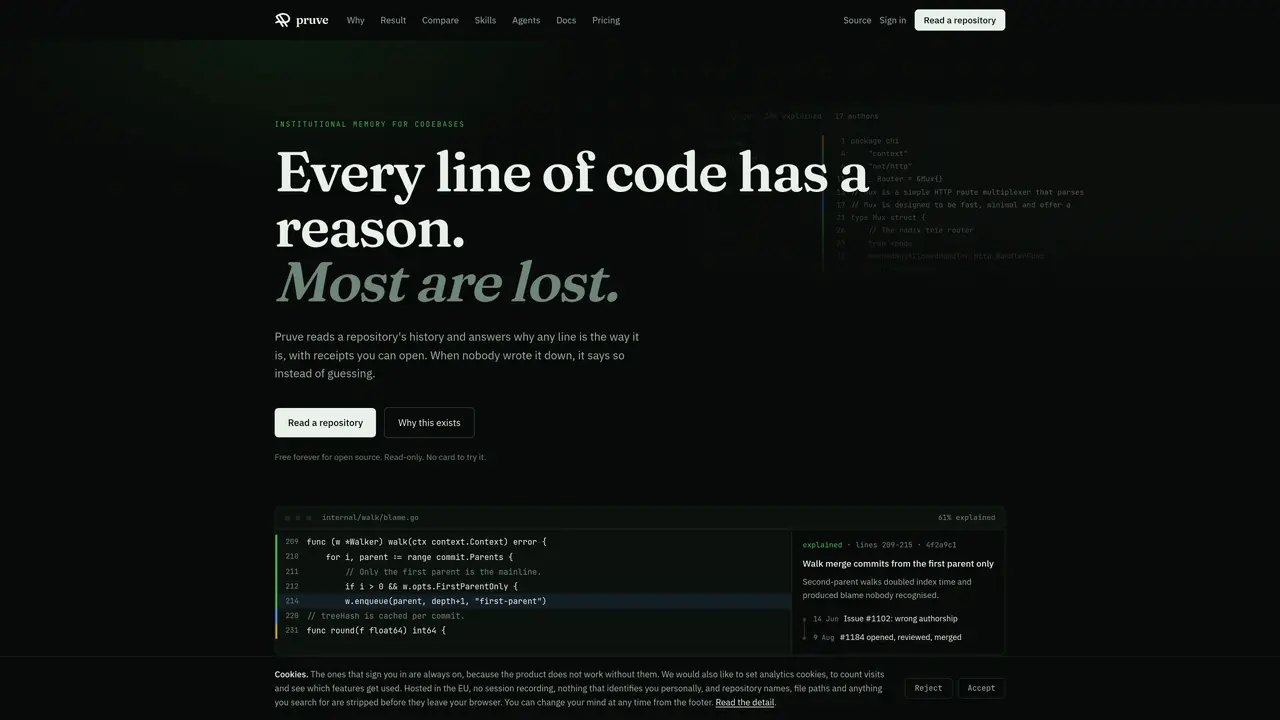
Pruve indexes the full commit history of a connected GitHub or GitLab repository to provide line-level explanations for code. It reads every commit, pull request, issue, review comment, and agent session to reconstruct the reasoning behind each change. The tool displays a visual gutter in the code browser indicating whether each line can account for itself, with clickable receipts linking directly to the original discussions or benchmarks. Coverage metrics show how much of a codebase has documented reasoning at file, folder, or repository level. Pruve operates read-only and does not modify repositories, focusing on preserving institutional knowledge that is otherwise lost during merges or personnel changes. It is designed for teams that need to understand legacy code, onboard new developers, or audit decisions without relying on tribal knowledge.
Key features
- Repository history indexing
- Line-level reasoning with receipts
- Coverage metrics per repository, folder, or file
- Code browser gutter indicating documented lines
- Cross-repository search across recorded reasoning
- Agent integration via MCP tools
- Pull request gate for enforcing reasoning requirements
- Weekly digest for team updates
Use cases
- Onboarding new developers to legacy codebases
- Auditing decisions in critical code paths
- Debugging issues by tracing original reasoning
Pros
- Preserves institutional knowledge by capturing reasoning behind code changes
- Provides line-level explanations with direct links to original discussions or benchmarks
- Offers coverage metrics to identify undocumented parts of a codebase
- Read-only operation that does not modify repositories
- Supports agent integration via MCP for automated reasoning queries
Cons
- Requires GitHub or GitLab repository connection
- No free tier for private repositories beyond open source allowance
- Pricing is per organisation, not per user
- Agent features require separate model keys for Enterprise plan
Frequently asked questions about Pruve
What does Pruve do?
Pruve indexes the full commit history of a connected GitHub or GitLab repository to provide line-level explanations for code. It reconstructs the reasoning behind each change by reading commits, pull requests, issues, review comments, and agent sessions, displaying whether each line can account for itself with clickable receipts.
Who is Pruve designed for?
Pruve is designed for teams that need to understand legacy code, onboard new developers, or audit decisions without relying on tribal knowledge. It is particularly useful for maintaining institutional knowledge during personnel changes or merges.
How does Pruve work?
Pruve operates in three steps: connect a repository, open any line in the web app or via a GitHub extension, and read the reasoning behind the code. It indexes repository history, tracks changes, and provides coverage metrics to show how much of a codebase has documented reasoning.
Does Pruve modify repositories?
No, Pruve operates read-only and does not modify repositories. It focuses solely on preserving and presenting institutional knowledge without altering the codebase.
Can Pruve integrate with agents or other tools?
Yes, Pruve exposes its functionality over MCP with eight read-only tools, allowing agents to query the reasoning behind code before making changes. It also tracks dependencies and their associated decisions within a repository.
How do I get started with Pruve?
To get started, connect a GitHub or GitLab repository to Pruve. Once connected, you can open any line in the web app or through the GitHub extension to view explanations and receipts for the code. No card is required to try it.