
OpenAI builds and deploys advanced AI models like GPT-4o for autonomous agents and workflows.

Strix
$29/mStarting price
0Popularity
About Strix
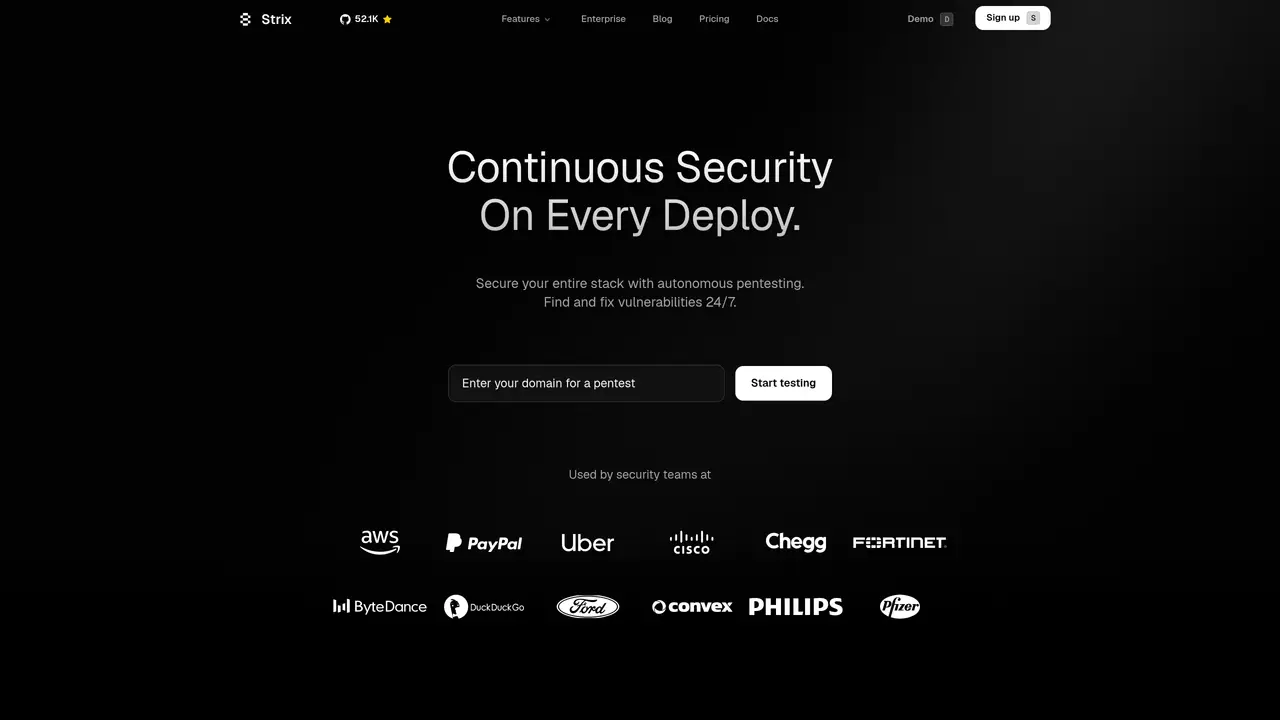
Strix is an AI penetration testing tool designed to simulate cyberattacks on applications to identify security vulnerabilities. It generates proof-of-concept exploits to validate findings and provides automatic fixes that can be applied directly. The tool is tailored for developers and security teams seeking to enhance application security efficiently. By automating parts of the penetration testing process, Strix reduces the time required to detect and address vulnerabilities. It integrates into existing workflows, allowing teams to validate security issues with real exploits and generate production-ready patches. The tool is particularly useful for continuous security testing and can be incorporated into CI/CD pipelines to maintain robust security standards throughout development cycles.
Key features
- Simulates cyberattacks to identify security flaws
- Generates proof-of-concept exploits for vulnerability validation
- Provides automatic fixes for detected vulnerabilities
- Reduces penetration testing time significantly
- Integrates with CI/CD pipelines for continuous security testing
- Supports production-ready patch generation
- Open source availability
- Designed for developers and security teams
Use cases
- Run continuous security testing to identify vulnerabilities early
- Validate security flaws with automated proof-of-concept exploits
- Auto-generate production-ready patches for detected issues
Pros
- Autonomously discovers and validates vulnerabilities with proof-of-concept exploits for every finding
- Generates merge-ready pull requests with auto-fixes to address identified security issues
- Integrates into CI/CD pipelines to block vulnerable code from reaching production
- Supports continuous security testing across code, APIs, web apps, infrastructure, and cloud environments
- Offers self-hosted deployment for full control over data privacy and compliance requirements
Cons
- May produce false positives or negatives in complex or highly customized environments
- Requires initial setup and configuration to align with specific stack and security policies
- Self-hosted deployment demands infrastructure management and maintenance responsibilities
Frequently asked questions about Strix
What is Strix and what does it do?
Strix is an AI-powered penetration testing platform that continuously tests applications, APIs, web apps, infrastructure, and cloud environments for security vulnerabilities. It autonomously discovers, validates, and prioritizes issues with proof-of-exploit, then generates auto-fixes delivered as merge-ready pull requests.
Who should use Strix?
Strix is designed for security teams, developers, and organizations that require continuous security testing and want to integrate security into their CI/CD pipelines. It is particularly useful for teams needing enterprise-grade control, self-hosting options, and compliance with standards like SOC 2 Type II and ISO 27001.
How does Strix integrate with existing workflows?
Strix integrates directly into CI/CD pipelines to review pull requests for vulnerabilities before code is merged. It also connects with GitHub repositories and domains to provide continuous coverage of the attack surface, including internal infrastructure testing.
Can Strix be self-hosted?
Yes, Strix supports self-hosted deployment in your own VPC, on-premise, or air-gapped environments, giving teams full control over infrastructure, data privacy, and compliance requirements.
Does Strix handle cloud and infrastructure security?
Strix tests for misconfigurations and exposures across cloud environments and infrastructure, identifying issues such as public S3 buckets, unencrypted RDS instances, and IAM policy risks before attackers can exploit them.
How does Strix ensure data privacy?
Strix operates under zero data retention agreements with model providers, meaning your source code is never stored or used for model training. All data handling complies with enterprise privacy and compliance standards.