Frontier-grade Claude models with agentic workflows, strong coding, and enterprise guardrails delivered via developer console, web app, and cloud partners.
AtRisk
$29Starting price
0Popularity
About AtRisk
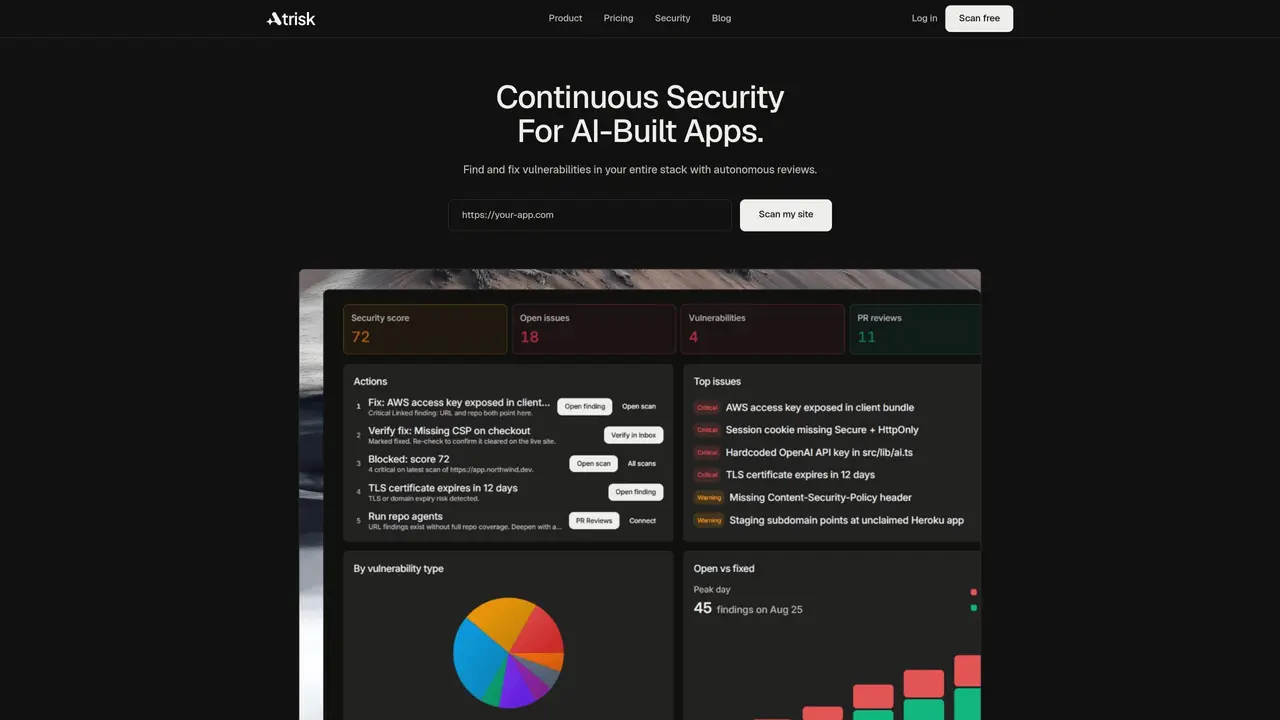
AtRisk is a continuous security tool designed for AI-built applications that scans live URLs and connected GitHub repositories for vulnerabilities. It performs over 100 automated checks and generates a Ship/Block score to indicate whether an app is safe to deploy. The platform consolidates findings from both live sites and source code into a unified inbox for streamlined review. AtRisk provides paste-ready fix prompts compatible with Cursor and Claude Code via MCP, enabling developers to address issues efficiently. It also offers automatic pull request reviews to catch vulnerabilities early in the development cycle. On the Pro plan, AtRisk can block risky deployments through a GitHub Action with SARIF output, ensuring compliance before changes go live. The tool is built to integrate seamlessly into existing workflows, supporting both automated and manual security assessments for AI-driven applications.
Key features
- Continuous scanning of live URLs and GitHub repositories
- Over 100 automated security checks
- Ship/Block score for deployment safety assessment
- Unified inbox consolidating live site and code findings
- Paste-ready fix prompts for Cursor and Claude Code via MCP
- Automatic pull request reviews
- GitHub Action integration for blocking risky deployments (Pro plan)
- SARIF output for compliance and reporting
- Real-time vulnerability detection
- Developer-friendly remediation workflows
Use cases
- Securing AI-built applications before deployment
- Automating security reviews in CI/CD pipelines
- Monitoring live applications for emerging vulnerabilities
Pros
- Provides continuous security assessments for AI-built applications across live URLs and GitHub repositories
- Generates a Ship/Block score based on over 100 automated checks to assess deployment safety
- Offers unified findings inbox linking issues across live sites and source code for streamlined review
- Includes paste-ready fix prompts compatible with Cursor and Claude Code via MCP for efficient issue resolution
- Supports automatic pull request reviews and CI deploy gates (Pro plan) to catch vulnerabilities early
Cons
- Requires GitHub connection for advanced features like linked findings and automatic PR reviews
- Pro plan is necessary for CI deploy blocking and advanced integrations like Vercel production signals
- May not cover all security categories as comprehensively as specialized SAST tools like Semgrep
Frequently asked questions about AtRisk
How do I scan a Lovable or Bolt app with AtRisk?
Paste the live URL on the AtRisk website and click 'Scan my site.' After signing in, AtRisk runs an on-demand scan of the public URL and returns a Ship/Block score without requiring GitHub connection initially.
Do I need GitHub connected to start an AtRisk scan?
No. A public URL is sufficient to begin scanning. Connecting a GitHub repository enables linked findings, repo audits, and automatic PR reviews.
What is the difference between AtRisk and CheckVibe?
AtRisk focuses on continuous security for AI-built apps, covering live URLs, GitHub repositories, linked findings, IDE fix prompts, PR reviews, and CI deploy gates. CheckVibe emphasizes broader launch health metrics like SEO, AEO, and uptime.
How is AtRisk different from Semgrep or other SAST tools?
SAST tools primarily analyze static code and PRs, while AtRisk also scans live public URLs, links matching issues to repositories, provides a Ship/Block score, and offers IDE fix prompts. AtRisk is designed for site and source security in one unified inbox.
What does the Ship/Block score represent?
The Ship/Block score is derived from over 100 automated checks across live URLs and connected repositories, indicating whether an application is safe to deploy based on consolidated findings.
Can AtRisk block risky deployments automatically?
Yes, the Pro plan includes a GitHub Action with SARIF output that can block risky deployments before they merge, ensuring compliance and reducing open risk in production.