
Frontier-grade Claude models with agentic workflows, strong coding, and enterprise guardrails delivered via developer console, web app, and cloud partners.

depgaze
€5000Starting price
0Popularity
About depgaze
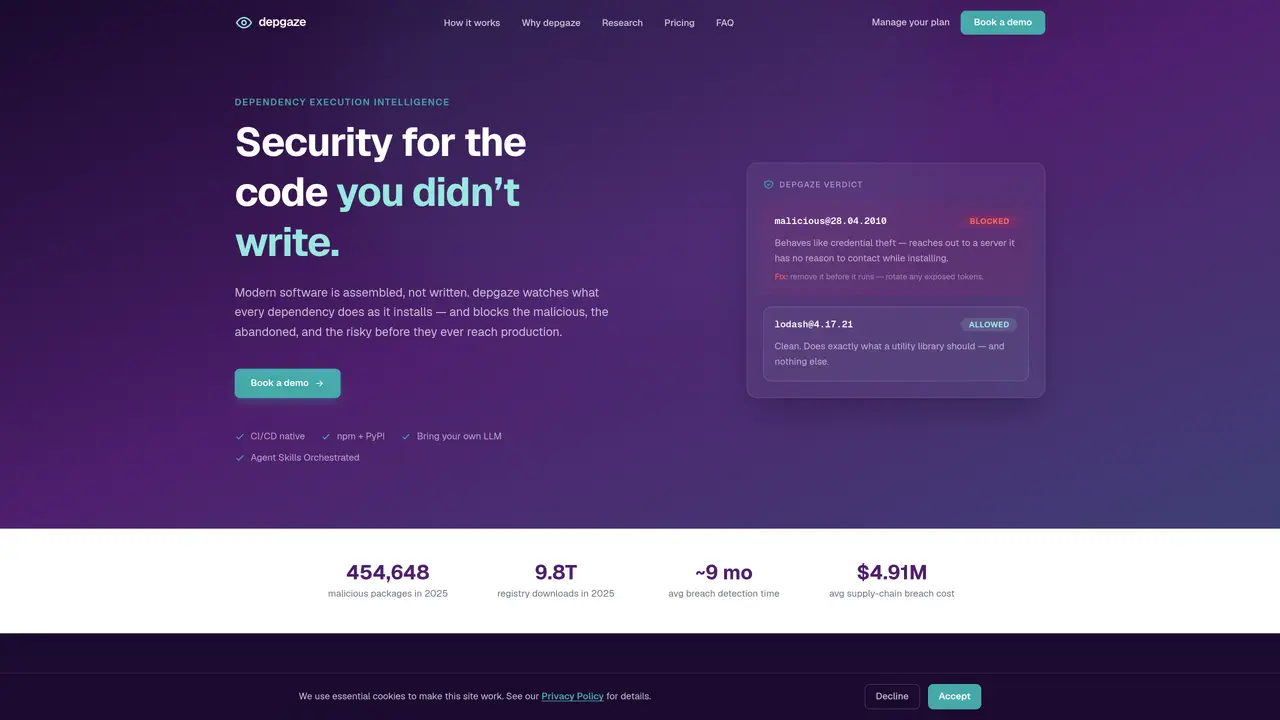
depgaze analyzes open-source package behavior during installation to identify and block malicious, abandoned, or risky dependencies before they reach production. It executes each package install inside an isolated, disposable sandbox with deep OS-level behavioral instrumentation, capturing real-time actions such as process spawns, file writes, network calls, and credential access. The tool uses an LLM to generate plain-language verdicts based on observed runtime behavior rather than static code analysis, enabling fail-closed blocking of packages that exhibit suspicious activity. depgaze integrates into CI/CD pipelines via a CLI command, supporting npm and PyPI ecosystems, and can run locally on Linux, remotely on Windows through the depgaze headless platform, or directly within CI runners. It works with existing LLM providers such as Amazon Bedrock, OpenAI, Anthropic, Azure Foundry, xAI, or local Ollama models, and can also be embedded into AI development agents like Claude Code or Codex for dependency vetting during development.
Key features
- OS-level behavioral instrumentation during package installation
- Disposable sandbox environments for each dependency
- Fail-closed blocking of risky packages in CI pipelines
- Support for npm and PyPI ecosystems
- Integration with major LLM providers or local models
- CLI-based analysis and integration
- Agent skills for AI development tools
- JSON output for CI pipeline automation
Use cases
- Blocking malicious or compromised open-source packages in CI/CD pipelines
- Preventing credential theft or unauthorized network access from dependencies
- Validating third-party packages before they enter production environments
Pros
- Executes packages in isolated sandboxes for real-time behavioral analysis
- Blocks dependencies based on runtime behavior rather than static code scanning
- Supports npm and PyPI ecosystems with fail-closed default behavior
- Integrates with existing LLM providers or local models
- Provides plain-language verdicts with specific remediation guidance
Cons
- Requires manual setup and configuration assistance from the vendor
- No public pricing details available on the website
- Limited to Linux-based CI runners for direct integration
- Depends on external LLM providers for analysis
Frequently asked questions about depgaze
What does depgaze do?
depgaze analyzes open-source package behavior during installation by executing each package in an isolated sandbox with deep OS-level instrumentation. It captures real-time actions such as process spawns, file writes, network calls, and credential access to generate plain-language verdicts using an LLM, enabling fail-closed blocking of risky packages before they reach production.
Who is depgaze suitable for?
depgaze is designed for development teams and organizations that rely on open-source dependencies and prioritize supply chain security. It is particularly useful for teams using npm or PyPI ecosystems who want to proactively block malicious, abandoned, or risky dependencies before deployment.
How does depgaze integrate with existing workflows?
depgaze integrates into CI/CD pipelines via a CLI command and can run locally on Linux, remotely on Windows through the depgaze headless platform, or directly within CI runners. It supports existing LLM providers such as Amazon Bedrock, OpenAI, Anthropic, Azure Foundry, xAI, or local Ollama models, and can also be embedded into AI development agents like Claude Code or Codex.
What happens if depgaze blocks a package?
If depgaze blocks a package, it returns an exit code of 1, which stops the build in a CI pipeline. The tool provides a plain-language verdict and a specific fix recommendation, such as removing the package or rotating exposed tokens, based on the observed runtime behavior.
Can depgaze be used with AI development agents?
Yes, depgaze can be installed as a skill in AI development agents like Claude Code or Codex. This allows agents to call depgaze during development, ensuring every dependency added by the agent receives a behavioral verdict before it reaches the codebase.
How does depgaze differ from static analysis tools?
Unlike static analysis tools that reason about code structure or match patterns against blocklists, depgaze executes each package install in a disposable sandbox and observes its actual runtime behavior. It uses an LLM to analyze the live runtime trace, making it more effective at detecting obfuscation, staged payloads, and dynamically constructed downloads.