
Cloud platform for web scraping, browser automation, and AI data extraction with 20,000+ pre-built tools and scalable cloud runs.

Dolly
$0.07Starting price
0Popularity
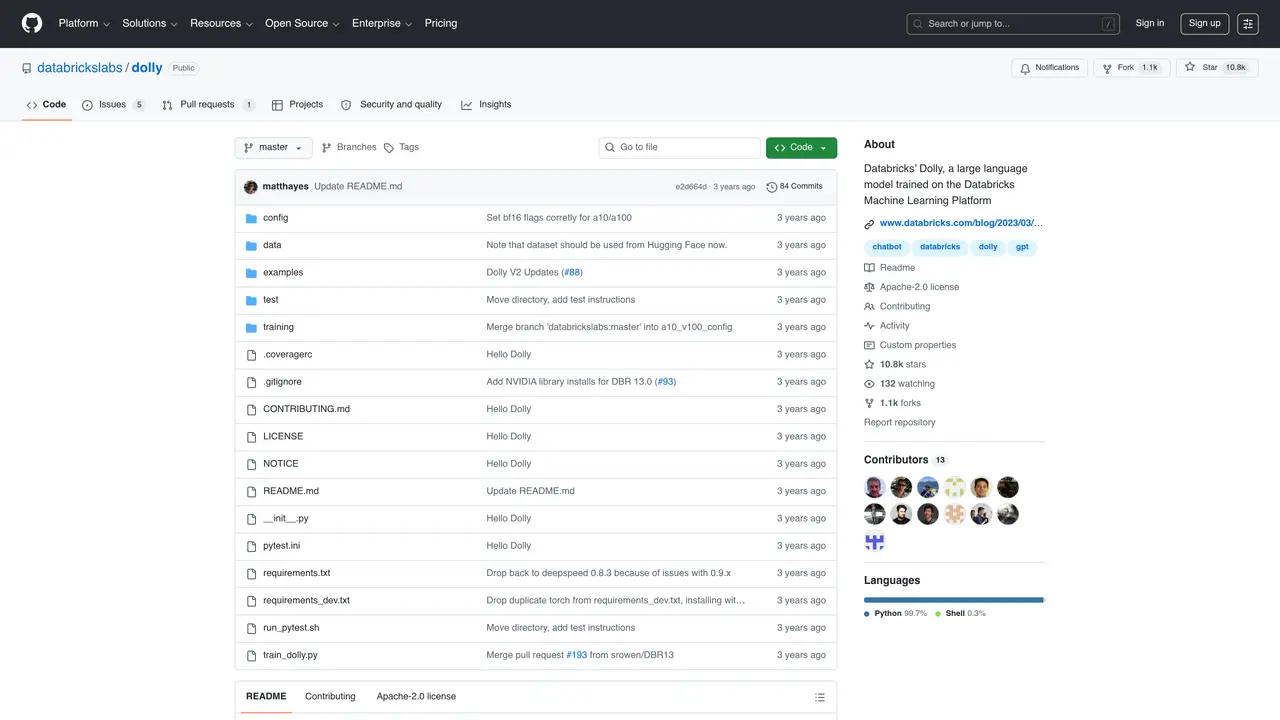
About Dolly
Dolly is an open source project from Databricks Labs that makes the process of moving data between different data sources faster, simpler, and more secure. With Dolly, users can easily and quickly move data between databases, cloud storage, and data lakes, with the assurance of strong authentication and encryption. Dolly supports a wide range of data formats and types, so users can conveniently move data between any two compatible sources. What’s more, Dolly is incredibly easy to use; users can set up and configure their data transfers in just a few clicks. With Dolly, users can be assured that their data transfers will be secure, efficient, and reliable. Dolly is suitable for anyone who needs to move data between different sources, including developers, data engineers, and IT professionals. It is particularly useful for large-scale data migrations and transfers, where security and efficiency are critical.
GitHub, Inc.
San Francisco, California, US · Founded 2008
- Founders
- Tom Preston-Werner, Chris Wanstrath, PJ Hyett, Scott Chacon
- Founded
- 2008
- Headquarters
- San Francisco, California, US
- Legal status
- Subsidiary of Microsoft (NASDAQ: MSFT)
Key features
- Automate data migration
- Transfer data securely and quickly
- Supports various data formats and types
- Easy to use with simple setup
- Strong authentication and encryption
- Supports databases, cloud storage, and data lakes
Use cases
- Automating data migration between databases and cloud storage
- Moving data between various data formats and types
- Transferring large-scale datasets securely and efficiently
Pros
- Open-source and permissively licensed (CC-BY-SA) for commercial use
- Instruction-following capabilities trained on ~15k Databricks-generated examples
- Based on EleutherAI’s Pythia-12b, enabling accessible fine-tuning for instruction tasks
- Released on Hugging Face for broad accessibility and integration
- Designed for practical use cases like brainstorming, classification, and summarization
Cons
- Not state-of-the-art and lacks competitive performance with modern models
- Struggles with syntactically complex prompts, programming, and mathematical operations
- Prone to factual errors, hallucinations, and biased associations from training data
- Limited capabilities in stylistic mimicry, humor, and well-formatted letter writing
Frequently asked questions about Dolly
What is Dolly and what does it do?
Dolly is an instruction-following large language model developed by Databricks, fine-tuned on a dataset of ~15k instruction/response pairs. It is designed to follow natural language instructions for tasks such as brainstorming, classification, question answering, generation, information extraction, and summarization.
Who is Dolly suitable for?
Dolly is suitable for developers, data scientists, researchers, and organizations looking to leverage an open, commercially licensed language model for tasks requiring instruction-following capabilities without the need for state-of-the-art performance.
How can I access and use Dolly?
Dolly is available as the model 'databricks/dolly-v2-12b' on Hugging Face, where users can download and deploy it for their applications. It can be integrated into workflows via standard model deployment methods.
What are the known limitations of Dolly?
Dolly struggles with syntactically complex prompts, programming problems, mathematical operations, factual accuracy, dates and times, open-ended question answering, and stylistic mimicry. It may also produce hallucinations or biased content due to its training data.
Is Dolly free to use?
Yes, Dolly is released under a permissive license (CC-BY-SA) and is available for commercial use, making it accessible for free to organizations and individuals.
Can Dolly be fine-tuned or customized further?
Yes, Dolly is designed to be fine-tuned on additional instruction datasets, allowing users to adapt it to specific domains or tasks beyond its base capabilities.