
Cloud platform for web scraping, browser automation, and AI data extraction with 20,000+ pre-built tools and scalable cloud runs.

Kadoa
0Popularity
About Kadoa
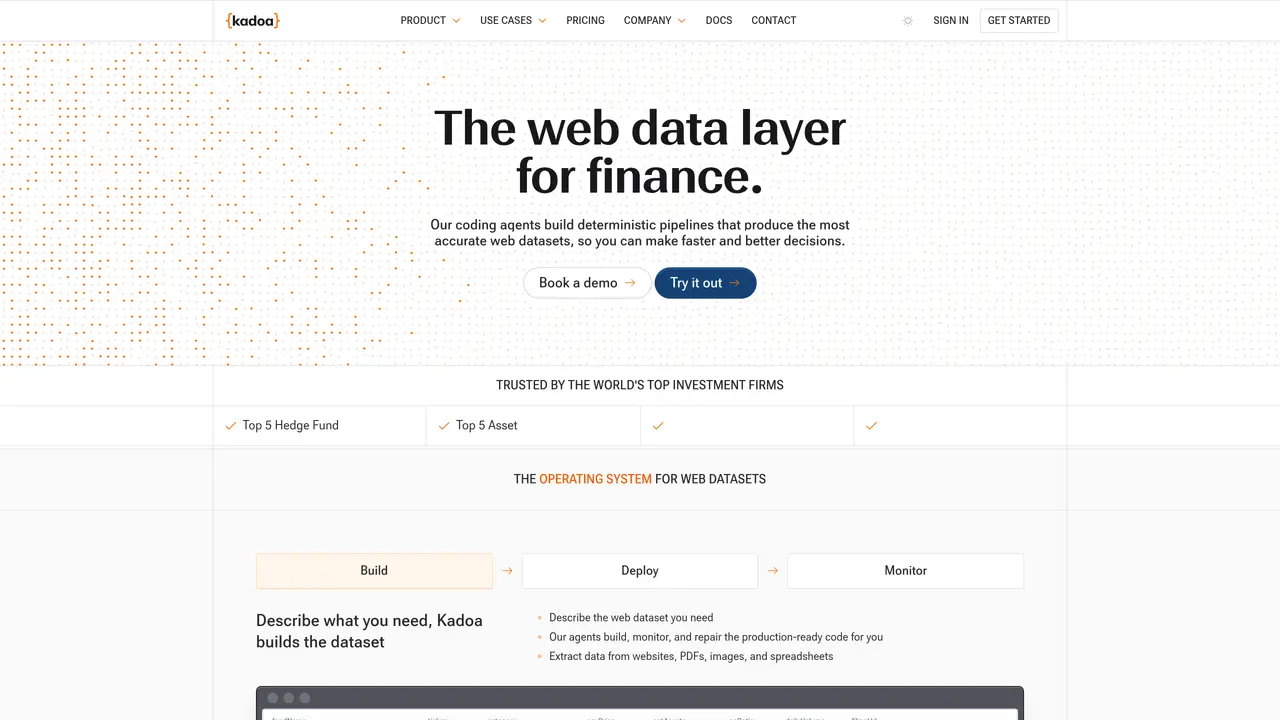
Kadoa is a powerful developer tool that makes it easy to extract data from any website. Its LLM-powered technology allows it to understand the structure of any web page, allowing you to quickly and accurately extract the data you need in the format you want. With Kadoa, you can quickly scan a website and extract the data you need without having to manually search for and copy it. You can also customize the output format to fit your specific requirements, making it easy to integrate the data you’ve extracted into your own applications and projects. Kadoa is designed to save you time and effort, so you can focus on the bigger picture of your development projects. Whether you’re a professional web developer or a hobbyist, Kadoa is the perfect tool for quickly and accurately extracting data from any website.
Key features
- Automate data extraction from multiple websites
- Quickly scan websites to find desired data
- Customize output format to fit specific requirements
Use cases
- Extracting product information from e-commerce websites for inventory management
- Scraping news articles from websites for content analysis and research
- Automating data entry tasks by extracting data from complex websites
Pros
- Build datasets in minutes without writing code
- Extract data from websites, PDFs, images, and spreadsheets
- Source-grounded and audit-ready data with every value traceable to its origin
- Automated recovery and error handling with transparent logging
Cons
- No information available on potential limitations or drawbacks
Frequently asked questions about Kadoa
What does Kadoa do?
Kadoa builds and maintains production-ready web scraping pipelines that extract, clean, and structure data from websites, PDFs, images, and spreadsheets. It converts plain-language descriptions of a dataset into automated, self-healing workflows that deliver structured data directly into data warehouses.
Who is Kadoa designed for?
Kadoa serves both analysts and engineers. Analysts can self-serve datasets via a UI or MCP without coding, while engineers can write and run ETL code natively and focus on high-level monitoring and data engineering tasks.
How does Kadoa ensure data quality?
Kadoa treats every extracted value as potentially incorrect until it passes validation checks for completeness, plausibility, and schema adherence. It also provides source-grounded outputs, allowing users to trace any data point back to its original source for audit purposes.
What integrations does Kadoa support?
Kadoa supports cloud-native delivery by pushing data directly into data warehouses such as S3, Snowflake, and BigQuery. It also integrates with monitoring tools via webhooks, Slack, or email for real-time alerts on data changes.
Can Kadoa handle changes to websites automatically?
Yes, Kadoa detects when a scraping workflow breaks due to website changes and automatically fixes the underlying code. Every fix is logged, and users are notified with full context if automated recovery fails.
How do I get started with Kadoa?
You can start by describing the dataset you need in plain language, and Kadoa will build the dataset for you. Alternatively, engineers can write and run ETL code natively within the platform. The process is designed to go from idea to dataset in minutes.