Cloud platform for web scraping, browser automation, and AI data extraction with 20,000+ pre-built tools and scalable cloud runs.
LoomFlow
0Popularity
About LoomFlow
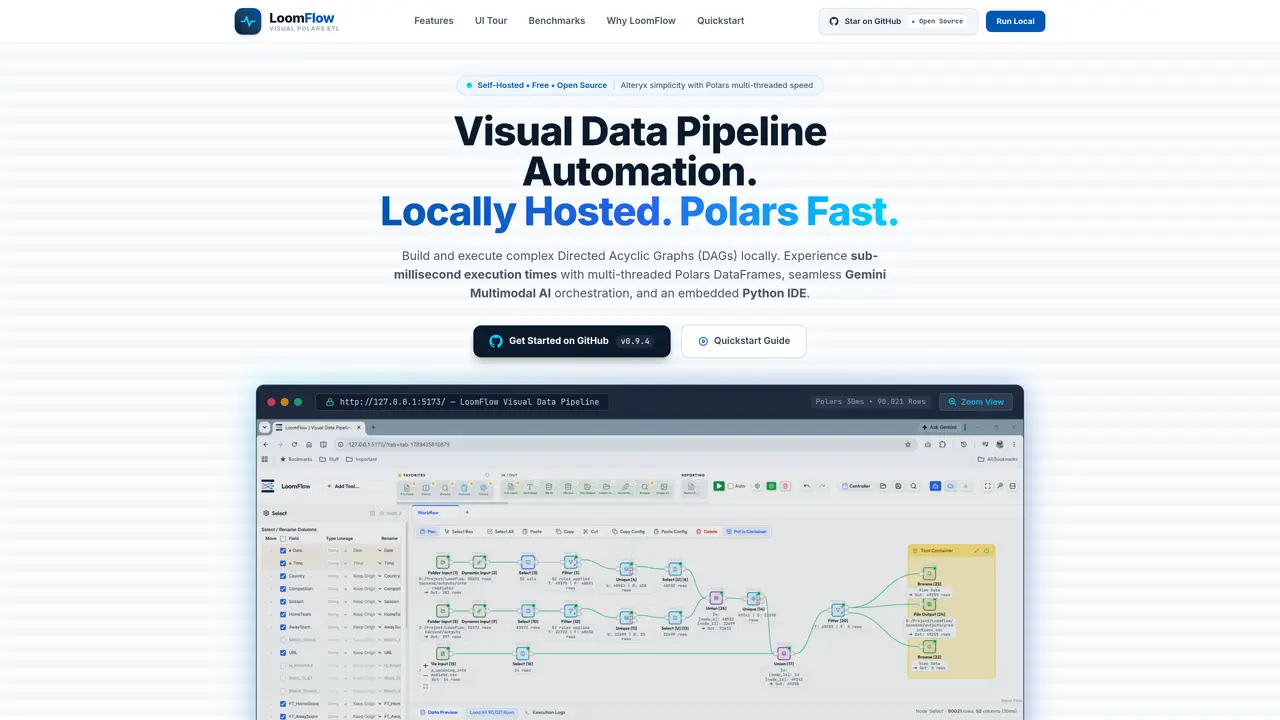
LoomFlow is a visual data pipeline automation tool designed for building and executing Directed Acyclic Graphs (DAGs) locally. It leverages the Polars Rust engine and multi-threaded vectorized execution to achieve sub-millisecond processing times, even with large datasets. The platform provides an embedded Python IDE and supports seamless orchestration with Gemini Multimodal AI. Workflows are constructed using an Alteryx-style tool ribbon with categories such as In/Out, Preparation, Transform, Join, and Reporting. Users can drag and drop tools like Dynamic Inputs, Formulas, and Filters onto a React Flow canvas. The interface includes real-time column lineage inspection, dynamic type casting, and data preview capabilities that allow immediate inspection of cached row profiles and schema types. Intermediate results are stored in Parquet format for caching and governance.
Key features
- Visual DAG builder with drag-and-drop tools
- Sub-millisecond execution with Polars engine
- Real-time data preview and schema inspection
- Column lineage tracking and dynamic type casting
- Tool containers for grouping and union operations
- Embedded Python IDE for custom logic
- Parquet and CSV export capabilities
- Multi-threaded vectorized query optimization
Use cases
- Automating complex ETL workflows locally
- Data preparation and transformation for analysis
- Building repeatable, auditable data pipelines
Pros
- Locally hosted and open source
- Uses Polars Rust engine for high-speed execution
- Embedded Python IDE for custom scripting
- Real-time data preview and column lineage inspection
- Supports multi-stream DAGs with tool containers
Cons
- Requires Python 3.10+ and Node.js 18+
- No cloud hosting option mentioned
- Limited to local execution environment
Frequently asked questions about LoomFlow
What is LoomFlow and what does it do?
LoomFlow is a visual data pipeline automation tool designed for building and executing Directed Acyclic Graphs (DAGs) locally. It enables users to construct workflows using an Alteryx-style tool ribbon and a React Flow canvas, leveraging the Polars Rust engine for high-speed data processing.
Who is LoomFlow designed for?
LoomFlow is architected for both analysts and engineers, translating enterprise Alteryx workflows into modern open-source software. It suits users who require visual clarity, high-speed execution, and local self-hosting capabilities.
How does LoomFlow achieve such fast execution times?
LoomFlow uses the Polars Rust engine and multi-threaded vectorized execution to achieve sub-millisecond processing times. It employs Apache Arrow for query optimization, disk caching, and branch pruning to maintain performance even with large datasets.
Does LoomFlow support AI integration?
Yes, LoomFlow supports seamless orchestration with Gemini Multimodal AI, allowing users to incorporate AI-driven steps into their data pipelines.
What are the key features of LoomFlow's interface?
The interface includes real-time column lineage inspection, dynamic type casting, data preview capabilities, and an embedded Python IDE. Users can drag and drop tools like Dynamic Inputs, Formulas, and Filters onto a React Flow canvas.
How do I get started with LoomFlow?
To get started, clone the LoomFlow repository, run the automated setup script, and open the browser at http://localhost:5173. The tool resolves virtual environments and dependencies automatically, requiring only Python 3.10+ and Node.js 18+.