
Unify customer data, automate workflows, and scale experiences with Einstein AI, Copilot, and Data Cloud in one CRM platform.

Runsight
0Popularity
About Runsight
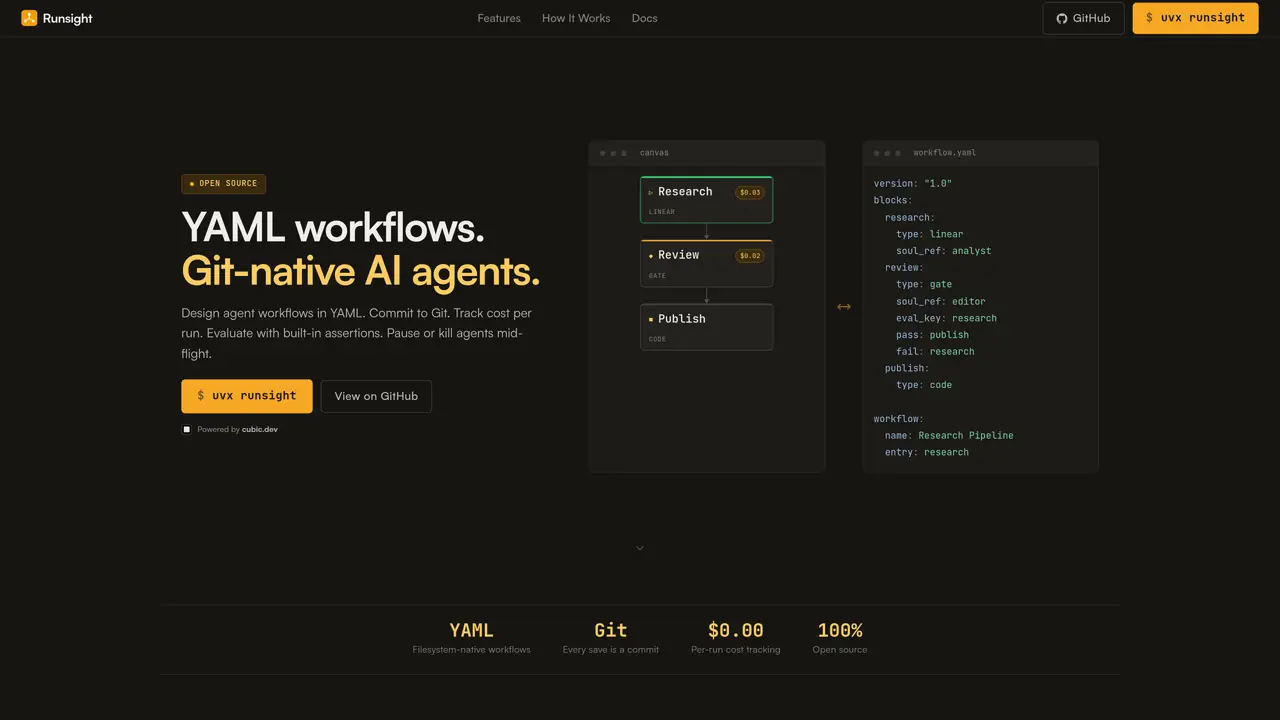
Runsight is an open-source, self-hosted workflow engine purpose-built for AI agents. It lets teams define, version, and execute agent pipelines entirely as Git-native YAML files or via a visual canvas, treating agent logic the same way developers treat application code. The tool orchestrates sequences of LLM and API calls into reusable blocks, automatically tracking per-step costs and latency while enforcing hard budget caps and providing pause/kill controls. Real-time state inspection surfaces intermediate outputs and errors, enabling rapid debugging without exposing data to external services. Runsight adds AI-specific features such as assertions, transform hooks, and regression testing to systematically evaluate and debug agent outputs before deployment. All API keys and models remain on-premise, ensuring sensitive data never leaves your infrastructure. By codifying agent behavior in version-controlled YAML, teams can turn ad-hoc scripts into reproducible, reviewable, and cost-controlled workflows that integrate seamlessly with existing Git development practices.
Key features
- YAML-first pipeline definition with Git-native versioning
- Visual canvas for drag-and-drop workflow design
- Per-step cost and latency tracking with budget enforcement
- Pause, kill, and real-time state inspection controls
- Assertions, transform hooks, and regression testing for AI outputs
- On-premise deployment to keep API keys and models secure
- Reusable blocks for LLM and API call orchestration
- Integration with standard Git development workflows
Use cases
- Building reproducible AI agent pipelines from ad-hoc scripts
- Enforcing cost controls and latency budgets in production workflows
- Debugging and validating agent outputs before deployment
Pros
- YAML-first workflow definition enables version-controlled, Git-native agent pipelines
- Real-time cost and latency tracking per block with hard budget caps to prevent overspending
- Dual visual canvas and YAML editor for synchronous editing and debugging
- Built-in assertions, transform hooks, and regression testing for systematic evaluation
- Self-hosted deployment ensures sensitive data and API keys remain on-premise
Cons
- Requires technical setup for self-hosting and local infrastructure management
- Limited to workflows defined in YAML, which may not suit teams preferring code-based orchestration
- Debugging mid-flight pauses may interrupt workflows and require manual intervention
Frequently asked questions about Runsight
What is Runsight and who is it designed for?
Runsight is an open-source, self-hosted workflow engine for AI agents that lets teams define, version, and execute agent pipelines as Git-native YAML files or via a visual canvas. It is designed for developers and teams building production-grade AI workflows who need reproducibility, cost control, and debugging capabilities.
How does Runsight track costs and enforce budgets?
Runsight tracks per-block costs and latency in real time, allowing users to set hard budget caps that automatically kill execution if exceeded. This prevents unexpected expenses and provides granular visibility into spending at each step of the workflow.
Can Runsight be used with external services or cloud APIs?
Yes, Runsight can integrate with external services and cloud APIs, but all workflows and data remain self-hosted. API keys and models are managed locally, ensuring sensitive data does not leave your infrastructure unless explicitly configured.
How do I get started with Runsight?
Getting started with Runsight requires running a single command to scaffold a project, followed by designing workflows in YAML or the visual canvas. No signup or cloud account is needed, and the tool provides onboarding to add API keys and execute workflows locally.
Does Runsight support iterative or looping workflows?
Yes, Runsight supports loops and sub-workflows, enabling iterative refinement with break conditions and hierarchical orchestration. Workflows can be nested as child steps, allowing for complex, multi-stage agent processes.
Is Runsight compatible with existing Git workflows?
Yes, Runsight treats workflows as Git-native YAML files, enabling teams to branch, review, and merge agent changes like any other code. Every save is committed to Git, ensuring version control and auditability.