
OpenAI builds and deploys advanced AI models like GPT-4o for autonomous agents and workflows.

Langflow
FreeStarting price
199KMonthly visits
38Popularity
About Langflow
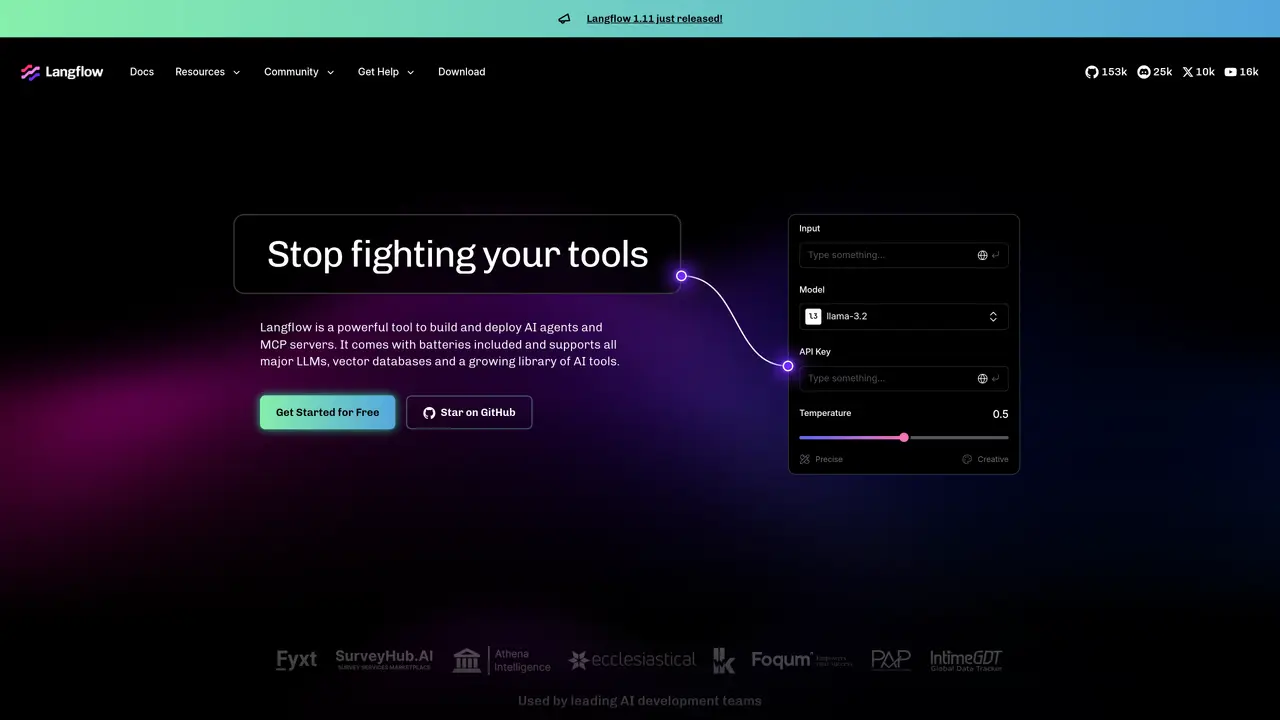
Langflow is an open-source low-code platform designed to simplify the creation and deployment of AI agents and retrieval-augmented generation (RAG) applications. It provides a visual editor that enables users to compose AI workflows by connecting modular components such as prompts, models, tools, vector databases, and outputs through an intuitive drag-and-drop interface. The platform supports real-time playground testing, allowing developers to iterate quickly and refine workflows without writing boilerplate code. Langflow is particularly suited for teams looking to prototype, test, and deploy AI systems efficiently, whether for building chatbots, document analysis tools, or multi-agent systems. It integrates with major large language models (LLMs), vector databases, and a growing library of AI tools, while also allowing customization through Python for advanced use cases. Workflows can be deployed as APIs, containerized for local or cloud deployment, or hosted on an enterprise-grade cloud platform, ensuring flexibility from development to production environments.
Key features
- Visual drag-and-drop flow builder for AI workflows
- Real-time playground for testing and debugging flows
- Reusable component library for prompts, models, tools, and data stores
- Python customization for extending flows while keeping them visual
- API deployment and cloud/container support for production workflows
- Agent and MCP server support for building and exposing AI tools
- RAG workflows with LLMs, embeddings, retrievers, and vector databases
- Template library for common AI app patterns
- Self-hosting and cloud deployment options
- Integration with external MCP servers and client tools
Use cases
- Prototyping and deploying AI agents and MCP servers
- Building RAG applications with document retrieval and LLM generation
- Creating chatbots and document analysis systems with reusable components
Pros
- Open-source platform with no vendor lock-in
- Visual drag-and-drop interface for building AI workflows
- Supports rapid prototyping and iteration of agentic systems and RAG pipelines
- Extensible with custom Python components while maintaining visual clarity
- Offers deployment options via APIs, containerization, or cloud services
Cons
- May require technical knowledge for advanced customization
- Visual complexity can increase with large or intricate workflows
- Dependency on community-driven component libraries
Frequently asked questions about Langflow
What is Langflow used for?
Langflow is used to visually compose, prototype, and deploy AI workflows such as agentic systems, RAG pipelines, chatbots, and document analysis tools without extensive coding.
Who is Langflow designed for?
The platform is designed for AI developers, data scientists, and teams who want to build and deploy AI applications efficiently using a low-code visual interface.
Does Langflow support custom components?
Yes, Langflow allows users to extend workflows with custom Python components while maintaining a clear visual representation of the entire system.
Can Langflow workflows be deployed for production use?
Workflows can be deployed through APIs, containerization, or an enterprise-grade cloud platform, enabling seamless transition from prototype to production.
What integrations does Langflow support?
Langflow supports integration with major LLMs, vector databases, and tools like Airbyte, Anthropic, Azure, GitHub, Google Drive, and more.
How do I get started with Langflow?
Users can start by downloading the open-source version from GitHub or signing up for a free cloud account to begin building and deploying AI workflows.
Langflow Website Engagement
Last Update: 10 days ago
Total Monthly Visits
0
Bounce Rate
0%
Visit Duration (avg)
0.00s
Pages Per Visit
0
Country Rank
0
Indonesia
Global Rank
0
Category Rank
#0
Programming & Developer Software
Monthly Traffic
Traffic Sources
Traffic Share By Country
- United States12.7%
- India8.9%
- China7.6%
- Indonesia6.8%
- Vietnam5.4%