
OpenAI builds and deploys advanced AI models like GPT-4o for autonomous agents and workflows.

Dify
$59Starting price
1MMonthly visits
50Popularity
About Dify
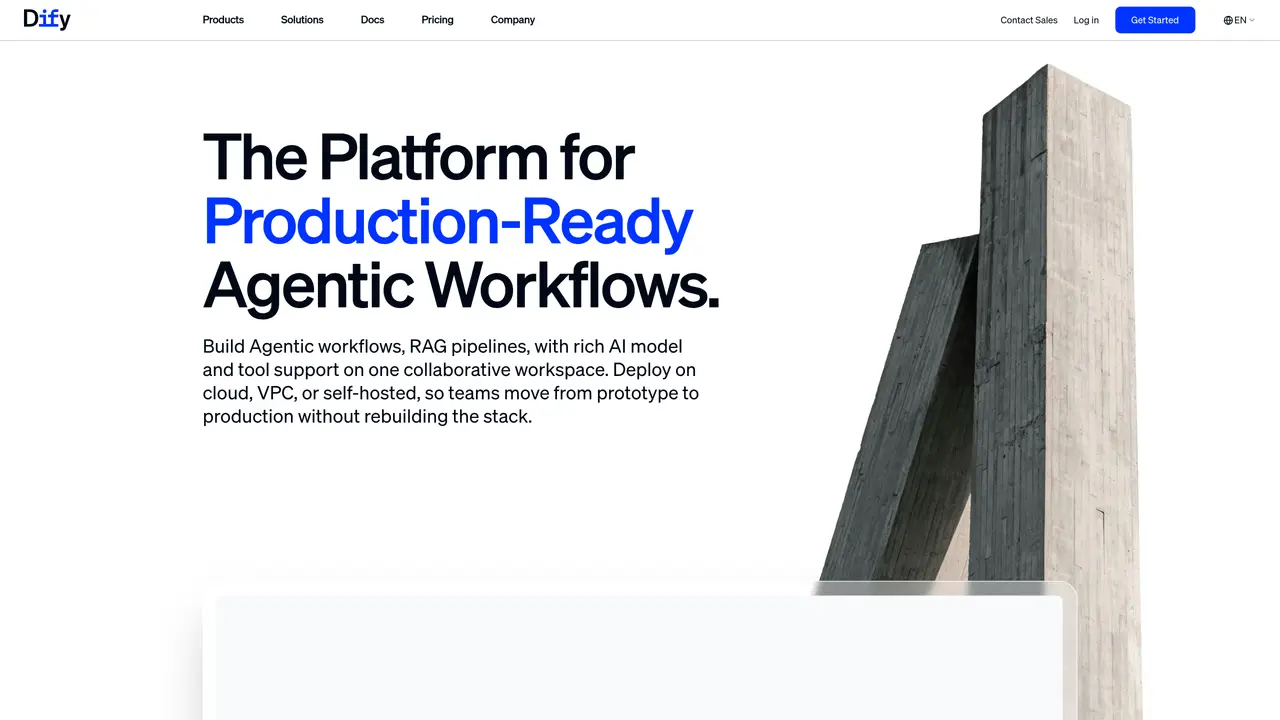
Dify is an open-source web platform and API designed for teams to build, deploy, and operate generative AI applications such as chatbots, agentic workflows, and RAG-based internal tools. The platform provides a visual orchestration studio with drag-and-drop nodes to design workflows, including LLM steps, knowledge retrieval, conditional logic, code execution, HTTP requests, and tool calls. It features a RAG engine for connecting external knowledge bases and real-time data retrieval, ensuring grounded answers for enterprise Q&A and customer support. Dify also includes an LLM agent framework for autonomous agents capable of using tools to complete multi-step tasks and automations. Additionally, it offers a Prompt IDE and LLMOps tooling for prompt iteration, monitoring, logging, and observability to support production deployments. The platform supports both SaaS and self-hosting options, catering to teams seeking to prototype and deploy AI applications rapidly without building orchestration infrastructure from scratch. Multi-model support includes major LLMs like GPT, Llama 2, and Qwen, as well as integrations with vendors such as Hugging Face and AWS Bedrock.
Key features
- Visual drag-and-drop workflow builder
- RAG engine for grounded answers
- LLM agent framework for autonomous tasks
- Prompt IDE and LLMOps tooling
- Multi-model support (GPT, Llama 2, Qwen, etc.)
- SaaS and self-hosting deployment options
- Backend-as-a-service APIs for rapid prototyping
- Conditional logic and tool integration
- Monitoring, logging, and observability
- HTTP requests and code execution nodes
Use cases
- Building AI-powered chatbots
- Automating multi-step workflows with agents
- Deploying RAG-based internal tools
Pros
- Open-source and self-hostable options for full control over data and infrastructure
- Visual drag-and-drop workflow builder for non-technical users to design AI applications
- Supports both cloud-hosted and on-premise deployment models for flexibility
- Includes built-in RAG engine and agent framework for grounded, multi-step AI tasks
- Multi-model support with integrations for major LLMs and external tools
Cons
- Steep learning curve for advanced workflows and agent configurations
- Limited native integrations compared to some enterprise-focused platforms
- Self-hosting requires technical expertise for setup and maintenance
- Documentation and community support vary for less common use cases
Frequently asked questions about Dify
What is Dify and what does it do?
Dify is an open-source platform for building, deploying, and operating generative AI applications such as chatbots, agentic workflows, and RAG-based tools. It provides a visual orchestration studio, a RAG engine, and an LLM agent framework to enable teams to prototype and deploy AI solutions without building orchestration infrastructure from scratch.
Who should use Dify?
Dify is designed for teams and enterprises seeking to build and deploy AI applications rapidly, including developers, business users, and organizations requiring production-ready AI workflows. It caters to industries such as manufacturing, logistics, finance, and education.
How does Dify support deployment options?
Dify offers multiple deployment options, including a managed SaaS cloud service, self-hosted enterprise deployments, and an open-source community edition. Teams can choose based on their infrastructure, security, and scalability needs.
What integrations does Dify support?
Dify supports integrations with major LLMs like GPT, Llama 2, and Qwen, as well as vendors such as Hugging Face and AWS Bedrock. It also allows installation of model providers, tools, data sources, and MCP integrations within a unified workspace.
Can Dify be used for non-technical users?
Yes, Dify is designed to be accessible to non-technical users through its no-code visual interface, enabling rapid development and deployment of AI applications without requiring deep programming expertise.
How does Dify handle knowledge bases and retrieval?
Dify includes a Knowledge Pipeline feature that allows users to prepare searchable knowledge bases by extracting, cleaning, chunking, indexing, and testing retrieval from files, websites, documents, and drives before connecting them to agents or workflows.
Dify Website Engagement
Last Update: 9 days ago
Total Monthly Visits
0
Bounce Rate
0%
Visit Duration (avg)
0.00s
Pages Per Visit
0
Country Rank
0
China
Global Rank
0
Monthly Traffic
Traffic Sources
Traffic Share By Country
- China52.6%
- Japan10.9%
- United States7.9%
- Singapore3.6%
- Hong Kong2.4%