
OpenAI builds and deploys advanced AI models like GPT-4o for autonomous agents and workflows.

Sim
$25Starting price
136KMonthly visits
36Popularity
About Sim
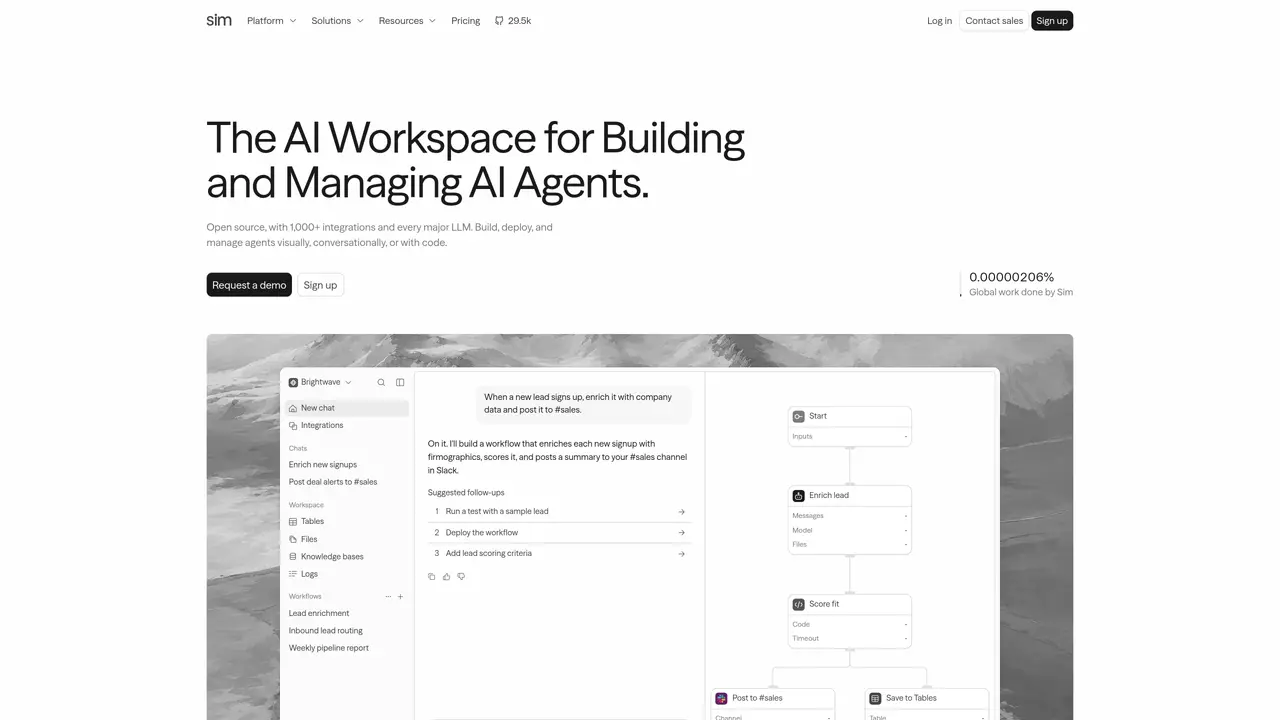
Sim is an open-source AI workspace designed for teams to build, deploy, and manage AI agents through visual interfaces, conversational workflows, or code. It supports integrations with over 1,000 tools including Slack, HubSpot, Salesforce, and Notion, and is compatible with every major large language model. The platform provides built-in context storage via tables, files, and knowledge bases, enabling agents to reason over user data effectively. Every agent interaction is fully traceable with live logs and real-time cost reporting, ensuring production readiness for teams of any size. Sim emphasizes scalability and flexibility, allowing users to switch between no-code, low-code, and developer-centric approaches as needed. It is particularly suited for organizations looking to operationalize AI agents without vendor lock-in. The tool is positioned as a foundational platform for teams aiming to integrate AI agents into their existing workflows seamlessly.
Key features
- Visual agent builder with no-code and low-code options
- Supports over 1,000 integrations (Slack, HubSpot, Salesforce, Notion, etc.)
- Built-in context storage via tables, files, and knowledge bases
- Real-time tracing and live logs for every agent run
- Real cost reporting for production monitoring
- Compatibility with every major LLM
- Code-first and conversational agent development options
- Open-source with a freemium pricing model
Use cases
- Building and deploying customer support AI agents integrated with CRM tools
- Automating internal workflows using agents connected to Slack and Notion
- Creating knowledge-base agents that reason over structured and unstructured data
Pros
- Open-source platform with no vendor lock-in
- Supports over 1,000 integrations with major tools like Slack, HubSpot, Salesforce, and Notion
- Compatible with every major large language model
- Provides built-in context storage via tables, files, and knowledge bases
- Offers full traceability with live logs and real-time cost reporting
Cons
- May require technical familiarity for advanced customization
- Enterprise features may involve complex setup
- Self-hosting options may demand additional infrastructure management
Frequently asked questions about Sim
What is Sim and what does it do?
Sim is an open-source AI workspace that enables teams to build, deploy, and manage AI agents through visual interfaces, conversational workflows, or code. It connects to over 1,000 tools and every major large language model to automate real work.
Who is Sim designed for?
Sim is designed for technical teams and organizations looking to operationalize AI agents without vendor lock-in. It suits engineering, sales, IT, compliance, finance, and HR teams seeking to automate workflows.
How does Sim handle data and context for AI agents?
Sim stores user data semantically in tables, files, and knowledge bases, providing agents with structured memory to ground their reasoning and responses.
Does Sim support monitoring and tracing of agent interactions?
Yes, Sim provides live logs, real-time cost reporting, and end-to-end tracing of every agent decision, ensuring transparency and audit readiness.
What integrations does Sim support?
Sim supports over 1,000 integrations with popular tools such as Slack, GitHub, Gmail, Notion, Salesforce, Jira, Linear, Supabase, and Stripe.
How can I get started with Sim?
Users can start by signing up on the Sim platform, exploring the visual builder or describing their automation needs in plain English, and then testing and deploying their agents.
Sim Website Engagement
Last Update: 9 days ago
Total Monthly Visits
0
Bounce Rate
0%
Visit Duration (avg)
0.00s
Pages Per Visit
0
Country Rank
0
United States
Global Rank
0
Category Rank
#0
Programming & Developer Software
Monthly Traffic
Traffic Sources
Traffic Share By Country
- United States16.7%
- India9%
- United Kingdom6.8%
- Brazil3%
- France3%