OpenAI builds and deploys advanced AI models like GPT-4o for autonomous agents and workflows.

NodeXLoop
$1Starting price
0Popularity
About NodeXLoop
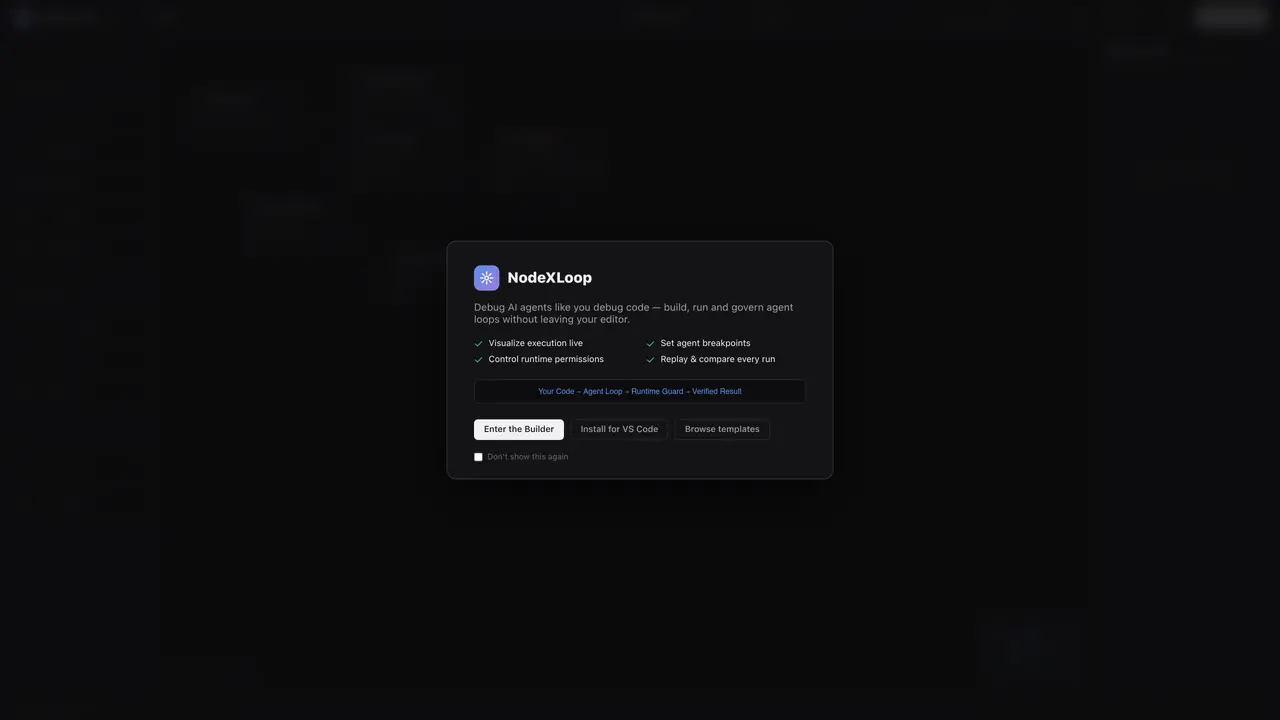
NodeXLoop provides a visual environment for building, running, and debugging AI agent loops within a code editor. It allows users to construct graphs of interconnected agent nodes—such as researcher, coder, writer, critic, and reader—alongside flow control elements like gates, merges, and loops. Each graph represents an agent workflow that can be executed step-by-step, with breakpoints halting execution before specific nodes to inspect inputs, outputs, and intermediate states. The tool integrates with local or remote LLM endpoints, including Ollama, OpenAI-compatible services, and custom providers, while storing API keys securely in the OS keychain. A runtime guard enforces governance policies offline, classifying prompts and completions before execution to block unauthorized or risky calls without incurring token costs. Runs produce detailed audit reports with provenance, token usage, governance decisions, and full logs, which can be exported in print-ready formats or saved as git-native .loop.yaml files for version control.
Key features
- Step-through debugging with F9 breakpoints
- Runtime guard with offline policy enforcement
- Model registry for local and remote LLM endpoints
- Audit reports with provenance and governance logs
- Simulator mode for synthetic runs without model calls
- Git-native .loop.yaml file export
- Built-in templates for agent workflows
- Secure API key storage in OS keychain
Use cases
- Debugging AI agent workflows in code review cycles
- Testing agent loops without incurring model costs
- Enforcing governance policies on LLM prompts and completions
Pros
- Visual debugging of agent loops with breakpoints and step-through execution
- Local execution with no proxying of data through external services
- Offline runtime guard enforces governance policies before model calls
- Git-native file format for version control and collaboration
- Built-in templates for common agent workflows
Cons
- Requires editor extension installation (VS Code or compatible)
- No free tier or open-access version mentioned
- Limited to desktop environments via editor extension
- Experimental templates may produce unreliable outputs
Frequently asked questions about NodeXLoop
What is NodeXLoop?
NodeXLoop is a visual development environment for building, running, and debugging AI agent workflows within a code editor. It allows users to construct graphs of interconnected agent nodes and flow control elements, execute them step-by-step, and inspect intermediate states using breakpoints.
Who is NodeXLoop designed for?
NodeXLoop is designed for developers and teams working with AI agents who need to design, test, and govern agent loops efficiently. It suits those who prefer visual debugging and want to integrate local or remote LLM endpoints securely.
How does NodeXLoop handle API keys and security?
API keys are stored securely in the OS keychain, and the tool integrates with local or remote LLM endpoints like Ollama or OpenAI-compatible services. A runtime guard enforces governance policies offline, classifying prompts and completions before execution to block unauthorized calls without incurring token costs.
Can I use NodeXLoop without making actual API calls?
Yes, NodeXLoop offers a Sim mode that produces synthetic runs with no model calls, which is useful for learning the workflow or testing graphs without incurring costs.
How do I get started with NodeXLoop?
Install the NodeXLoop extension for your editor (VS Code, Cursor, VSCodium, Windsurf, Gitpod, or Open VSX). Open the Builder, add a model by pasting a key or pointing to an endpoint, select a template, and run the graph while using breakpoints to debug step-by-step.
Does NodeXLoop support version control for agent workflows?
Yes, each graph is saved as a .loop.yaml file, which is git-native and can be version-controlled alongside your code. Runs produce detailed audit reports with provenance, token usage, governance decisions, and full logs that can be exported in print-ready formats.