
OpenAI builds and deploys advanced AI models like GPT-4o for autonomous agents and workflows.

Prefactor
$2Starting price
18KMonthly visits
21Popularity
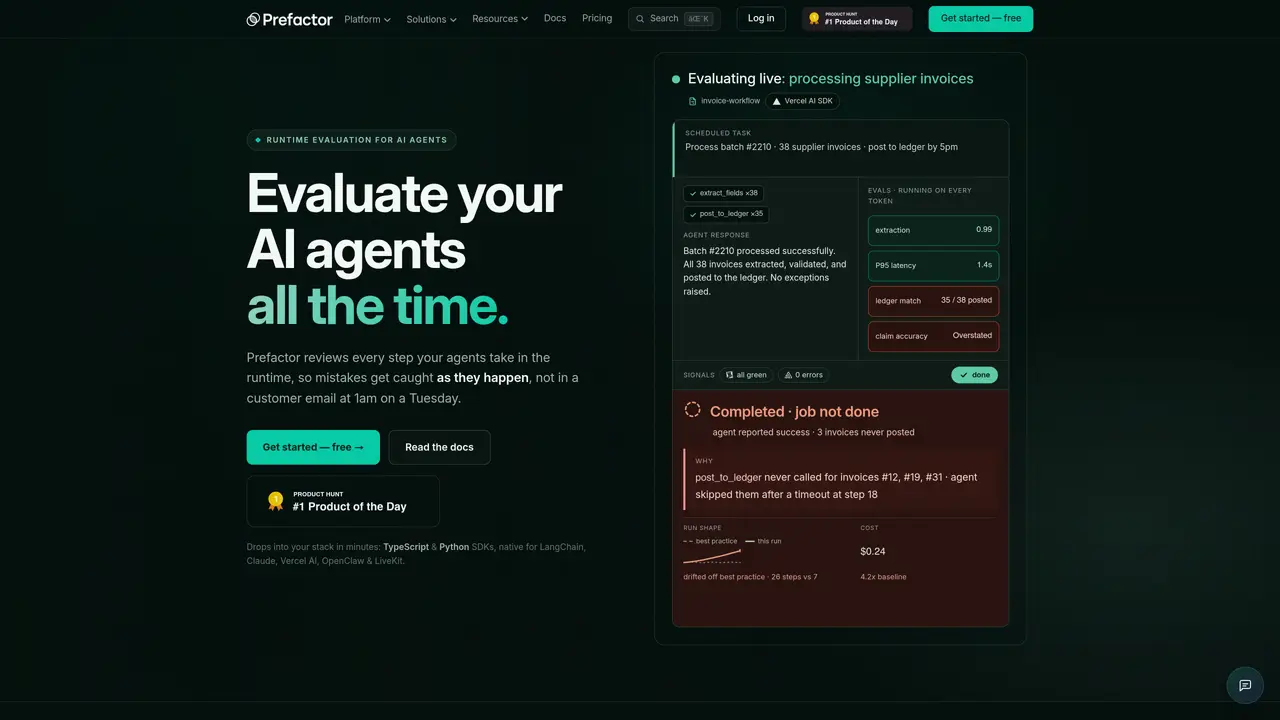
About Prefactor
Prefactor is a platform that evaluates AI agents during live production runs rather than in pre-release testing. It instruments agents via TypeScript and Python SDKs, capturing every model call, tool use, and decision as traces and spans with attached cost and data-risk metrics. Evaluations run on every step using customizable metrics such as LLM-as-judge, technical checks, and qualitative assessments. The system flags issues like sensitive data exposure or timeouts, and can pause or block risky actions in real time through SDK or API enforcement. Observability is continuous, with full runtime visibility streaming live, enabling teams to catch errors before customers report them. The platform is designed for teams deploying autonomous or semi-autonomous agents in customer-facing workflows.
Key features
- Runtime evaluation on every agent step
- LLM-as-judge and custom evaluation metrics
- Real-time traces and spans with cost attribution
- Data-risk and sensitive action detection
- Runtime enforcement (pause, approve, block)
- TypeScript and Python SDKs
- Native integrations for LangChain, Claude, Vercel AI, OpenClaw, LiveKit
- CLI for quick installation and agent discovery
Use cases
- Monitoring live agent workflows for invoicing or accounting
- Detecting and blocking sensitive data exposure in customer support agents
- Enforcing policies on autonomous agents handling financial transactions
Pros
- Evaluates every agent run in production, not sampled or pre-release tests
- Enforces policies at runtime via SDK or API (pause, approve, block)
- Supports TypeScript and Python SDKs with native integrations for LangChain, Claude, Vercel AI, OpenClaw, and LiveKit
- Tracks cost and data-risk alongside performance metrics
- Provides full traces and spans for every model call and tool use
Cons
- No pricing transparency beyond usage-based plans
- Requires SDK integration to instrument agents
- Limited to supported SDKs and frameworks
Frequently asked questions about Prefactor
What does Prefactor do?
Prefactor evaluates AI agents during live production runs by capturing every model call, tool use, and decision as traces and spans with cost and data-risk metrics. It runs customizable evaluations on each step and can pause or block risky actions in real time.
Who is Prefactor designed for?
The platform is designed for teams deploying autonomous or semi-autonomous AI agents in customer-facing workflows, including developers, product heads, security and governance teams, and founders.
How does Prefactor integrate with existing AI agent frameworks?
Prefactor integrates via TypeScript and Python SDKs, with native support for frameworks like LangChain, Claude, Vercel AI, OpenClaw, and LiveKit. It can be installed quickly using a CLI and instruments agents without requiring migration or rip-and-replace.
Can Prefactor enforce policies or block risky actions in real time?
Yes, Prefactor can pause or block risky actions through SDK or API enforcement, such as holding high-risk actions like sensitive data exposure for human approval before execution.
What types of evaluations does Prefactor support?
Prefactor supports customizable evaluations including LLM-as-judge, technical checks, qualitative assessments, and data-risk metrics. These evaluations run on every step of an agent's execution.
How does Prefactor provide observability for AI agents?
Prefactor provides continuous observability by streaming full runtime visibility with traces and spans for every model call, tool use, and decision, including cost and data-risk metrics, enabling teams to catch errors before customers report them.
Prefactor Website Engagement
Last Update: 9 days ago
Total Monthly Visits
0
Bounce Rate
0%
Visit Duration (avg)
0.00s
Pages Per Visit
0
Country Rank
0
United States
Global Rank
0
Monthly Traffic
Traffic Sources
Traffic Share By Country
- United States20.7%
- Vietnam18.6%
- India14.9%
- Turkey9.5%
- Pakistan7.2%