
OpenAI builds and deploys advanced AI models like GPT-4o for autonomous agents and workflows.

Cycles
FreeStarting price
3.4KMonthly visits
9Popularity
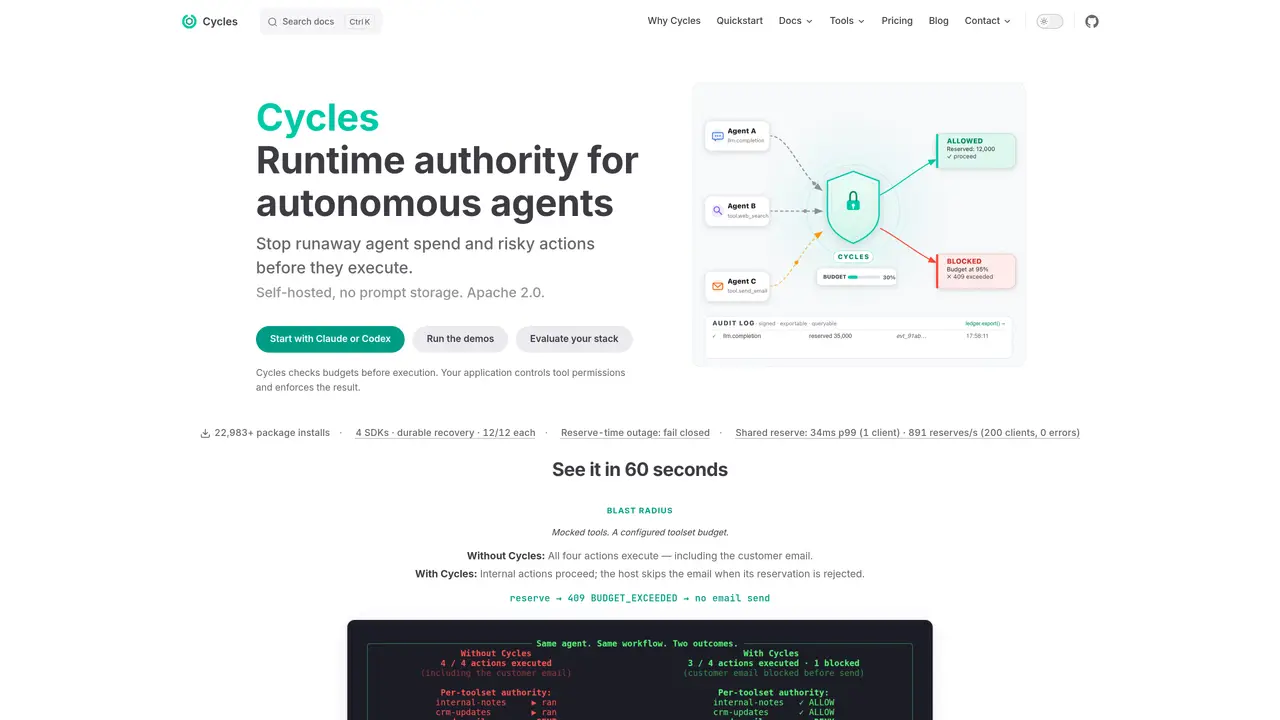
About Cycles
Cycles is a runtime authority for autonomous AI agents and workflows designed to enforce hard, pre-execution limits on spend, risk, and actions. It operates on a reserve-commit lifecycle where SDKs estimate and reserve budget for LLM calls or tool invocations before execution, allowing or denying actions based on configured policies such as token caps or tool denylists. Actual usage is committed post-execution, and unused amounts are released, ensuring predictable cost and compliance controls. The tool supports deterministic, auditable policy decisions across providers including OpenAI, Anthropic, Bedrock, LangChain, and others, making it suitable for teams deploying autonomous AI systems with strict governance requirements. By integrating Cycles, organizations can prevent cost overruns, isolate per-tenant API budgets, and safely deploy AI-driven workflows without sacrificing autonomy or performance. It is self-hosted, does not store prompts, and is licensed under Apache 2.0, offering flexibility for deployment and data control.
Key features
- Pre-execution budget reservation for LLM calls and tool invocations
- Hard limits on spend, risk, and actions via reserve-commit lifecycle
- Support for max tokens, tool denylists, and action caps
- Deterministic and auditable policy enforcement across AI providers
- Per-tenant API budget isolation
- Compatibility with OpenAI, Anthropic, Bedrock, and LangChain
- Autonomous AI system deployment with predictable cost controls
- Compliance-ready governance for AI workflows
Use cases
- Preventing runaway costs in autonomous AI agents
- Enforcing per-tenant budget limits in multi-tenant systems
- Ensuring compliance and auditable controls in AI-driven workflows
Pros
- Pre-execution budget checks prevent runaway agent costs and risky actions before they execute
- Supports deterministic, auditable policy decisions with hard limits on spend, risk, and actions
- Self-hosted deployment with no prompt storage, ensuring data privacy and control
- Offers multi-tenant budget isolation to prevent one tenant from exhausting shared resources
- Provides interactive tools like cost and blast-radius calculators to evaluate enforcement needs
Cons
- Server-enforced action-kind quotas and allow/deny policies remain in preview and are not fully production-ready
- Requires integration effort to wrap existing workflows with budget reservations and policy enforcement
Frequently asked questions about Cycles
What does Cycles do?
Cycles acts as a runtime authority for autonomous AI agents by enforcing pre-execution limits on spend, risk, and actions. It uses a reserve-commit lifecycle to estimate and reserve budgets before any action executes, preventing runaway costs and risky operations.
Who is Cycles designed for?
Cycles is designed for teams deploying autonomous AI agents or workflows that require strict governance over costs, compliance, and risk exposure. It suits organizations managing multi-tenant systems, research loops, or production-grade AI applications.
How does Cycles integrate with existing AI stacks?
Cycles provides SDKs and wrappers for languages and frameworks such as Python, TypeScript, Java/Spring, MCP, LangChain, and OpenAI Agents. It can be added to existing workflows with minimal code changes, typically via decorators or wrappers.
Can Cycles work with multiple AI providers?
Yes, Cycles supports enforcement across multiple AI providers including OpenAI, Anthropic, AWS Bedrock, Google Gemini, Groq, Ollama, and others. It also integrates with tools like LangChain, LangGraph, and MCP.
Does Cycles support multi-tenant budget isolation?
Yes, Cycles allows teams to configure tenant-specific budget isolation, ensuring that one tenant's usage does not exhaust shared resources. This is achieved through separate application ledgers and configurable budget scopes.
How do I get started with Cycles?
Getting started involves running a local demo, wrapping an LLM call or tool with a budget reservation, and gradually moving from shadow mode (dry-run enforcement) to hard enforcement in production. The quickstart guides provide step-by-step instructions for various languages and frameworks.
Cycles Website Engagement
Last Update: 9 days ago
Total Monthly Visits
0
Bounce Rate
0%
Visit Duration (avg)
—
Pages Per Visit
0
Country Rank
0
India
Global Rank
0