Cloud platform for web scraping, browser automation, and AI data extraction with 20,000+ pre-built tools and scalable cloud runs.

Tesseract
$0.07Starting price
0Popularity
About Tesseract
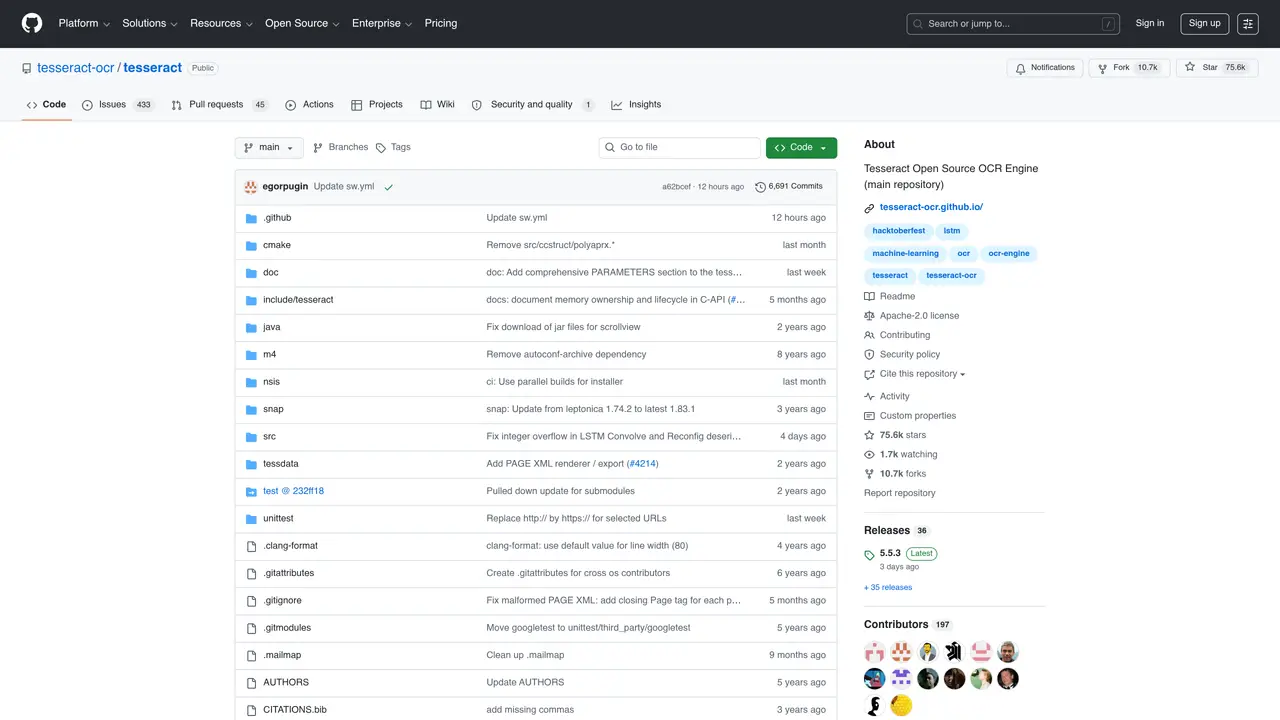
Tesseract is an open-source optical character recognition (OCR) engine developed by Hewlett-Packard and later maintained by Google. It supports over 100 languages and can process various image formats, including JPEG, PNG, TIFF, and PDF, as well as multi-page documents. The tool is designed to extract text from scanned documents, screenshots, photographs, and even handwritten notes with high accuracy. Tesseract uses advanced algorithms, including LSTM-based neural networks, to improve text recognition quality, particularly for complex layouts and low-quality images. It can be integrated into workflows via command-line interfaces or through APIs in applications. The engine is highly customizable, allowing users to fine-tune parameters such as language models, page segmentation modes, and preprocessing steps to optimize performance for specific use cases. Tesseract is widely used for digitizing printed materials, automating data entry from forms, and enabling accessibility for visually impaired users by converting text into speech-ready formats. Its open-source nature fosters community contributions, ensuring continuous improvements and broad compatibility across platforms.
GitHub, Inc.
San Francisco, California, US · Founded 2008
- Founders
- Tom Preston-Werner, Chris Wanstrath, PJ Hyett, Scott Chacon
- Founded
- 2008
- Headquarters
- San Francisco, California, US
- Legal status
- Subsidiary of Microsoft (NASDAQ: MSFT)
Key features
- Extract text from photos
- Extract text from handwritten notes
- Convert PDFs into editable documents
- Customizable settings
- High accuracy and reliability
- Easy to use
Use cases
- Digitizing handwritten notes
- Converting PDF documents
- Extracting text from images
Pros
- Open-source and free to use
- Supports over 100 languages out of the box
- Handles multiple image formats including PNG, JPEG, and TIFF
- Provides multiple output formats such as plain text, hOCR, PDF, TSV, ALTO, and PAGE
- Offers both legacy and LSTM-based OCR engines for flexibility
Cons
- Requires manual image quality improvement for optimal results
- Lacks a built-in graphical user interface (GUI)
- Training for additional languages requires additional steps
Frequently asked questions about Tesseract
What is Tesseract and what does it do?
Tesseract is an open-source optical character recognition (OCR) engine that extracts text from images, PDFs, and other documents. It supports over 100 languages and can output text in formats like plain text, hOCR, PDF, and TSV.
Who should use Tesseract?
Tesseract is suitable for developers, researchers, and organizations needing reliable text extraction from scanned documents, screenshots, or images. It is ideal for digitizing handwritten notes, converting PDFs, or automating text extraction workflows.
How do I install and run Tesseract?
Tesseract can be installed via pre-built binary packages or built from source. It is run from the command line with a basic command like 'tesseract imagename outputbase [-l lang]' to process images and extract text.
Does Tesseract support multiple languages?
Yes, Tesseract supports over 100 languages out of the box and can be trained to recognize additional languages or specialized fonts for improved accuracy.
What image formats does Tesseract support?
Tesseract supports common image formats such as PNG, JPEG, and TIFF. It also handles PDFs and can output text in multiple formats including plain text, hOCR, PDF, and TSV.
Is there a graphical user interface (GUI) for Tesseract?
No, Tesseract itself does not include a GUI. Users can integrate it with third-party applications or use external tools that provide a graphical interface for easier interaction.