Meshy turns text prompts or images into fully textured 3D models in minutes.

Allonic
1.8KMonthly visits
4Popularity
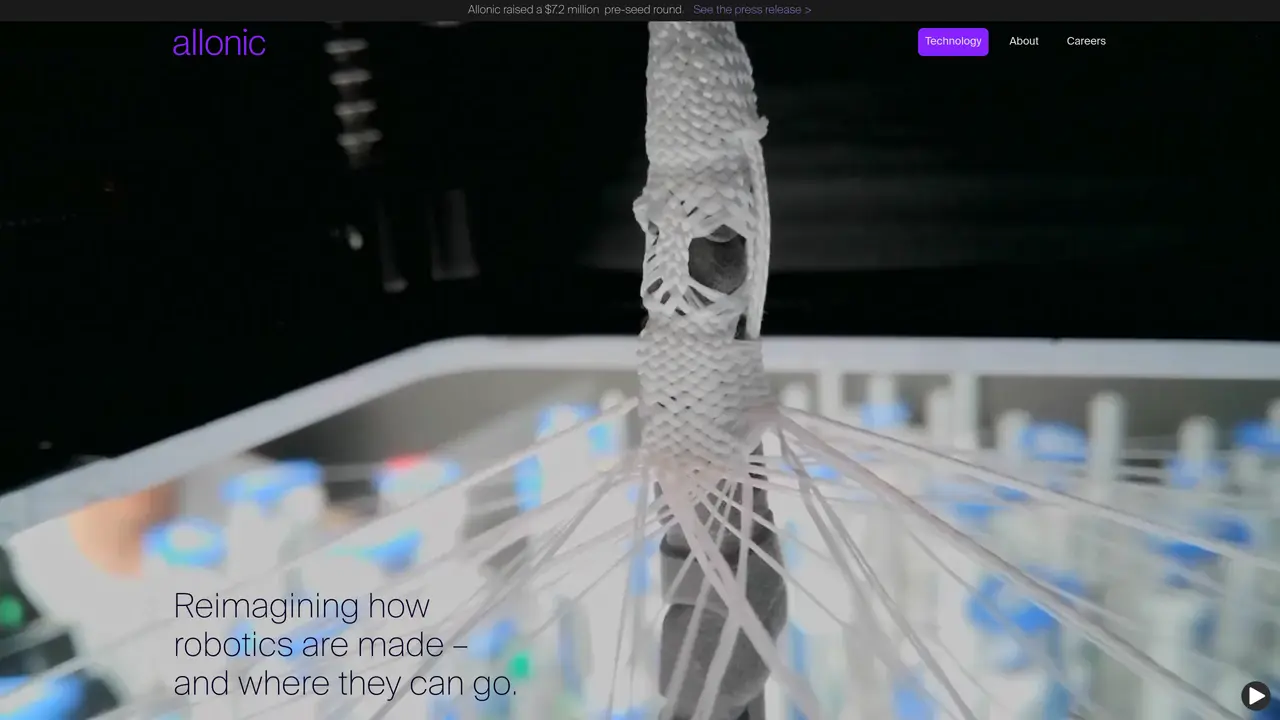
About Allonic
Allonic provides an automated 3D Tissue Braiding platform that enables robotics teams to design and produce complex robotic hardware as monolithic structures. The platform integrates tendons, pulleys, guides, compliant joints, and actuator-ready mechanisms into single, cohesive robotic bodies, eliminating the need for multi-part assembly. It supports the creation of soft-touch, strong, agile, and load-bearing systems suitable for human-centered environments. By automating the manufacturing workflow, Allonic accelerates the transition from robotic concept to pilot hardware, allowing teams to prototype and iterate faster. The technology is particularly useful for developing new robot morphologies such as manipulators, limbs, tendon systems, robotic hands, and custom bodies. Robotics companies, physical AI builders, and research teams use Allonic to streamline the production of compliant, tendon-driven, and soft robotic structures while reducing assembly complexity and time-to-market.
Key features
- Automated 3D Tissue Braiding for monolithic robotic bodies
- Integration of tendons, pulleys, guides, and compliant joints
- Production of soft-touch, load-bearing, and agile robotic systems
- Accelerated design-to-manufacturing workflows
- Support for custom robot morphologies (manipulators, limbs, hands)
- Reduced assembly complexity through single-piece manufacturing
- Compatibility with actuator-ready mechanisms
- Faster prototyping and iteration for robotic hardware
Use cases
- Manufacture custom robotic bodies for physical AI and embodied robot systems
- Integrate tendons, pulleys, guides, compliant joints, and soft tissues into one robotic structure
- Automate robotic hardware prototyping and design-to-manufacturing workflows
Pros
- Enables fully automated design and production of complex robotic bodies in a single process
- Eliminates multi-part assembly by integrating tendons, pulleys, guides, and compliant joints into monolithic structures
- Supports the creation of soft-touch, load-bearing, and agile robotic systems suitable for human-centered environments
- Accelerates transition from robotic concept to pilot hardware, reducing time-to-market
- Allows custom hardware development in-house, accessible to non-specialist teams
Cons
- Currently focused on tendon-driven and soft robotic structures, which may not suit all robotic applications
- Requires access to specialized automated machinery for production, limiting deployment to equipped facilities
Frequently asked questions about Allonic
What is Allonic's 3D Tissue Braiding technology?
Allonic's 3D Tissue Braiding is an automated process that produces fully functional robotic bodies in a single workflow by creating scaffolding, braiding soft tissues, and integrating pulleys and tendons without assembly.
Who should use Allonic?
Robotics companies, physical AI builders, and research teams looking to prototype and produce compliant, tendon-driven, or soft robotic structures efficiently.
How does Allonic reduce time-to-market for robotic hardware?
By automating the entire design and manufacturing process, Allonic enables teams to move from concept to pilot hardware in hours instead of weeks, streamlining iteration and scaling.
Does Allonic require specialized knowledge to operate?
No, Allonic is designed to allow custom hardware development with any team, not just specialists, by simplifying the production workflow.
What types of robotic structures can be produced with Allonic?
The platform supports the creation of manipulators, limbs, tendon systems, robotic hands, and custom bodies, with biomechanical strength and soft, safe interactions.
What are the key benefits of monolithic robotic structures?
Monolithic structures eliminate weak points at junctions, distribute stress uniformly, and integrate components like pulleys and guides during production, enhancing durability and performance.
Allonic Website Engagement
Last Update: 9 days ago
Total Monthly Visits
0
Bounce Rate
0%
Visit Duration (avg)
0.00s
Pages Per Visit
0
Country Rank
0
United States
Global Rank
0
Monthly Traffic
Traffic Sources
Traffic Share By Country
- United States68.6%
- Hungary31.4%