Meshy turns text prompts or images into fully textured 3D models in minutes.

BlenderGPT
$0.07Starting price
0Popularity
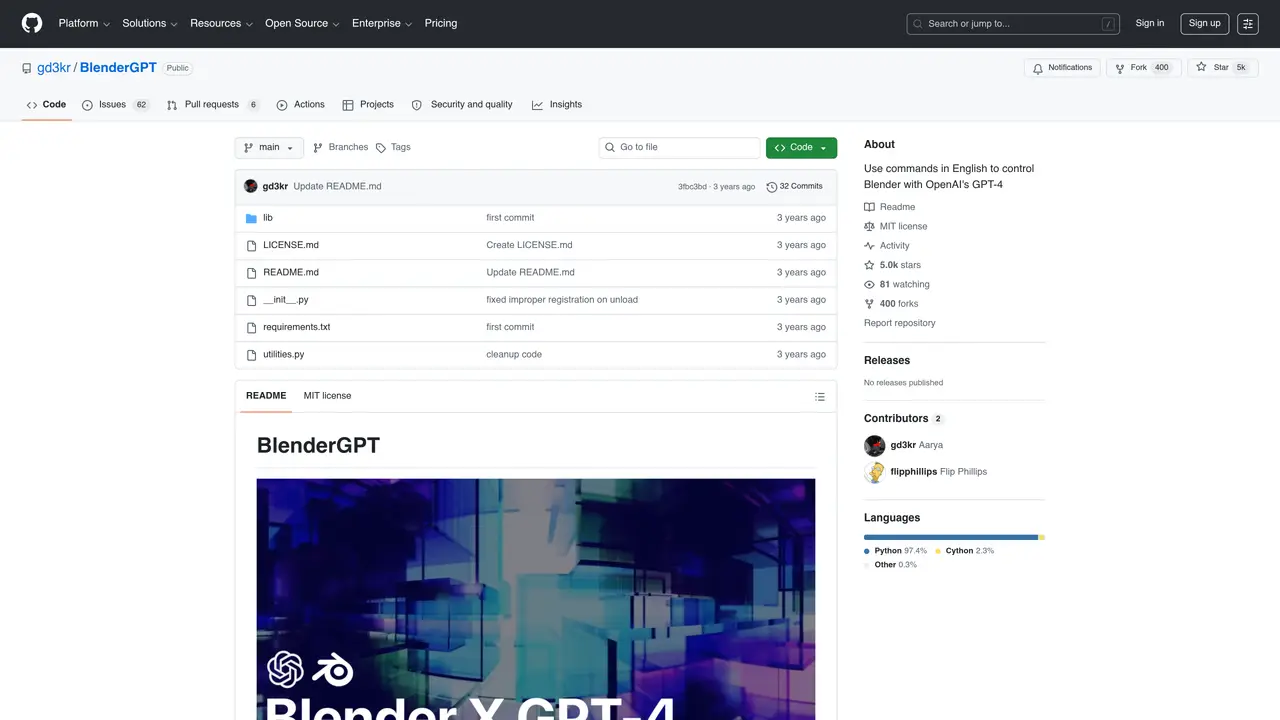
About BlenderGPT
BlenderGPT is an AI-powered extension for Blender that enables users to generate and manipulate 3D models, animations, and scenes using natural language prompts. Designed to integrate seamlessly with Blender’s existing workflow, it allows creators to describe their desired 3D assets or modifications in plain English, which the tool then translates into actionable commands within the software. This bridges the gap between conceptual design and technical execution, making 3D modeling more accessible to users without deep expertise in Blender’s interface or scripting. The tool leverages AI to automate repetitive tasks, such as generating complex geometries, applying textures, or adjusting lighting, while still providing full manual control for fine-tuning. It is particularly useful for artists, designers, and developers who need to rapidly prototype ideas, iterate on designs, or explore creative possibilities without spending excessive time on manual modeling. BlenderGPT supports a wide range of 3D creation tasks, from sculpting and texturing to animation and rendering, all within the familiar environment of Blender.
GitHub, Inc.
San Francisco, California, US · Founded 2008
- Founders
- Tom Preston-Werner, Chris Wanstrath, PJ Hyett, Scott Chacon
- Founded
- 2008
- Headquarters
- San Francisco, California, US
- Legal status
- Subsidiary of Microsoft (NASDAQ: MSFT)
Key features
- Design and render 3D models in various styles and formats
- Real-time preview of changes
- Powerful animation tools
- Vast library of 3D objects, textures, materials, and lighting effects
- Physics-based materials and environment creation
- High-quality image and animation rendering
Use cases
- Create stunning visuals for graphic design, game development, or other applications
- Design and render 3D models for product design, architecture, or engineering projects
- Develop animations and special effects for film, television, or video games
Pros
- Enables natural language control of Blender via OpenAI's GPT-4/GPT-3.5
- Integrates directly into Blender's UI for seamless workflow integration
- Simplifies 3D modeling tasks by converting English commands into Python scripts
- Supports real-time code generation and execution within the 3D View
- Accessible to users with varying technical expertise through intuitive interface
Cons
- Requires OpenAI API key and GPT-4 waitlist access for full functionality
- Dependent on external API availability and potential rate limits
- Limited to Blender users, excluding those using other 3D software
- Natural language interpretation may occasionally produce unexpected results
Frequently asked questions about BlenderGPT
What is BlenderGPT and how does it work?
BlenderGPT is a Blender add-on that integrates OpenAI's GPT-4 or GPT-3.5 to control Blender using natural language commands. Users type English instructions in the sidebar, and the plugin generates and executes corresponding Python scripts in Blender.
Who is BlenderGPT designed for?
The tool is designed for Blender users, including 3D artists, designers, and developers who want to streamline workflows by using conversational commands instead of manual scripting.
What are the requirements to use BlenderGPT?
BlenderGPT requires Blender 3.1 or later and an OpenAI API key. Access to GPT-4 is only available through the OpenAI waitlist for API usage.
How do I install BlenderGPT?
Installation involves downloading the repository as a ZIP file, opening Blender, navigating to Edit > Preferences > Add-ons > Install, selecting the ZIP file, and enabling the add-on. Users must then paste their OpenAI API key in the add-on preferences.
Can I use BlenderGPT with GPT-3.5 instead of GPT-4?
Yes, BlenderGPT supports both GPT-4 and GPT-3.5, provided you have access to the respective OpenAI API models.
Where can I see the generated code in real time?
To view the code generations in real time, users can open the System Console via Window > Toggle System Console in Blender.