Meshy turns text prompts or images into fully textured 3D models in minutes.

DreamPose
$0.07Starting price
0Popularity
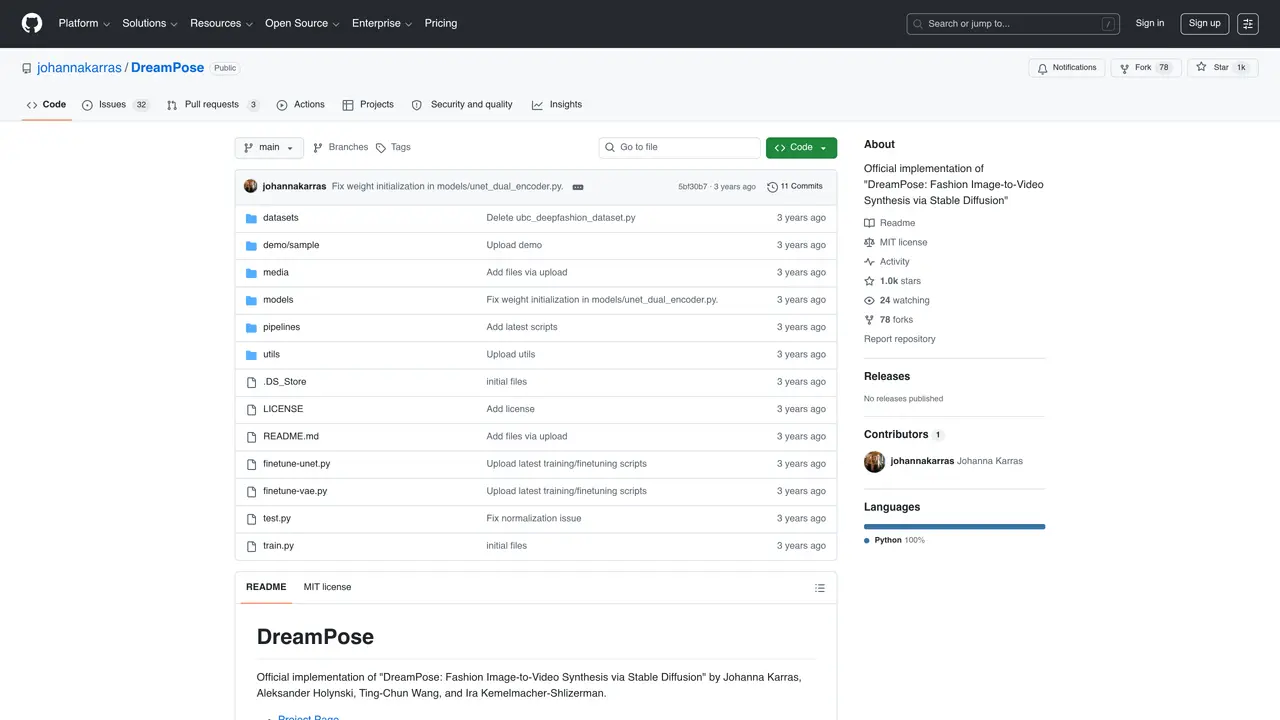
About DreamPose
DreamPose is an innovative and powerful 3D motion capture tool designed to make motion capture simpler and more accessible than ever before. With DreamPose, animators, game developers, and creative professionals can capture realistic 3D motion quickly and easily without having to purchase expensive equipment. DreamPose comes with a range of features designed to streamline the motion capture workflow. It uses advanced AI algorithms to accurately detect and track motion from any source, including video, camera input, and motion capture systems. The easy-to-use interface allows for seamless integration into existing workflows, making it a great choice for both experienced professionals and those just getting started. DreamPose is also incredibly affordable, meaning you don’t have to break the bank to get high quality motion capture results. Plus, with an ever-growing library of motion capture assets, DreamPose is the perfect choice for creating realistic 3D motion.
GitHub, Inc.
San Francisco, California, US · Founded 2008
- Founders
- Tom Preston-Werner, Chris Wanstrath, PJ Hyett, Scott Chacon
- Founded
- 2008
- Headquarters
- San Francisco, California, US
- Legal status
- Subsidiary of Microsoft (NASDAQ: MSFT)
Key features
- Capture realistic 3D motion quickly and easily from any source using advanced AI algorithms
- Streamline workflow with an easy-to-use interface and seamless integration into existing projects
- Access high quality motion capture results without breaking the bank, plus an ever-growing library of assets
Use cases
- Animation and game development: use DreamPose to create realistic character movements and interactions
- Film and video production: use DreamPose to capture complex motion sequences with ease
- Education and research: use DreamPose to teach and demonstrate advanced motion capture techniques
Pros
- Leverages Stable Diffusion for high-quality image-to-video synthesis
- Open-source implementation with community-driven development
- Supports finetuning on custom datasets for subject-specific models
- Provides pretrained models for immediate use cases
- Integrates with DensePose for pose estimation and tracking
Cons
- Requires technical expertise to set up and run locally
- Dependent on GPU resources for training and inference
- Limited documentation for non-technical users
- May require manual data preparation steps
Frequently asked questions about DreamPose
What is DreamPose and what does it do?
DreamPose is an AI-based tool for fashion image-to-video synthesis, enabling users to generate realistic videos from a single fashion image by animating it with pose sequences. It leverages Stable Diffusion and custom-trained models to produce motion sequences.
Who is DreamPose designed for?
DreamPose is designed for creative professionals, researchers, and developers working in fashion, animation, or video synthesis who need to generate dynamic fashion content from static images.
How do I get started with DreamPose?
To get started, download the pretrained models and sample data, then run the provided scripts such as `test.py` or `train.py` to generate or fine-tune videos. Detailed instructions are available in the project's README and GitHub repository.
Can I use DreamPose with my own fashion images?
Yes, DreamPose allows fine-tuning on custom fashion image datasets. Users can prepare their own data, fine-tune the UNet and VAE components, and generate subject-specific videos using the provided training scripts.
What are the system requirements for running DreamPose?
DreamPose requires a GPU for training and inference, with recommended setups including NVIDIA A100 GPUs for training. The tool is implemented in Python and relies on PyTorch and Stable Diffusion dependencies.
Does DreamPose support integration with other AI models or tools?
DreamPose is built on Stable Diffusion and integrates with DensePose for pose estimation. It is primarily designed as a standalone tool but can be adapted to work within broader AI-driven creative pipelines.