Meshy turns text prompts or images into fully textured 3D models in minutes.

NVIDIA Lyra
$0.07Starting price
0Popularity
About NVIDIA Lyra
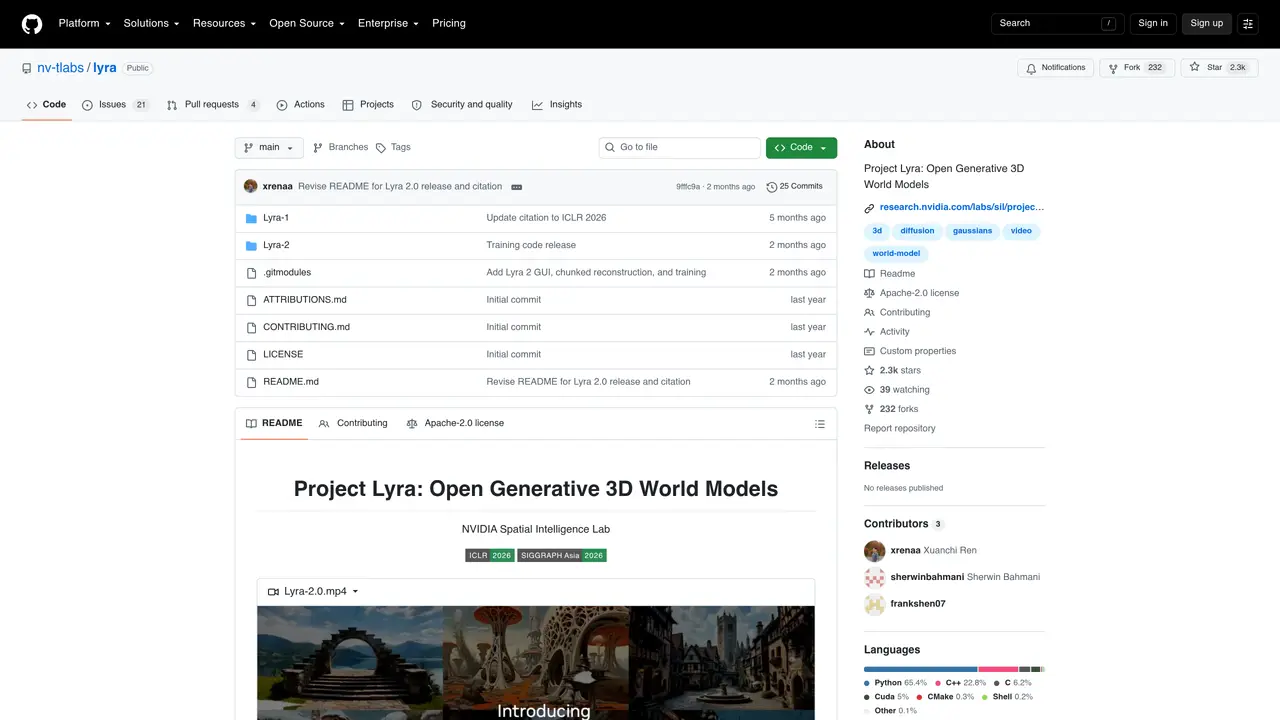
NVIDIA Lyra is an open series of generative 3D world models designed to transform casual image or video captures into explorable, 3D-consistent scenes. It provides both a graphical user interface and training code to support reproducible research, rapid prototyping, and controllable long-horizon world generation. Users can sample and navigate generated worlds interactively via the GUI or run feed-forward inference scripts for batch processing and multi-view generation. The tool reconstructs 3D and 4D scenes from single images or videos, enabling downstream evaluation, visualization, or integration into simulation pipelines. Lyra is tailored for graphics and vision researchers, simulation teams, robotics labs, and technical artists who require data-efficient 3D scene generation and long-horizon consistency. It also serves engine prototypers and content tool developers who need navigable scenes for previsualization, layout studies, or synthetic data staging. The codebase emphasizes reproducibility and evaluation, making it suitable for academics benchmarking long-horizon consistency and practitioners building internal baselines for novel view synthesis and world-model research. The Lyra 2.0 GUI includes a 3D viewport, camera controls, trajectory timeline, sampling parameters, and export options, while inference scripts provide console-based processing for batches of inputs.
GitHub, Inc.
San Francisco, California, US · Founded 2008
- Founders
- Tom Preston-Werner, Chris Wanstrath, PJ Hyett, Scott Chacon
- Founded
- 2008
- Headquarters
- San Francisco, California, US
- Legal status
- Subsidiary of Microsoft (NASDAQ: MSFT)
Key features
- Convert single images or videos into explorable 3D-consistent scenes
- Interactive GUI for sampling, navigation, preview, and export
- Feed-forward inference scripts for fast multi-view generation and batch processing
- Training code and instructions for reproducible research and custom dataset adaptation
- Reconstruction of 3D and 4D scenes with long-horizon camera motion
- Per-version model licenses with clear usage terms
- Integration with downstream evaluation, visualization, or simulation pipelines
- Open-source codebase under Apache-2.0 license
Use cases
- Previsualize environments for simulation, autonomy testing, and robotics
- Rapid world blockouts and layout studies for game prototyping
- Research long-horizon 3D consistency with reproducible baselines
Pros
- Open-source implementation with reproducible research focus
- Supports both feed-forward inference and interactive GUI for scene exploration
- Enables 3D and 4D scene reconstruction from single images or videos
- Provides long-horizon, 3D-consistent generative world models
- Includes training code and evaluation tools for benchmarking
Cons
- Requires technical expertise to set up and operate
- Limited to research and prototyping use cases due to model complexity
- Dependent on GPU resources for training and inference
Frequently asked questions about NVIDIA Lyra
What is NVIDIA Lyra?
NVIDIA Lyra is a series of open generative 3D world models that transform single images or videos into explorable, 3D-consistent scenes. It includes both Lyra 1.0 for feed-forward scene generation and Lyra 2.0 for interactive world exploration.
Who should use NVIDIA Lyra?
The tool is designed for graphics and vision researchers, simulation teams, robotics labs, technical artists, and engine prototypers who need data-efficient 3D scene generation and long-horizon consistency.
How does NVIDIA Lyra work?
Lyra uses video diffusion model self-distillation to reconstruct 3D and 4D scenes from input images or videos. Lyra 2.0 additionally provides an interactive GUI for sampling, navigating, and exporting generated worlds.
What are the main use cases for NVIDIA Lyra?
Typical use cases include previsualization for content creation, synthetic data generation for simulation pipelines, and benchmarking long-horizon consistency in world-model research.
Does NVIDIA Lyra support batch processing?
Yes, Lyra provides feed-forward inference scripts that enable batch processing of inputs for multi-view generation and downstream applications.
How can I get started with NVIDIA Lyra?
Users can access the official implementations of Lyra 1.0 and Lyra 2.0, including training code and GUI instructions, through the GitHub repository under the Apache 2.0 license.