Meshy turns text prompts or images into fully textured 3D models in minutes.

Point·E
$0.07Starting price
0Popularity
About Point·E
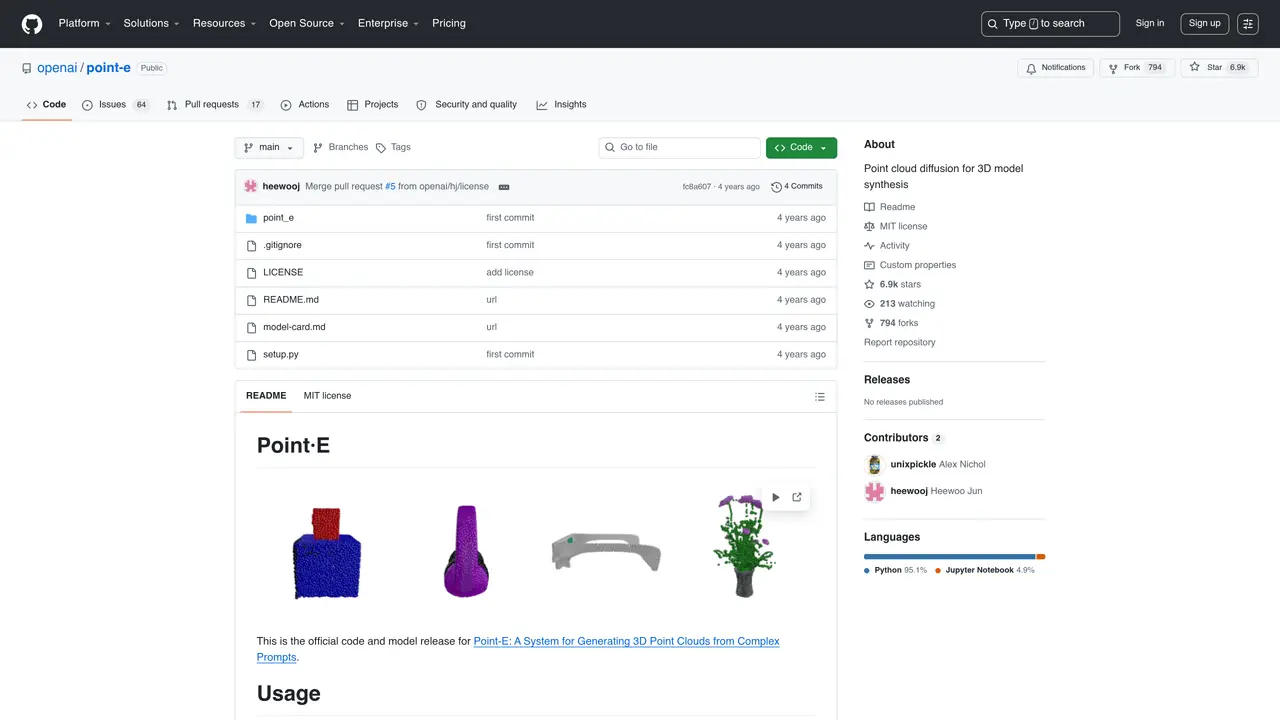
Point·E is an open-source AI system developed by OpenAI for generating 3D models from text prompts. The tool leverages a diffusion-based approach to convert point clouds into detailed and realistic 3D representations. Designed for 3D modeling professionals, artists, and developers, Point·E streamlines the creation process by automating complex steps, enabling users to produce high-quality models efficiently. The system is particularly useful for generating objects, scenes, or prototypes based on textual descriptions, reducing the time and expertise traditionally required for manual 3D modeling. Released under the MIT license, Point·E is accessible to a wide audience, allowing for customization and integration into existing workflows. It serves as a practical solution for rapid prototyping, visualization, and creative projects where 3D assets are needed without extensive manual intervention. The tool emphasizes flexibility and accessibility, making advanced 3D modeling more approachable for both professionals and enthusiasts.
GitHub, Inc.
San Francisco, California, US · Founded 2008
- Founders
- Tom Preston-Werner, Chris Wanstrath, PJ Hyett, Scott Chacon
- Founded
- 2008
- Headquarters
- San Francisco, California, US
- Legal status
- Subsidiary of Microsoft (NASDAQ: MSFT)
Key features
- Create accurate 3D prototypes
- Transform point clouds into realistic 3D models
- Design like a professional
- Available as an open source project on GitHub
- Released under the MIT license
- Diffusion algorithm for transforming point clouds
Use cases
- Create 3D prototypes quickly and accurately with Point-E
- Transform point clouds into realistic 3D models using a diffusion algorithm
- Design and build 3D models like a professional
Pros
- Generates 3D point clouds from text or image prompts using diffusion models
- Open-source and released under the MIT license for free use and modification
- Includes multiple notebooks for different workflows (text-to-3D, image-to-3D, point cloud-to-mesh)
- Provides evaluation scripts for assessing model performance
- Supports integration with Blender for rendering and further processing
Cons
- Text-to-3D model has limited capabilities and may not handle complex prompts well
- Requires technical expertise to install and use, as it is primarily a codebase
- Outputs are point clouds or meshes, which may need additional processing for final use
- No official graphical user interface (GUI) is provided
Frequently asked questions about Point·E
What does Point·E do?
Point·E is a system for generating 3D point clouds from complex prompts, including text descriptions or images. It uses diffusion models to synthesize point clouds and can convert these into meshes for 3D modeling workflows.
Who is Point·E designed for?
Point·E is designed for 3D modeling professionals, designers, and developers who need to generate or refine 3D models efficiently. It is particularly useful for those working with point clouds or seeking to create 3D assets from text or images.
How do I get started with Point·E?
To get started, install Point·E using pip and follow the provided example notebooks, such as `text2pointcloud.ipynb` for text-to-3D generation or `image2pointcloud.ipynb` for image-conditioned point cloud synthesis. The repository includes detailed instructions for setup and usage.
What are the main capabilities of Point·E?
Point·E can generate point clouds from text descriptions or images, convert point clouds into meshes, and evaluate generated models using metrics like P-FID and P-IS. It also provides rendering tools for visualizing results in Blender.
Does Point·E support integration with other tools?
Point·E is an open-source tool that can be integrated into existing 3D modeling pipelines. It provides scripts for rendering in Blender and supports custom workflows through its Python-based API.
What are the limitations of Point·E?
Point·E’s text-to-3D model has limited capabilities and may only understand simple categories and colors. The quality of generated point clouds and meshes can vary, and additional refinement may be required for professional use.