
AI platform for upscaling images, enhancing photos, and generating high-quality creative assets with contextual detail.

Pixray
$0.07Starting price
0Popularity
About Pixray
Pixray is a powerful image editing platform that helps creative professionals and amateur photographers create beautiful pieces of art. With Pixray, users can make adjustments to their photos with ease, taking advantage of an array of tools, effects, and filters to turn ordinary photos into unique works of art. Pixray also offers a library of assets, allowing users to add text, shapes, and other elements to their photos. With its intuitive and user-friendly interface, Pixray is perfect for both novice and experienced image editors. Whether you’re a professional photographer or just getting started, Pixray makes it easy to take your photos to the next level. With Pixray, you can enhance and transform your photos with high-quality tools, effects, and filters. You can also create stunning compositions with the library of assets and share your work with the world. With Pixray, you can make your photos look better than ever before.
GitHub, Inc.
San Francisco, California, US · Founded 2008
- Founders
- Tom Preston-Werner, Chris Wanstrath, PJ Hyett, Scott Chacon
- Founded
- 2008
- Headquarters
- San Francisco, California, US
- Legal status
- Subsidiary of Microsoft (NASDAQ: MSFT)
Key features
- Create stunning compositions
- Make adjustments to photos with a range of tools
- Enhance photos with high-quality effects and filters
- Library of assets for adding text, shapes, and other elements
- Intuitive and user-friendly interface
- Perfect for both novice and experienced image editors
Use cases
- Create beautiful pieces of art for professional photographers
- Enhance and transform photos with high-quality tools and filters
- Make adjustments to photos with ease using a range of tools
Pros
- Open-source and freely available for modification and distribution
- Supports multiple image generation and manipulation techniques including CLIP-guided GANs and latent space navigation
- Can be used via command line, Python library, or Google Colab notebooks for accessibility
- Combines multiple advanced image generation methods into a single framework
- Offers flexibility through modular components and customizable loss functions
Cons
- Requires technical knowledge for local installation and usage, particularly in setting up dependencies
- Lacks a dedicated graphical user interface, limiting accessibility for non-technical users
- Documentation is minimal and primarily available through code comments and community resources
Frequently asked questions about Pixray
What is Pixray?
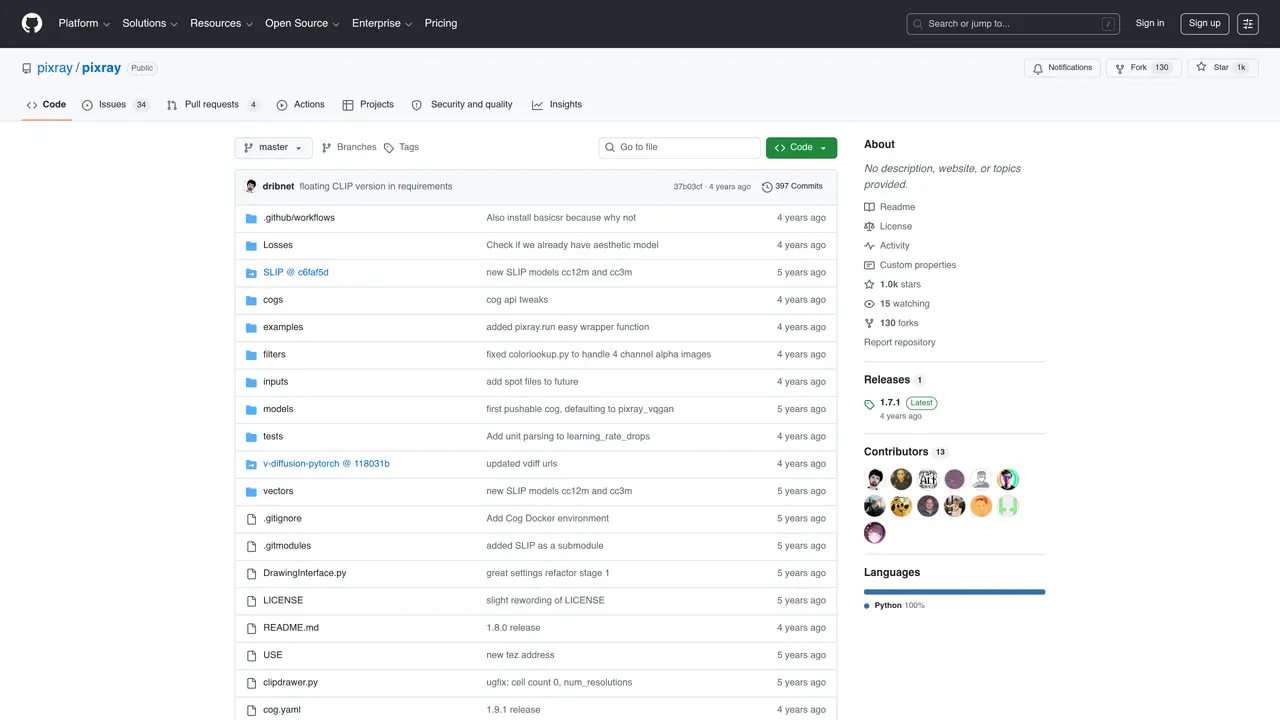
Pixray is an open-source image generation system that combines techniques like Perception Engines, CLIP-guided GAN imagery, and latent space navigation to create and modify images. It functions as both a Python library and a command-line utility, with support for Google Colab notebooks and Docker.
Who is Pixray designed for?
Pixray is designed for users interested in AI-driven image generation and manipulation, including developers, researchers, and creative professionals who want to experiment with generative models and custom loss functions.
How do I get started with Pixray?
To get started, clone the repository with submodules, install dependencies using pip, and run the pixray.py command-line utility or integrate it into your Python code. Example commands and Python snippets are provided in the repository.
Can Pixray be used in Google Colab?
Yes, Pixray is compatible with Google Colab notebooks, and example notebooks are available in a separate repository for users who prefer cloud-based execution.
Does Pixray support Docker?
Yes, Pixray can be run inside Docker using Cog. Users need to install Docker and Cog, then use the cog run command to execute Pixray in a containerized environment.
What are the main use cases for Pixray?
Pixray is primarily used for AI-driven image generation, iterative image optimization against classifiers, and exploring latent space for creative modifications. It is also useful for prototyping generative models and custom loss functions.