
AI chatbot for conversation, work, research, coding, and content creation.

Big Sleep
$0.07Starting price
0Popularity
About Big Sleep
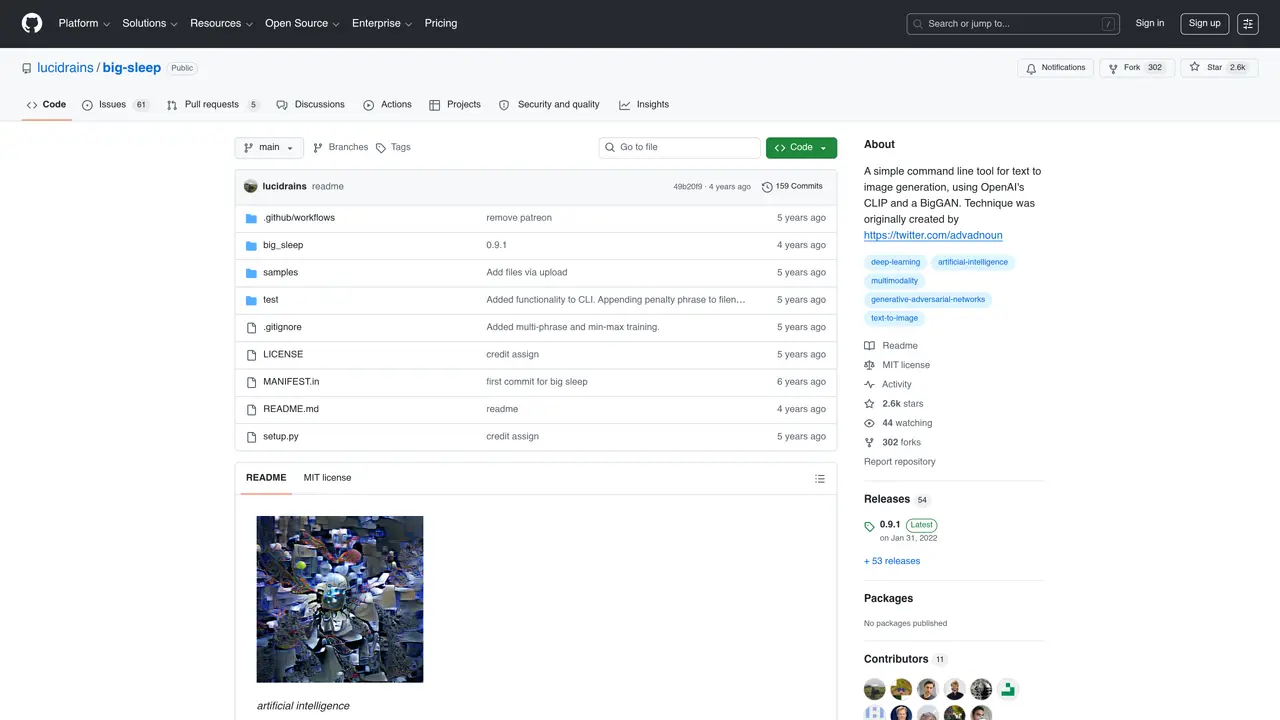
Big Sleep is a command line tool that makes creating images from text both simple and fast. This tool utilizes OpenAI’s CLIP, a cutting-edge deep learning model, and BigGAN, a large-scale generative adversarial network, to convert text into high-quality images. Developed by https://twitter.com/advadnoun, Big Sleep is an easy-to-use tool that eliminates the need to manually create images. It is perfect for those looking to quickly generate visuals for their content, be it for websites, blogs, or social media posts. Big Sleep is an accessible way to add compelling visuals to your content without needing to spend time designing or learning complex image editing tools. With a few simple commands, you can easily convert your text into stunning visuals. Big Sleep is the perfect companion to help you create engaging visuals that will capture the attention of your audience.
GitHub, Inc.
San Francisco, California, US · Founded 2008
- Founders
- Tom Preston-Werner, Chris Wanstrath, PJ Hyett, Scott Chacon
- Founded
- 2008
- Headquarters
- San Francisco, California, US
- Legal status
- Subsidiary of Microsoft (NASDAQ: MSFT)
Key features
- Quickly generate visuals for websites, blogs, and social media
- Easily convert text into stunning visuals with simple commands
- Leverage OpenAI’s CLIP and BigGAN deep learning models to create high-quality images
Use cases
- Generate visuals for website content
- Create stunning visuals for social media posts
- Convert text into high-quality images for blogs
Pros
- Combines OpenAI’s CLIP and BigGAN for text-to-image generation
- Accessible via simple command-line interface with minimal setup
- Supports training on multiple phrases using a delimiter for varied outputs
- Allows penalization of unwanted prompts to refine results
- Offers flags for saving best images and tracking progress during training
Cons
- Requires a GPU for optimal performance
- May produce noisy or off-manifold images due to GAN limitations
- Larger models demand significant memory resources
- Limited expressivity when restricting classes for stability
Frequently asked questions about Big Sleep
What is Big Sleep and how does it work?
Big Sleep is a command-line tool that generates images from text descriptions using OpenAI’s CLIP model for text-image alignment and a BigGAN generator for image creation. It combines these models to interpret natural language prompts and produce corresponding visuals.
Who is Big Sleep designed for?
Big Sleep is designed for users who need a quick and accessible way to generate images from text without requiring advanced design skills or complex software. It is particularly useful for content creators, developers, and artists.
How do I install and use Big Sleep?
Big Sleep can be installed via pip with the command 'pip install big-sleep'. To generate an image, users run a simple command like 'dream "a pyramid made of ice"' in the terminal, which saves the resulting image to the current directory.
Can I train Big Sleep on multiple text prompts at once?
Yes, Big Sleep supports training on multiple phrases simultaneously by separating them with a delimiter '|'. Users can also penalize certain prompts to refine the output further.
What are the advanced features of Big Sleep?
Advanced features include saving image progression during training with '--save-progress', selecting the best-scoring image with '--save-best', using a larger vision model with '--larger-model', and restricting the number of classes with '--max-classes'.
Are there any limitations to using Big Sleep?
Big Sleep relies on GPU resources for optimal performance, and its outputs may sometimes deviate into noise due to the class-conditioned nature of the GAN. Users may need to experiment with parameters to achieve desired results.