
AI chatbot for conversation, work, research, coding, and content creation.

Google Imagen 3
$1Starting price
0Popularity
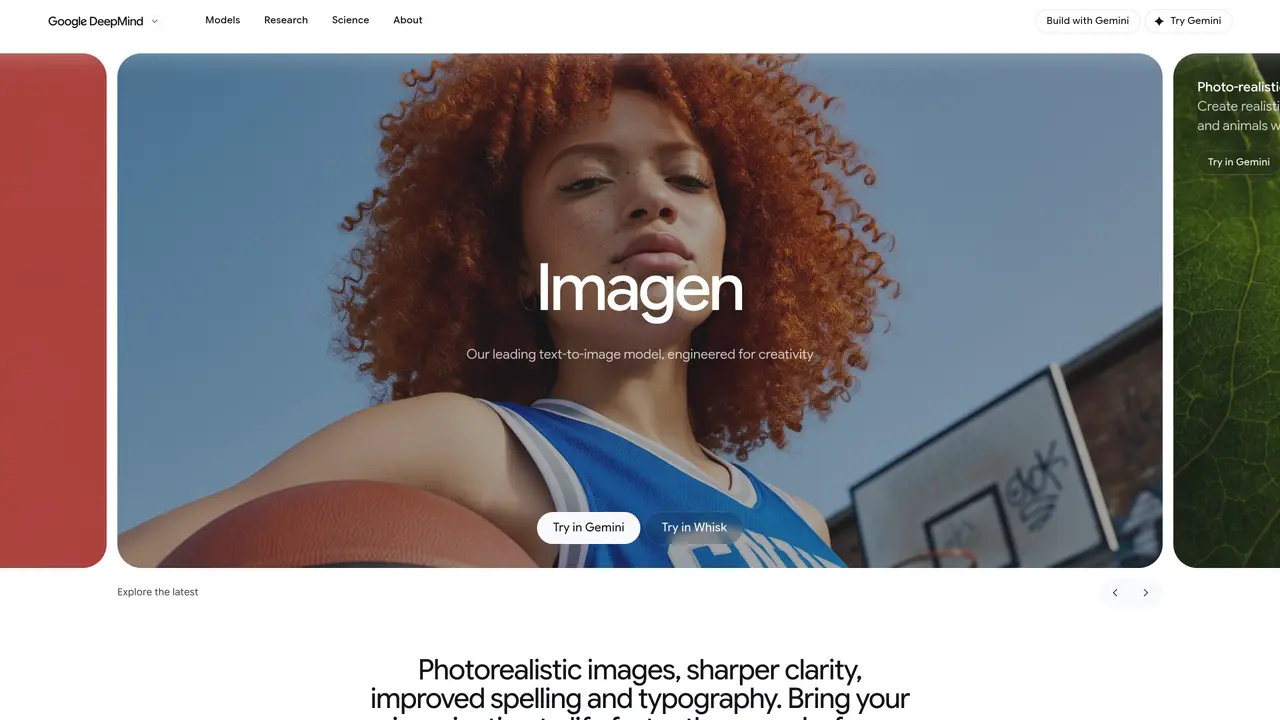
About Google Imagen 3
Google Imagen 3 stands out as a groundbreaking development by Google Research’s Brain Team in the ever-evolving sphere of artificial intelligence. This text-to-image diffusion model is revolutionizing the way we think about and interact with AI-generated imagery, boasting an unprecedented degree of photorealism combined with a deep level of language understanding. At its core, Google Imagen 3 leverages the power of large transformer language models to interpret text inputs, which it then translates into high-fidelity images using advanced diffusion models. This unique combination not only enables the creation of stunningly realistic images from textual descriptions but also pushes the boundaries of AI’s creative capabilities. Key Features: Photorealistic Image Generation: Produces images with an unparalleled level of realism, making it difficult to distinguish between AI-generated images and actual photographs. Advanced Language Understanding: Utilizes large transformer models like T5 for a profound comprehension of text inputs, ensuring accurate translation of complex descriptions into images. State-of-the-Art Fidelity: Achieved a record-breaking FID score of 7.27 on the COCO dataset, showcasing its superior image quality and text-image alignment. DrawBench Benchmarking: Introduces a comprehensive and challenging benchmark for text-to-image models, demonstrating Google Imagen 3’s dominance over other models in terms of image fidelity and alignment.
Google DeepMind
London, United Kingdom · Founded 2010
- Founders
- Shane Legg, Demis Hassabis
- Founded
- 2010
- Headquarters
- London, United Kingdom
Key features
- Photorealistic Image Generation
- Advanced Language Understanding
- State-of-the-Art Fidelity
- DrawBench Benchmarking
- Innovative Text-to-Image Conversion
- High-Quality Image Resolution
Use cases
- Graphic Designers and Artists: Leveraging Google Imagen 3 for creating detailed and realistic artwork from simple text descriptions.
- Marketing Professionals: Utilizing the tool for generating high-quality visuals for advertising campaigns and social media content.
- Film and Animation Studios: Employing Google Imagen 3 to conceptualize scenes and characters during the pre-production phase.
Pros
- Generates photorealistic images with high fidelity and true-to-life details
- Supports diverse art styles, from realism to abstract and illustration
- Enables extreme close-ups with rich colors, textures, and gradients
- Optimized for creativity with enhanced colors, styles, and text rendering
- Offers an ultra-fast mode for rapid iteration of ideas
Cons
- May struggle with highly complex or abstract prompts requiring fine-grained control
- Text rendering and typography accuracy can vary depending on the input
Frequently asked questions about Google Imagen 3
What is Google Imagen 3?
Google Imagen 3 is a text-to-image diffusion model developed by Google DeepMind, designed to generate high-quality, photorealistic images from text descriptions. It leverages advanced transformer language models to interpret prompts and produce detailed visuals across diverse styles and subjects.
Who is Google Imagen 3 suitable for?
The tool is suitable for creative professionals, designers, marketers, and anyone needing high-fidelity image generation from text. It is particularly useful for visualizing concepts, creating marketing materials, or generating artistic content with precise control over style and detail.
How does Google Imagen 3 work?
Imagen 3 uses a combination of large transformer language models to parse text inputs and diffusion models to generate images. It interprets complex descriptions, including fine details like textures and lighting, to produce realistic or stylized outputs aligned with the prompt.
Can Google Imagen 3 generate images in different art styles?
Yes, Imagen 3 supports a wide range of art styles, from photorealism to impressionism, abstract, and illustration. It can also render diverse subjects, including landscapes, plants, people, and animals, with high accuracy and detail.
Does Google Imagen 3 offer fast image generation?
Imagen 4, the latest iteration, includes an ultra-fast mode that can generate dozens of ideas quickly, up to 10 times faster than previous versions. This allows users to iterate rapidly on creative concepts.
What are the typical use cases for Google Imagen 3?
Common use cases include creating marketing visuals, generating concept art, producing educational illustrations, and enhancing creative workflows with high-resolution, detailed images. It is also used for prototyping and visualizing ideas in design and advertising.